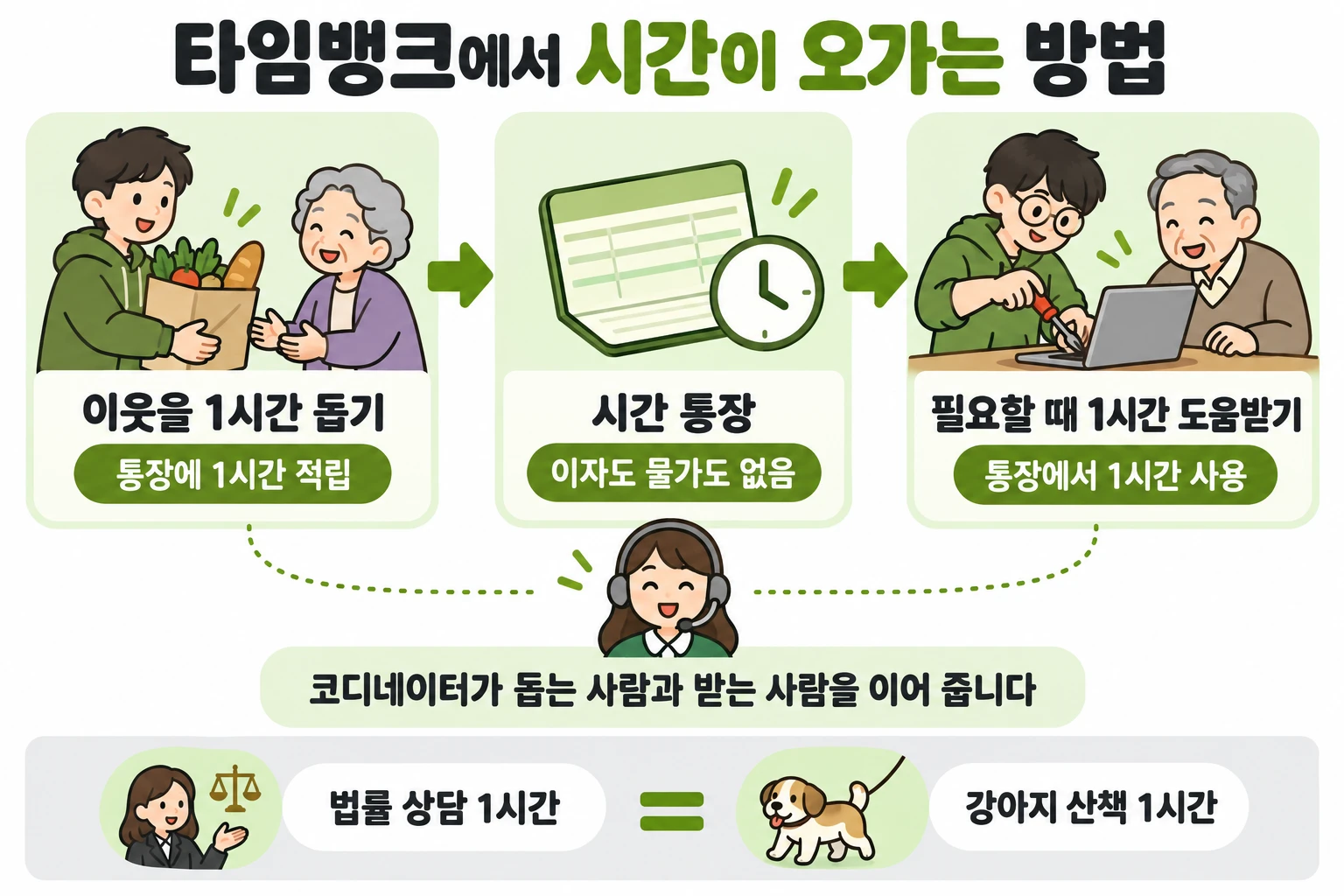
You spend an hour helping an elderly woman on your apartment floor with her grocery shopping, and that hour is recorded in your account. A few days later your computer breaks down, a college student from the neighborhood comes over and spends an hour fixing it, and one hour is deducted from your account. Not a single coin changed hands, yet both people got the help they needed.
A system like this, where people exchange time instead of money, is called ‘Time Banking.’ Time banking refers to a service-exchange system among neighbors in which you build up credits measured in time for every hour you help someone else, and then use those credits to receive help from others when you need it.
In this article, we will look in turn at the basic principle of how time banking works, how it came about, the five values the system seeks to uphold, and its uses and limits in the field of social welfare.
A Neighborhood Bank Where People Help Each Other with Time
One Hour Is One Hour for Everyone

The rules of time banking are very simple. If you help someone for an hour, you receive an hour; if you receive help for an hour, you pay an hour.
(1) Counting That Ignores the Type of Work
Whether a lawyer gives legal advice or a student walks someone's dog, one hour counts equally as one hour. Its most distinctive feature is that everyone's time is valued the same, regardless of skill level or market price.
(2) Credits with No Interest and No Inflation
Credited hours don't have to be spent right away and can be saved for a long time. However, because an hour is always worth the same, it earns no interest and does not rise or fall with prices. Since there is nothing to gain by simply hoarding it, many time banks let members donate spare hours to a community pool that goes to people who need more help.
(3) People Who Keep the Records and Make the Connections
A time bank can start out with a paper ledger, but these days most record exchanges with dedicated software. Many time banks have a coordinator who connects people seeking help with people who can offer it.
A History of Experiments Using Labor Time as Money

The idea of using time like money is older than you might think.
(1) The Time Store of the 19th Century
In 1827 in Cincinnati, USA, Josiah Warren opened a store where goods were paid for with hours of labor, and he ran it until 1830. In 1832 in London, England, Robert Owen set up an exchange where goods were traded for notes stating hours of labor.
(2) The First Time Bank Began in Japan
Time banking as we know it today is considered to have begun with the Volunteer Labor Bank founded in 1973 by Teruko Mizushima, a Japanese housewife and social commentator. Her idea was to save up the hours you spent helping others while young and use them when you need help in old age, and by the early 1980s it had more than 3,800 members.
(3) A Movement That Spread to the US and the UK
In the United States, the lawyer Edgar S. Cahn expanded on this idea from the early 1980s and used the term ‘Time Dollars’ in a 1992 book. In the United Kingdom, the first time bank opened in Stroud in 1998, and a national organization was formed in 2002.
Five Values That Time Banking Upholds
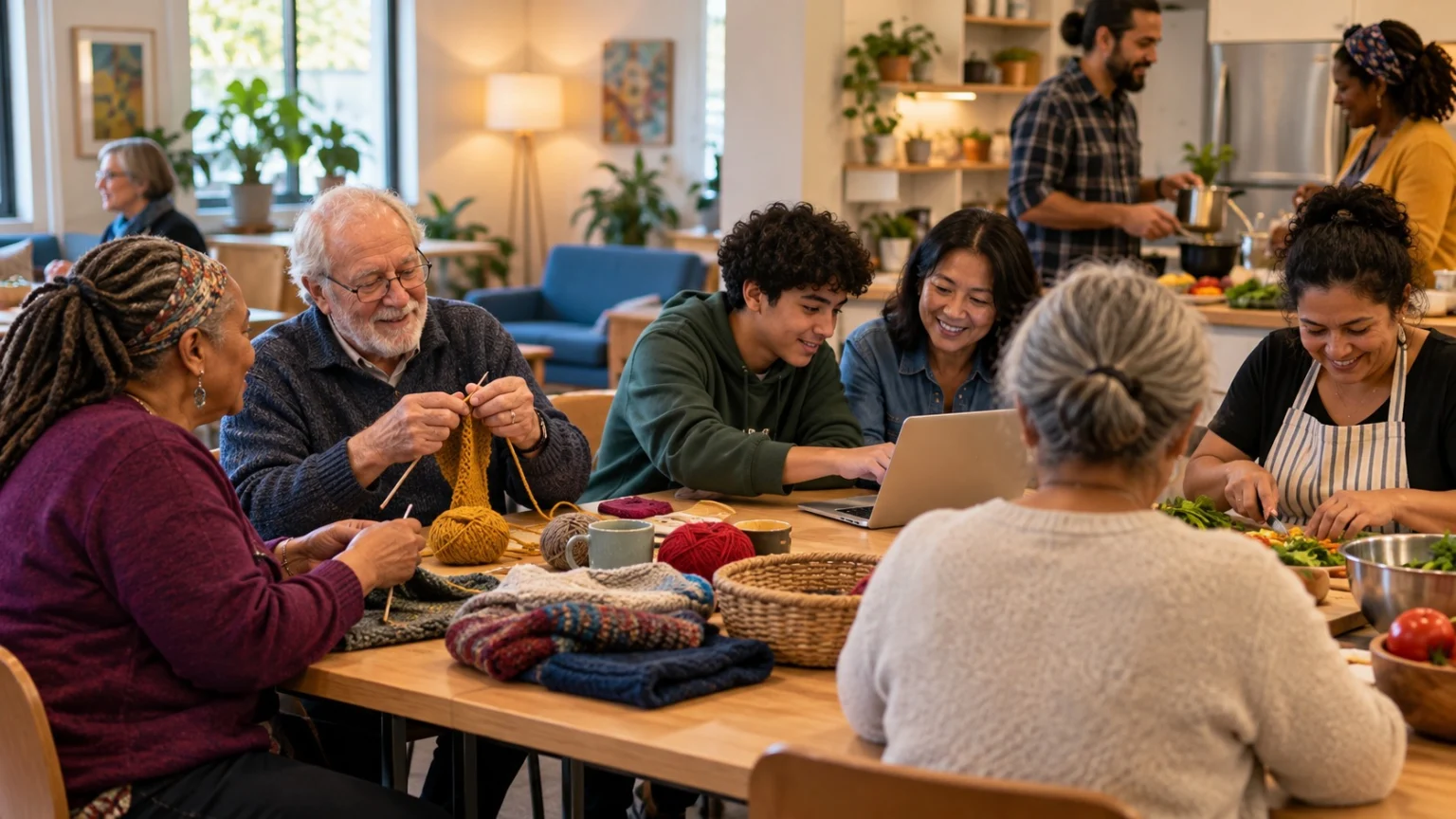
Edgar Cahn saw time banking not as a mere exchange mechanism but as a tool for rebuilding communities, and he summed up its foundations in five values.
- Asset: Every person is valuable and has something to give to others.
- Redefining Work: Work that cannot be priced in money, such as raising children and looking after neighbors, is also valuable work.
- Reciprocity: Help should not flow in only one direction but be given and received by both sides.
- Social Networks: People grow stronger within a web of relationships in which they rely on one another.
- Respect: Every person is respected as they are.
From Someone Who Only Receives to Someone Who Gives
Cahn criticized many welfare agencies for seeing the people they help only in terms of what they lack. In a time bank, even older people or people with disabilities who have always received help can earn time by keeping someone company over the phone or teaching cooking. The experience of helping others builds both self-confidence and social connections.
Uses in Social Welfare and Remaining Challenges

Time banking has spread to more than 30 countries and also operates in places such as Japan, South Korea, Taiwan, New Zealand, and Senegal.
(1) Elder Care and Community Health
By 1990, the Robert Wood Johnson Foundation in the United States had invested $1.2 million in testing time banking for elder care. Typical examples include driving older people who live alone to the hospital or giving worn-out family caregivers a short break.
(2) A Path Back into Society
Time banking has also been used in programs for first-time juvenile offenders, in helping people released from prison reintegrate into society, and in supporting addiction recovery. That is because the experience of helping others is itself part of the recovery process.
(3) Problems Still to Solve
Critics point out that valuing all time equally may make people with professional skills hesitant to take part. In the United States, debate has continued over whether credited hours should be taxed, and securing steady funding to employ coordinators is also cited as a challenge.
Time banking is a system that has shown people can help one another even without money. Because it brings care and neighborly kindness, which the market has rarely valued, back into the count, it is drawing attention as a welfare approach that revives the strength of communities.
Sharing the belief that anyone's hour is equally precious is the first step toward a community where neighbors live together.