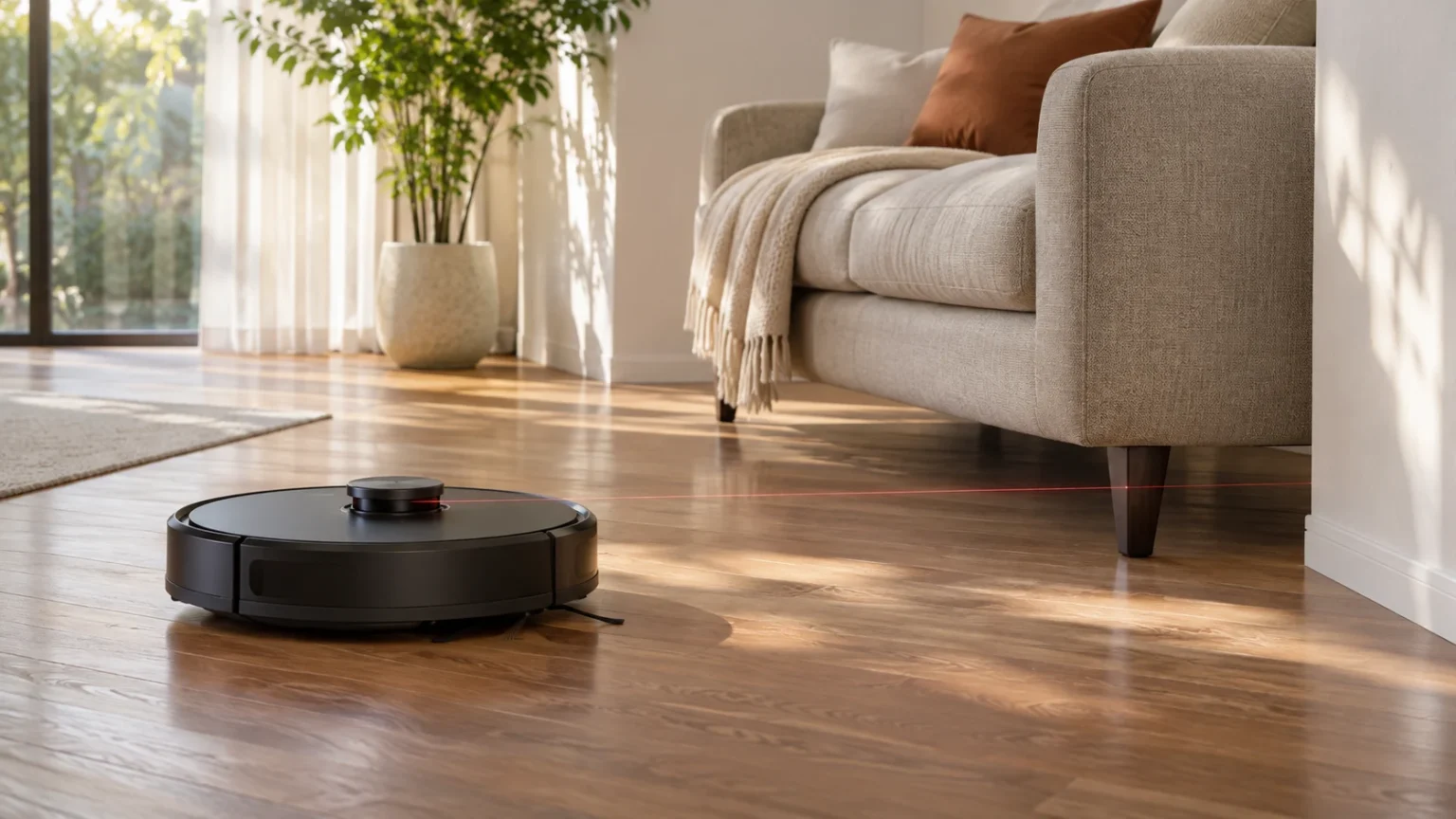
Inside the round cap on top of a robot vacuum, an invisible laser spins around and around without stopping. The vacuum times how long that light takes to bounce off walls and furniture and come back, and uses it to draw the shape of the room.
This technology is called LiDAR (Light Detection and Ranging). As the name suggests, it finds objects and measures distance with light, and today it is one of the main ways robots and self-driving cars see the world.
The 3-Minute Summary
- LiDAR fires a laser and works out distance from the time the light takes to hit an object and return.
- Repeating this measurement quickly in many directions produces a 3D map made of dots: a point cloud.
- It measures distance more precisely than a camera and sees finer detail than radar, but it struggles in thick fog or heavy rain.
What: Measuring Distance by How Long Light Takes to Return
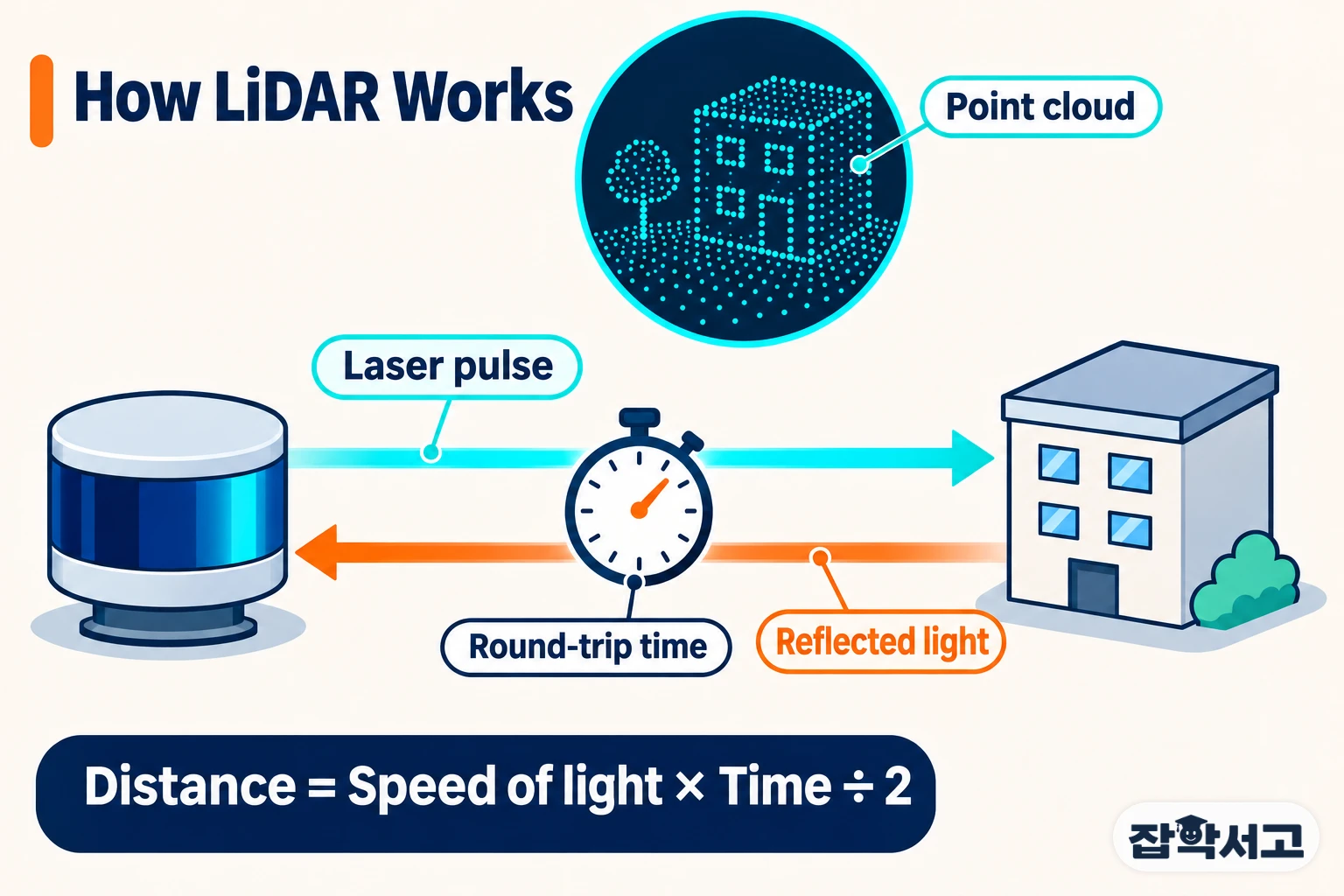
LiDAR works much like an echo in the mountains. It fires a short laser pulse and times how long it takes for the light to hit an object and reach the sensor again. Light travels about 30 cm in one nanosecond (a billionth of a second), so multiplying the round-trip time by the speed of light and dividing by 2 gives the distance.
For example, if the light comes back after 200 nanoseconds, the object is about 30 m away. By changing direction with a rotating unit or mirrors and repeating this up to around a million times per second, countless distance values add up to a point cloud, a 3D snapshot of the surroundings. From these dots, a computer reads the shapes and distances of people, cars and walls all at once.
The light it uses is usually invisible near-infrared. Automotive LiDAR commonly uses wavelengths of 905 nm and 1,550 nm: 905 nm light reaches the retina, so its power has to be kept low, while 1,550 nm light is mostly absorbed inside the eye before it reaches the retina, which allows stronger beams.
Why: How It Differs from Cameras and Radar
Cameras are good at recognizing colors and text, but on their own they cannot measure distance directly, so depth has to be estimated with two or more cameras or by calculation. They also struggle in the dark. LiDAR emits its own light, so even at night it measures the distance to objects directly, down to the centimeter.
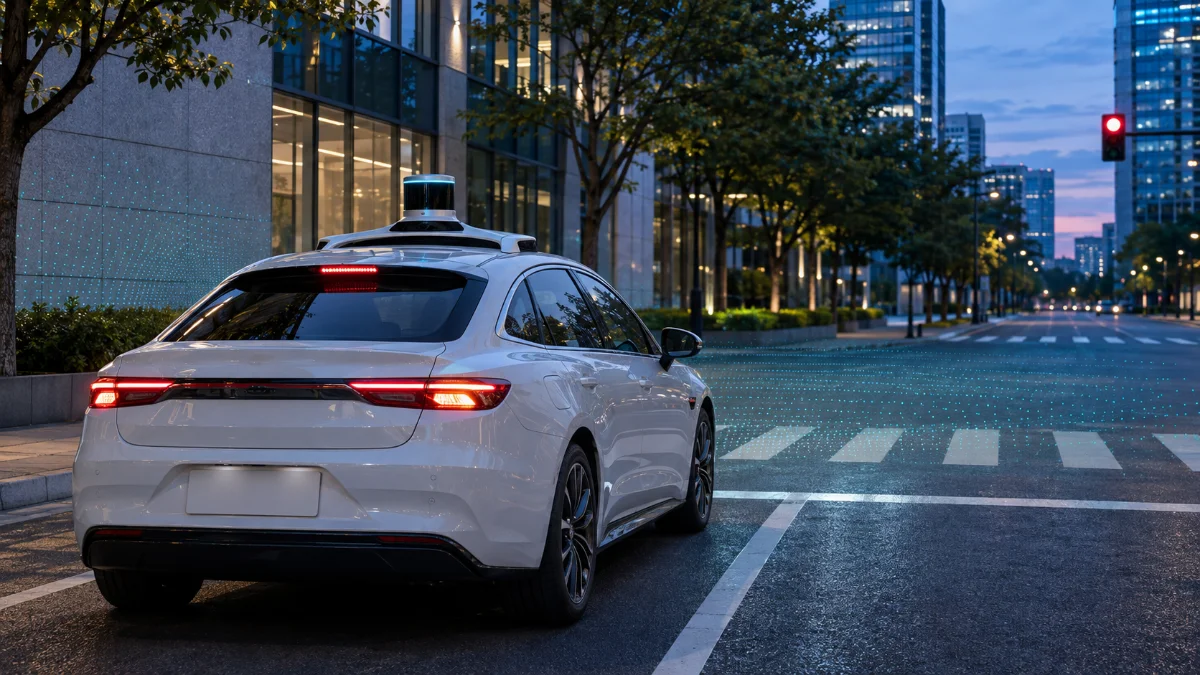
Radar uses long-wavelength radio waves instead of light, so it cuts through fog and rain well but has trouble drawing the fine shape of objects. LiDAR uses short-wavelength near-infrared light to capture a much denser picture, but in thick fog or heavy rain the light scatters off water droplets and performance drops. That is why many self-driving cars use all three together.
Early LiDAR units were large cylinders that spun as a whole on the roof. Today, compact fixed LiDARs with fewer moving parts are becoming common, tucked discreetly into bumpers, beside headlights or inside a robot's body.
Where: From Robot Vacuums to Lunar Orbit
LiDAR began in 1961, shortly after the laser was invented, as a ranging device introduced by Hughes Aircraft in the United States. It was named Colidar, short for “coherent light detecting and ranging.” In 1971, Apollo 15 used a laser altimeter to measure the highs and lows of the Moon's surface, and today aircraft still sweep the ground with LiDAR to make 3D maps of forests and terrain.
Robot vacuums at home use the same principle. The sensor on top spins 360 degrees, measuring the distance to walls and furniture, then joins the dots to draw a map of the room and work out where the vacuum is right now. That is why it cleans in neat rows instead of wandering aimlessly, and why the virtual walls you draw in the app sit on this map.
LiDAR really caught the robotics world's attention at the 2007 driverless car competition held by the U.S. Defense Advanced Research Projects Agency (DARPA). A Velodyne sensor that spun 64 lasers was mounted on five of the six cars that finished, measuring about one million points per second compared with roughly 5,000 for earlier sensors.
Today, warehouse and delivery robots also find their position with LiDAR, and since 2020 small LiDAR sensors that measure within about 5 m have appeared even in handheld devices such as the iPad Pro.
Timing the round trip of a single invisible beam of light: that is all LiDAR does. Yet by repeating that simple measurement quickly and densely, machines can find their way without bumping into things, even in a room they have never entered before.
Recommended reading