
Score 92 on the English section of Korea's college entrance exam (the CSAT, or Suneung) and you get grade 1, no matter how anyone else did. Yet the same 92 on a high school record could end up as grade 2, depending on your classmates' scores.

The same score can lead to different results depending on what it is compared with. The two yardsticks at work here are absolute grading (criterion-referenced evaluation) and relative grading (norm-referenced evaluation).
Absolute vs. Relative Grading: What's the Difference?
The difference lies less in how scores are given than in how they are read. The test and the marking can be identical; what changes is whether the score is held up against a preset standard or turned into a rank among other people.
In education research, absolute grading is also called criterion-referenced evaluation and relative grading norm-referenced evaluation. A criterion is the standard to be reached, while a norm is the score distribution of the group used for comparison.
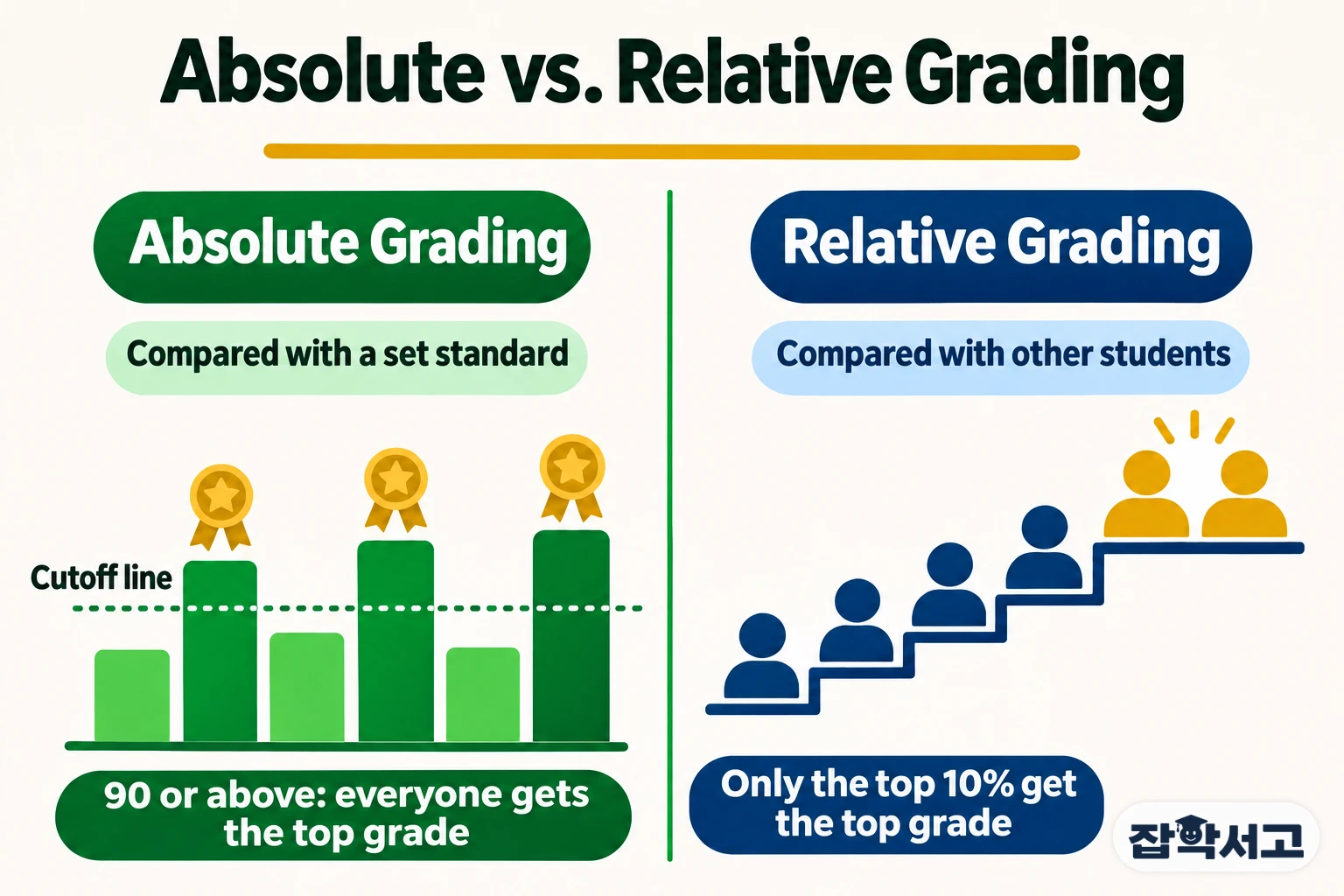
Say 25 out of 30 students score above 90 on a test. Under absolute grading with 90 as the cutoff, all 25 receive the top grade; under relative grading where only the top 10% get grade 1, just 3 students do.
What Is Absolute Grading?

Absolute grading judges how well learning goals have been met against a standard set in advance. With rules like 90 and above is an A and 80 and above is a B, everyone who clears the bar gets the same grade, however many people that is. It is much like the high jump: everyone who clears the bar passes.
Under this system, a classmate doing well never pushes your grade down. That makes it easier to teach each other and study together, and it shows clearly what each learner can now do. The downside is that an easy test piles up top grades, making it hard to tell who performed better.
The term criterion-referenced was introduced in 1963 by the American educational psychologist Robert Glaser. His idea was that teaching can only be improved by measuring whether students actually mastered what they were supposed to learn, not whether they beat others.
What Is Relative Grading?

Relative grading looks at where you stand within the group that took the same test. Scores are converted into ranks and then split by proportion: the top so many percent get grade 1, the next so many percent grade 2, and so on. Percentiles and standard scores are also scores that show your position within a group.
Because the share of each grade stays fixed whether a test is easy or hard, this system makes it easy to separate candidates for selection. But however well you do, your grade falls if others do better, and in groups of similar ability a gap of one or two points can split grades, which intensifies competition.
The nine-grade scale of the CSAT and older Korean school records comes from the stanine method, which divides a normal distribution into nine bands. Grade 1 is 4%, grade 2 7%, grade 3 12%, grade 4 17% and grade 5 20%, so the middle band is the widest, and grades 6 to 9 narrow again to 17, 12, 7 and 4%.
Side-by-Side Comparison
Placing the two systems side by side on the same points makes the difference clearer.
| Item | Absolute grading | Relative grading |
|---|---|---|
| Compared with | A preset standard (criterion) | The group that took the test (norm) |
| Other name | Criterion-referenced evaluation | Norm-referenced evaluation |
| How grades are set | Clear the cutoff and you get that grade | Split by proportion according to rank |
| Strengths | Confirms goal mastery, supports cooperative learning | Discriminates well, suits selection |
| Weaknesses | Easy tests crowd the top grades | More competition; grades shift with the group |
As the table shows, the strengths and weaknesses of the two systems interlock. One's weakness is the other's strength, so real-world systems either choose one according to their purpose or combine both.
Telling Them Apart with Confusing Cases
Real exam systems often mix the two approaches, which makes them easy to confuse. Here are three common cases to tell them apart.
CSAT English Uses Absolute Grading
The English section of Korea's College Scholastic Ability Test switched to absolute grading starting with the 2018 exam. Everyone with a raw score of 90 or above gets grade 1, and grades are divided in 10-point steps. Korean history switched one year earlier, with the 2017 exam, while subjects such as Korean language and math are still graded according to other test takers' scores.
In the first year of absolute grading for English, news reports said more than 10% of test takers received grade 1. It showed a typical feature of absolute grading: the number of grade 1 students can swing widely with the difficulty of the test.
High School Records Use Both Yardsticks
Starting with students who entered high school in 2025, Korea's rank-based school grades changed from nine grades to a five-grade relative scale. The share for grade 1 widened from the top 4% to the top 10%; grade 2 extends to the top 34%, grade 3 to 66% and grade 4 to 90%. Report cards list these rank-based grades alongside an A–E achievement level.
The achievement level is absolute grading, set by fixed standards such as typically 90 and above for A, 80 and above for B, 70 and above for C, 60 and above for D and below that E, while the rank-based grade is relative grading, set by ranking among students who took the same course. One report card carries both yardsticks.
A Driver's License Test Uses Absolute Grading
You pass the written driver's license test as long as you reach the passing score. If everyone who took the test that day reaches it, everyone passes. Most certification exams use absolute grading because their purpose is to check whether a person can do the job.
By contrast, in exams with a fixed number of openings, such as civil service exams, there may be a minimum score for each subject, but the final pass line is ultimately decided by score rank. It is a case where standards and ranks are used together, in stages, within a single exam.
It is hard to say flatly that one is better. Absolute grading fits when you want to confirm what someone can now do, and relative grading fits when you need to decide who fills a limited number of places. When you get a report card, first check which yardstick produced each score, and the numbers will look different.
Recommended reading