
It sounds startling that airlines sell more tickets than they have seats, yet passengers pushed off a plane against their will are very rare. According to the U.S. Department of Transportation, the rate in the first quarter of 2017 was 0.62 per 10,000 passengers.
This practice of accepting more bookings than there are seats is called overbooking, or overselling. It is a calculation meant to fill the empty seats left by passengers who book but never show up, the so-called no-shows.
Following overbooking through five numbers shows how much compensation passengers receive and why this risky calculation usually works out.
Overbooking in Numbers
Overbooking is not unique to airlines. Hotels, car rentals and restaurants use the same calculation, but aviation has the best-documented rules and statistics, so most of the numbers come from the skies. When a hotel runs out of rooms, it books the guest into another hotel nearby and covers the cost, which the industry calls “walking” the guest.
The U.S. Department of Transportation also explains that selling more tickets than seats is not illegal in itself. Instead, it sets rules on whom to remove, in what order, and how much to pay when there are not enough seats.
Airlines decide whom to bump using criteria such as check-in time, fare paid and frequent flyer status. They cannot, however, use criteria that amount to unfair discrimination, such as race or ethnicity, and they must give passengers bumped involuntarily a written statement of their rights and the selection criteria.
0.62 per 10,000 — Involuntary Bumping Is Very Rare
The U.S. Department of Transportation collects and publishes, airline by airline, the number of passengers denied boarding against their will. The rate was 0.62 per 10,000 in the first quarter of 2017 and 0.44 in the second quarter, the lowest level since 1995.
There was an event behind the sudden drop. On April 9, 2017, at Chicago O’Hare airport, United Airlines forcibly dragged passenger David Dao, who was already in his seat, off a plane to free up seats. After the video spread, airlines rushed to cut back on overbooking.
200% and 400% — The U.S. Pays a Multiple of the Fare
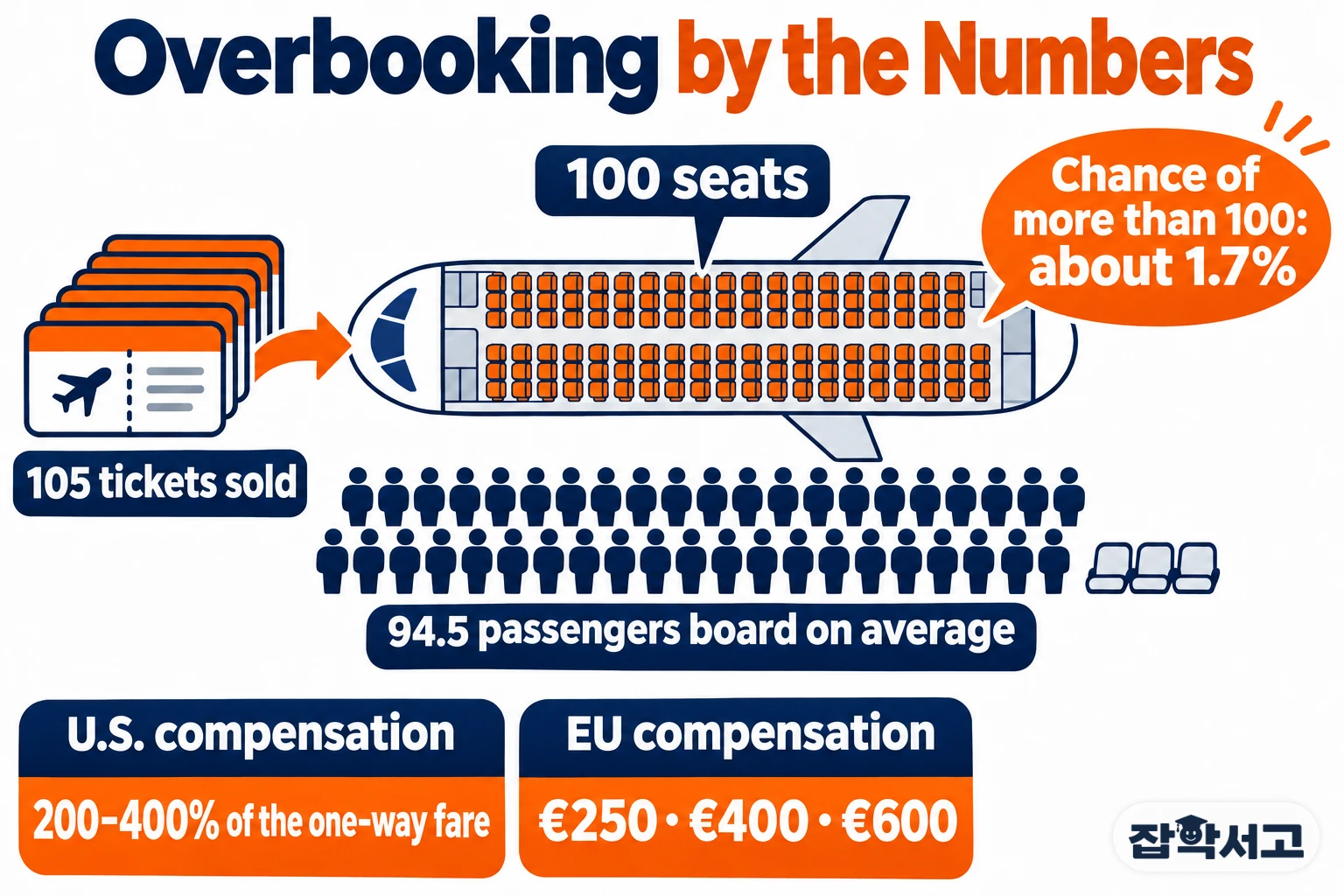
On flights departing from U.S. airports, compensation for being bumped involuntarily depends on how late you reach your destination compared with the original arrival time. If the airline gets you there within one hour, nothing is owed; on domestic flights, a delay of one to two hours earns 200% of the one-way fare, and more than two hours earns 400%.
Airlines may, however, cap these amounts at 1,075 dollars for 200% and 2,150 dollars for 400%. For international flights the thresholds are a little more generous: one to four hours, and more than four hours. Compensation must be offered at the airport on the same day, and if the substitute flight leaves first, it must be paid within 24 hours.
Not every case qualifies. Passengers are not eligible when a smaller aircraft is substituted, on planes with fewer than 30 seats, or on flights into the United States from abroad. Also, passengers whose boarding pass has been accepted and who are seated cannot be removed because of overbooking unless there is a safety or security reason or disruptive behavior.
€250 · €400 · €600 — Europe Sets the Amount by Distance
The European Union’s air passenger rights regulation (EC 261/2004) sets the amount by flight distance rather than fare: 250 euros for flights of 1,500 km or less, 400 euros for flights of 1,500 to 3,500 km and intra-EU flights over 1,500 km, and 600 euros for longer flights. If the passenger is rerouted and arrives within two to four hours (depending on distance) of the original time, however, the amount can be cut in half.
This regulation also requires airlines to look for volunteers before bumping anyone. On top of the payment come the right to choose between a refund and another flight, meals and refreshments while waiting, and, if needed, a hotel and transport to and from the airport. The same experience can pay out differently depending on which country you depart from.
$10,000 — The Price of Finding Volunteers
Before bumping anyone involuntarily, an airline must first look for passengers willing to give up their seats. There is no cap on the money or vouchers offered at this stage, so passengers can negotiate the amount and the conditions.
After the Dao incident, United Airlines announced that it would reduce overbooking and offer up to 10,000 dollars to passengers who give up their seats. The judgment was that the trust lost by forcibly removing passengers costs far more than paying volunteers generously.
July 20, 2016 — Korea Made Compensation a Rule
Under Korea’s Air Transportation User Protection Standards, in force from that day, passengers who cannot board flights departing from Korean airports because of overselling must be compensated according to the Consumer Dispute Resolution Standards. Foreign airlines are subject to the same standards.
Gaps remain, however. When the Korea Consumer Agency reviewed the terms of 22 airlines in October 2026, two foreign airlines either stated no liability beyond a refund for passengers unable to board because of overselling, or let the airline choose the form of compensation. In the same announcement, applications for relief related to air passenger services in 2025 totaled 3,201, up 26.4% from a year earlier.
The Principle Behind the Numbers
Airlines take this risk because an empty seat is revenue that vanishes. Once the plane departs, an unsold seat can never be sold again, so leaving no-show seats empty is also a loss.
For example, suppose that on a 100-seat plane one in ten booked passengers does not show up. If the airline sells exactly 100 tickets, the plane leaves with 10 empty seats on average. If it sells 105, the average number of passengers is 94.5, and the probability that more than 100 actually show up is only about 1.7%. Selling 110 tickets pushes that probability up to about 33%.
No one can tell whether a single passenger will show up, but the law of large numbers, which says that the more passengers there are, the closer the overall no-show rate gets to the average, underpins this calculation. Airlines estimate this rate from past records by route, day of the week and time of day, and set the number of tickets where the combined cost of compensation and empty seats is lowest.
The numbers also tell passengers what to watch for. Checking in early and reaching the gate on time are the basics, and when the airline asks for volunteers, it is wise to check the time of the substitute flight, whether meals and a hotel are provided and how long the voucher is valid before raising your hand.
Recommended reading