Goods piled up in a warehouse are money that has not been sold yet. Even with the same 100 million won of stock, a shop that sells it all within a month and a shop whose goods sit on the shelves all year are in very different financial shape. The measure that shows this gap in a single number is “inventory turnover.”
Put simply, inventory turnover is a ratio showing how many times, over a given period, a business sold off and replenished the average inventory it held. It is the first basic metric checked anywhere that handles stock, whether a distribution center, a store, or a factory, and it also comes up often when reading financial statements.
This article lays out, in an easy-to-follow way, the concept of inventory turnover, how to calculate it with an example, how to interpret high and low values, and how to manage inventory so the rate climbs.
The Concept and Calculation of Inventory Turnover
What Is Inventory Turnover?

Inventory arrives and piles up, sells and goes out, and is replenished again, over and over. Inventory turnover counts how many laps this cycle has run in a year or a quarter. The more laps, the shorter the time stock spends in the warehouse.
- Inventory turnover: the cost of goods sold in a period divided by average inventory, showing how many times the stock was sold and replenished.
- Days sales of inventory (DSI): the average number of days it takes for inventory to sell, also called the days inventory is held.
- Cost of goods sold (COGS): the cost of making or buying the goods that were sold.
Turnover expresses the same phenomenon as a count, and days of inventory expresses it as a number of days. The two move in opposite directions, so when turnover rises, days of inventory get shorter.
Calculation Method and Example

The calculation is not hard. You need three figures: the cost of goods sold, beginning inventory, and ending inventory.
(1) Find the average inventory
Add the inventory at the start of the period to the inventory at the end, then divide by two. Inventory rises and falls with seasons and promotions, so a single point in time can give a skewed result, which is why an average is used.
(2) Find the turnover
Inventory turnover = cost of goods sold ÷ average inventory. The numerator is cost of goods sold rather than sales revenue because inventory is recorded on the books at cost. Revenue has profit mixed in, so dividing it by inventory recorded at cost inflates the figure. Some methods do use sales revenue, though, so when comparing with other data, first check which formula was used.
(3) Convert it to days
Days of inventory = 365 ÷ inventory turnover. For quarterly data, use the number of days in that period instead of 365.
[Example] One Year at a Food Ingredient Wholesaler
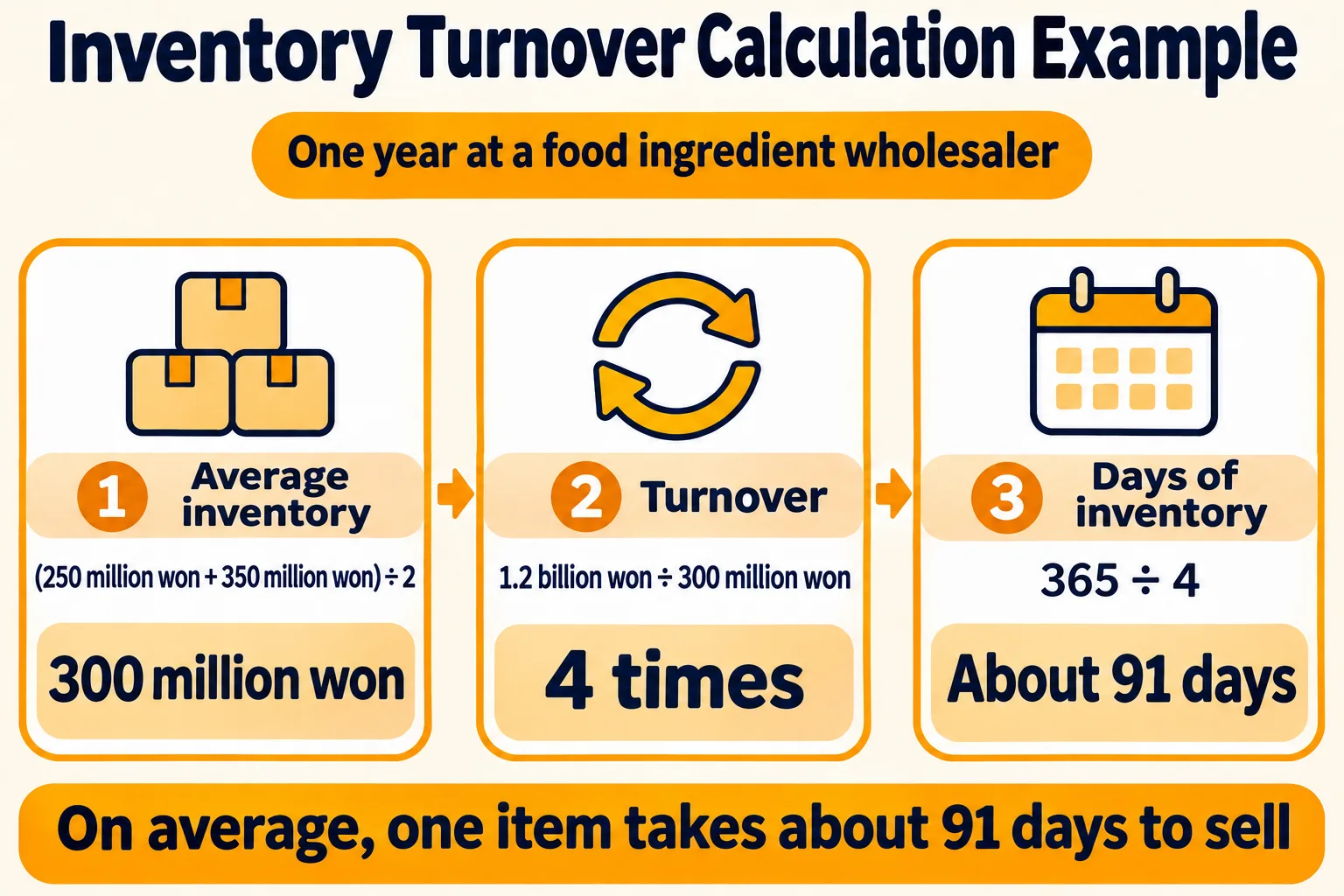
Suppose a business has a cost of goods sold of 1.2 billion won for the year, with 250 million won of inventory at the start of the year and 350 million won at the end. Average inventory is 300 million won, and turnover is 1.2 billion ÷ 300 million, or 4 times. Days of inventory are 365 ÷ 4, about 91 days, so each item sits in the warehouse for roughly three months on average before it sells.
If this business keeps the same cost of goods sold and cuts average inventory to 240 million won, turnover becomes 5 times and days of inventory 73. Just by trimming inventory 20% without raising sales, goods sell 18 days sooner and 60 million won of tied-up cash is freed.
Is Higher Always Better, and Is Lower Always Bad?

In general, a high turnover means inventory turns into cash quickly, so it is read as a good sign. Storage costs and interest burdens shrink, and the risk of goods with short shelf lives or fashion-driven demand losing their value unsold also falls. Conversely, a low turnover makes you suspect that unsold goods are piling up or that more has been brought in than needed.
But judging from the number alone invites misreading. Several things have to be looked at together.
(1) Industry benchmarks
Each industry has its own normal level. Fast-spoiling goods such as groceries need to turn quickly, while high-priced goods such as furniture or machinery naturally turn slowly.
(2) A turnover that is too high
It can be a sign that stock is kept so lean that items often run out. If shortages cause missed sales, turnover looks high but revenue falls.
(3) What to compare against
It only means something when set against competitors in the same industry and against your own past values.
Days of inventory are also the first stage of the cash conversion cycle, which shows the path from a company buying goods to getting the money back. So the faster inventory turns, the lighter a company’s cash flow becomes.
4 Ways to Raise Turnover

Raising turnover means matching inventory to a suitable quantity for the speed at which goods sell. Cutting stock blindly only leads to more stockouts, so the following methods are used in balance.
(1) Sharpen demand forecasting
Analyzing sales records, seasons, and promotion schedules to predict more accurately how much will sell reduces buying more than needed.
(2) Manage by item group
Keep core fast sellers well stocked, and cut order quantities or clear out items that barely move. Treating all inventory the same lowers efficiency.
(3) Shorter order cycles, smaller order sizes
Bringing in small amounts often reduces the quantity piled up at one time. In exchange, more orders mean higher shipping costs and more workload, so it has to be balanced against cost.
(4) Share information with suppliers
Sharing sales data quickly with suppliers brings deliveries closer to the pace of sales, which cuts the stock that builds up in between.
Inventory turnover is a clock that measures time inside the warehouse. The shorter the time that money sits asleep as goods, the lighter a business moves, but spinning the clock faster is not automatically good. Only when you also count the customers lost to stockouts does the right speed come into view.
A single line of numbers tells you only an average, so it has to be read together with the nature of the industry and the products. Asking first how fast stock flows, rather than how much is piled up: that is the first step to reading inventory turnover properly.