Have you ever felt your headache easing just minutes after swallowing a pill? It was too early for the drug to spread through your body, yet your mind had already responded.
This improvement in symptoms after receiving a fake pill or a treatment with no active effect is called the placebo effect. In this article, we look at the meaning and origin of the word, how it works, the experiments that confirmed it, and its limits along with its opposite, the nocebo effect.
The placebo effect is when expectation changes how the body responds
Meaning and Origin: “I Shall Please”
The placebo effect is a phenomenon in which a substance or treatment with no pharmacological action relieves symptoms through the patient’s belief and expectation. The fake medicine itself, which only looks like real medicine, is called a placebo.
(1) The Latin word “placebo”
Placebo comes from the Latin verb placere (to please) and means “I shall please.” Because the medieval Church’s evening prayer for the dead began with this word, it first referred to a prayer.
(2) A medicine to comfort patients
Over time, the word came to mean a medicine given to reassure patients, closer to comfort than to cure. Sugar or starch pills and saline injections are typical examples.
(3) Focus on the “effect,” not the fake pill
What matters is not the fake pill itself but the changes that happen in the body and mind after taking it. That is why today the placebo effect is understood broadly to include effects created by factors outside the pill, such as the way it is handed over, the atmosphere of the clinic and the ritual of treatment.
Why Does It Happen? Expectation, Learning and the Brain

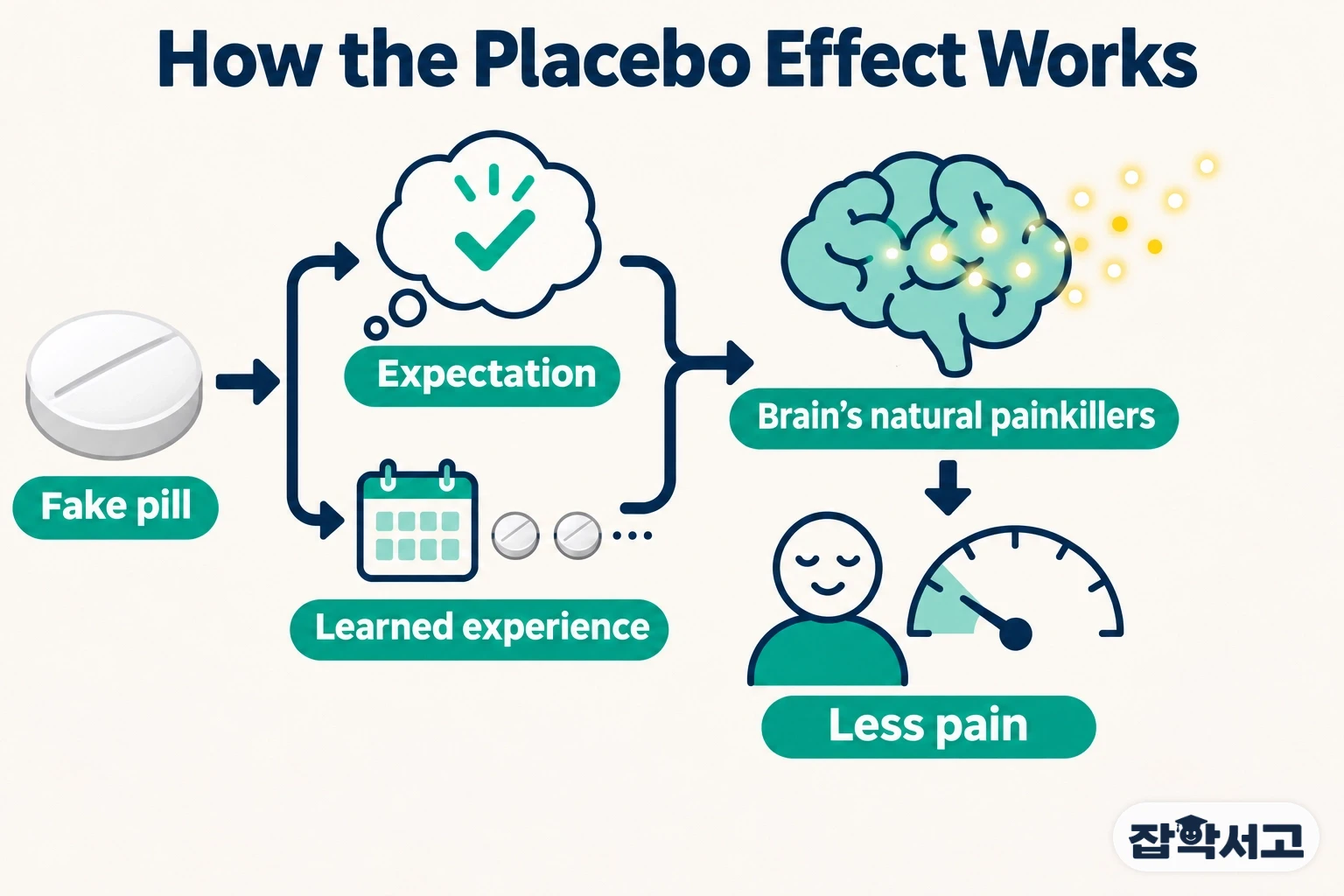
The placebo effect cannot be explained by willpower alone. Researchers generally explain it through three routes: expectation, learning and chemical reactions in the brain.
(1) Expectation
The belief that “this pill will make me better” changes the very way we feel pain and anxiety. The more confidently a doctor explains, and the bigger and more expensive a pill looks, the stronger the expectation tends to be.
(2) Learned experience
As experiences of getting better after taking medicine pile up, the body is trained to respond to the act of swallowing a pill itself. Like Pavlov’s dog salivating at the sound of a bell, conditioning draws out the body’s response in advance.
(3) Painkillers in the brain
In 1978, a research team led by Jon Levine in the United States gave fake painkillers to patients who had their wisdom teeth removed, then gave some of them naloxone, a drug that blocks opioid pain relief. The pain of those who had felt relief from the fake pill grew stronger again, and the team concluded that endorphins produced by the brain itself are involved in placebo pain relief.
Here are some terms that are useful for understanding the placebo effect.
- Placebo: a fake medicine or treatment made to have no pharmacological action
- Nocebo effect: a phenomenon in which negative expectations actually cause symptoms or side effects
- Double-blind test: an experimental method in which neither patients nor researchers know who received the real drug
- Open-label placebo: a placebo given after telling the patient in advance that it is fake
- Endorphin: a natural painkiller made in the brain that reduces pain
Experiments That Confirmed the Placebo Effect
The placebo effect has been revealed little by little through many experiments. The three studies below are still cited often.
(1) “The Powerful Placebo,” 1955
In a paper published in the Journal of the American Medical Association (JAMA), American anesthesiologist Henry K. Beecher analyzed 15 studies with more than 1,000 patients and reported that on average about 35% obtained satisfactory symptom relief from a placebo alone. The paper spread the idea that new drug trials must include a placebo control group.
(2) Expensive fake pills work better
In 2008, a team led by American behavioral economist Dan Ariely gave 82 people mild electric shocks to the wrist and then had them take a fake painkiller. Of those told a pill cost $2.50, 85% said their pain decreased, but only 61% of those told it had been discounted to 10 cents said the same.
(3) It works even when you know
In 2010, a team led by Ted Kaptchuk at Harvard Medical School gave 80 patients with irritable bowel syndrome a bottle labeled “placebo.” After three weeks, 59% of those who took the fake pills reported adequate symptom relief, compared with 35% of those who received no treatment.
Limits and the Other Face: The Nocebo Effect

The placebo effect is real, but it is not a power that cures everything. Debate continues over how large it is and how it should be used.
(1) Inflated numbers
Beecher’s 35% has been criticized for including natural recovery, in which people get better on their own over time. In 2001, Hróbjartsson and Gøtzsche in Denmark analyzed clinical trials comparing groups given a placebo with groups given no treatment. They concluded that there was generally little evidence that placebos have powerful clinical effects, and that small effects appeared only in symptoms patients feel themselves, such as pain.
(2) The nocebo effect
Expectation also works in the opposite direction. Just as people who have heard detailed explanations of side effects may complain of headaches or nausea after taking a fake pill, expecting a bad outcome can actually make the body feel unwell; this is called the nocebo effect. The name comes from the Latin nocebo, meaning “I shall harm.”
(3) How it differs from pseudoscience
The placebo effect is a scientific phenomenon that can be measured with a placebo control group in double-blind experiments. Conversely, if a treatment fails to show a better effect than a placebo, its effect is no more than the placebo effect. That is why the claim that “even a placebo is fine as long as it works” cannot justify ineffective treatments.
In the end, the placebo effect shows that the body and mind do not act separately, and it also serves as a yardstick for telling whether a new treatment is real. The next time you feel better right after taking a pill, take a moment to think about how much of that feeling comes from your own expectations.
Recommended reading