The handful of news stories you skimmed on your phone this morning are what was left after someone chose from the countless articles written that day. Media studies has a name for this process of deciding what to run and what to drop.
That name is gatekeeping. It comes from the idea that information passes through several gates before it reaches readers, and that a gatekeeper at each gate decides what gets through and what is stopped.

At first the term referred to the choices of a single newspaper editor, but today organizations, society, readers and even algorithms are seen as gatekeepers. Let’s follow, period by period, how this concept has expanded over nearly 80 years.
The Path Gatekeeping Has Traveled
Gatekeeping was not a theory completed in one stroke. The answer to the question “Who is the gatekeeper?” changed with each era and gradually broadened, and that change is the history of the concept itself. The day-to-day work of newsroom gatekeepers such as editors and desk chiefs is covered in our article on the news production process and the gatekeeper’s role, so this piece focuses on the path the theory itself has taken.
1940s — The Gatekeeper at the Dinner Table

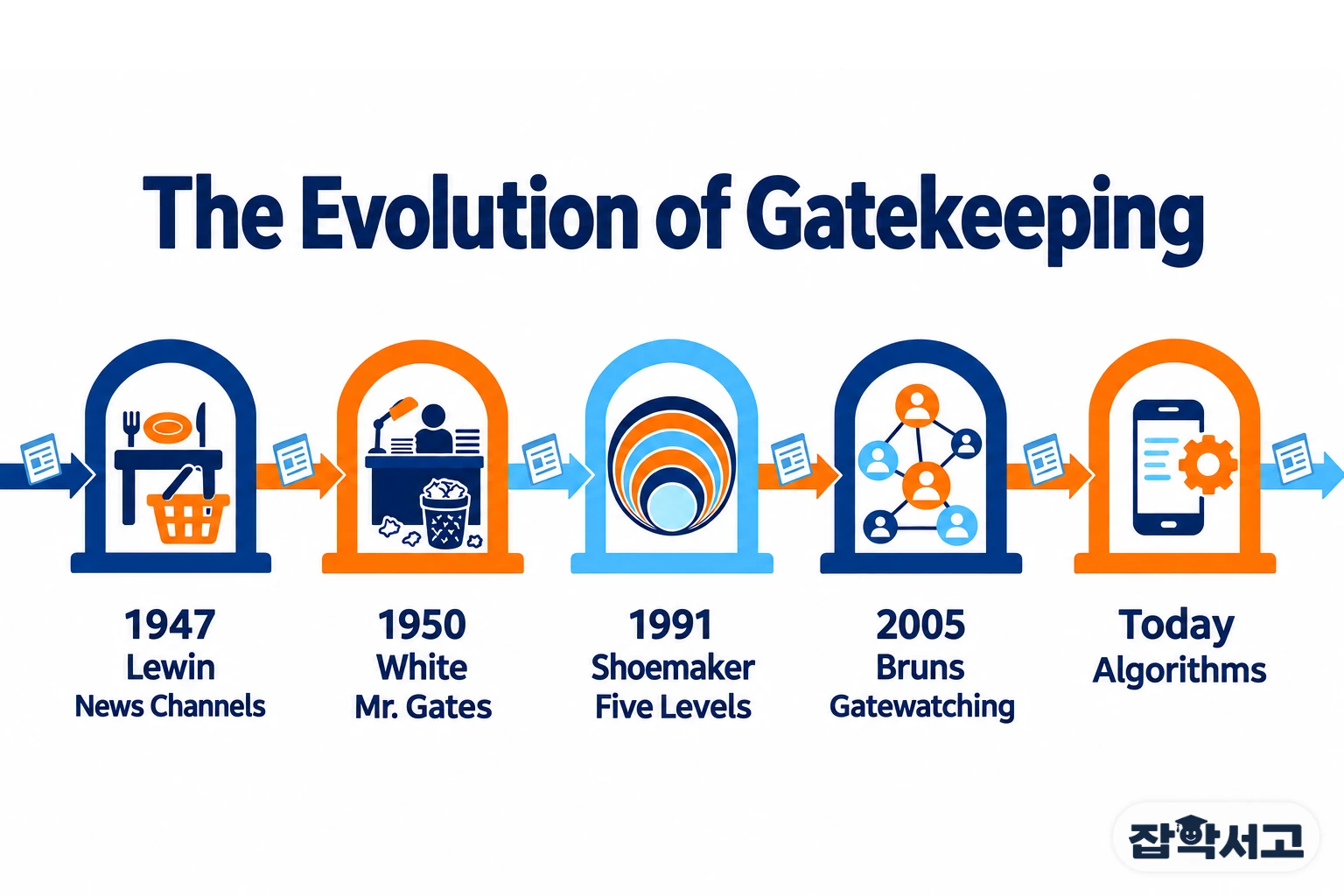
The first person to use the word gatekeeper as an academic term was not a media scholar but the social psychologist Kurt Lewin. Around the time of World War II, he studied the eating habits of American households and traced the path food takes to reach the table.
Food starts at stores and gardens and reaches the table through several channels: shopping, storage and cooking. Lewin called the points in each channel where it is decided what gets in “gates,” and he saw the housewife, who at the time mostly handled shopping and cooking, as the person guarding those gates.
What Lewin focused on was that when the gatekeeper’s choices change, everything that reaches the end of the channel changes. To change eating habits, he reasoned, it is better to move the gatekeeper first than to try to persuade everyone.
In a 1947 paper, Lewin wrote that this idea applies not only to food but also to the channels through which news flows into a group. This brief remark became the starting point of gatekeeping research in media studies.
1950 — Mr. Gates’s Week
The first person to apply Lewin’s idea to an actual newspaper was the media scholar David Manning White. He asked for the cooperation of an editor who selected wire-service stories at a small morning newspaper in the American Midwest.
White called the editor “Mr. Gates” and, for one week in February 1949, compared all the wire copy that came in with the stories that were actually printed. What made it into the paper was only about one-tenth of what had arrived.
Even more striking were the reasons for rejection. The editor wrote down why each story was cut, and while lack of space was a common reason, many others relied on personal judgment, such as “not interesting,” “too vague” and “just propaganda.”
Published in 1950 in the journal Journalism Quarterly, the study showed that news can be filtered through one person’s tastes and values, and it became a classic of gatekeeping research.
Seventeen years later, in 1966, when Paul Snider revisited the same editor and conducted a similar survey, story selection still largely followed the criteria the editor himself considered important.
1956–1990s — Forces Beyond the Desk
A different interpretation soon emerged. In 1956, Walter Gieber examined 16 wire editors at newspapers in Wisconsin and reported that story selection depended more on deadlines, space and the company’s way of working than on personal taste. He looked for the reason newspapers receiving the same wire stories produce similar pages not in individual editors but in the structure of their work.
Later research began to see the gatekeeper not as one person but as several layers of forces. Where reporters are assigned, what the desk considers news and whom the company takes advertising from all change the shape of the gate.
The person who organized this line of thinking was Pamela Shoemaker. In her 1991 book Gatekeeping, she explained the forces that influence gatekeepers at five levels: the individual, communication routines, the organization, social institutions and the social system.
In Gatekeeping Theory, written with Tim Vos in 2009, Shoemaker extended this framework to the online environment and reorganized it. Gatekeeping research had widened its view from one person’s desk to society as a whole.
2000s — An Era of Many Gates
The internet changed the very number of gates. Once anyone could post on blogs and message boards, information found ways to reach many people without passing through a newspaper newsroom. The first page of search results and lists of popular articles are also forms of these new gates.
Axel Bruns, a media scholar working in Australia, called this change gatewatching in 2005. It means that instead of blocking things at the gate, what matters now is watching information from many sources and picking out, publicizing and spreading what is worthwhile.
Readers became gatekeepers too, because every share and recommendation helps decide what appears on other people’s screens. In 2008, information scientist Karine Barzilai-Nahon organized this situation into the theory of network gatekeeping.
Here is the story so far, summarized in chronological order.
- 1947 — Kurt Lewin points out that the channels through which news flows also have gatekeepers
- 1950 — David Manning White publishes the “Mr. Gates” study
- 1956 — Walter Gieber reports that organizational routines shape story selection
- 1991 — Pamela Shoemaker organizes the forces of influence into five levels
- 2005 — Axel Bruns proposes the concept of gatewatching
How Is It Used Today?

Today the most visible gatekeepers are algorithms. Portal front pages, video recommendations and social media feeds calculate what users have clicked and choose what to show next, which is called algorithmic gatekeeping.
The difference from human editors is that the selection criteria are hard to see. Editors reveal their judgment through page layout, but algorithms show each person a different screen, so it is hard to know what you are not seeing. This problem leads into the debate over the filter bubble.
In South Korea, too, whether portal news should be edited by people or recommended by algorithms has repeatedly been a subject of debate. Either way, the fact that someone or something is guarding the gate does not change.
Because gatekeeping is the stage that decides what is covered as news, it is often explained together with agenda-setting theory, which deals with which issues come to seem important. Only news that has passed through the gate can become a topic of public conversation.
There are also things you can do as a reader. If you get into the habit of comparing coverage of the same event across several outlets and looking for stories yourself outside your recommendation feed, you will gradually start to see what the gate in front of you has filtered out.
Recommended reading