20 minutes. Only 20 minutes after memorizing a list of meaningless syllables, relearning it still took about 42% of the original effort. That number came from a psychologist who, about 140 years ago, used himself as his only test subject.
Joining these numbers in time order gives the forgetting curve. German psychologist Hermann Ebbinghaus published it in his 1885 book On Memory (Über das Gedächtnis), and it is still the first graph people bring up when they talk about review schedules.

Yet the numbers on this graph mean something slightly different from what is often claimed. Let’s follow the five numbers that make up the curve, one by one, and read what it actually says.
The Forgetting Curve in Numbers
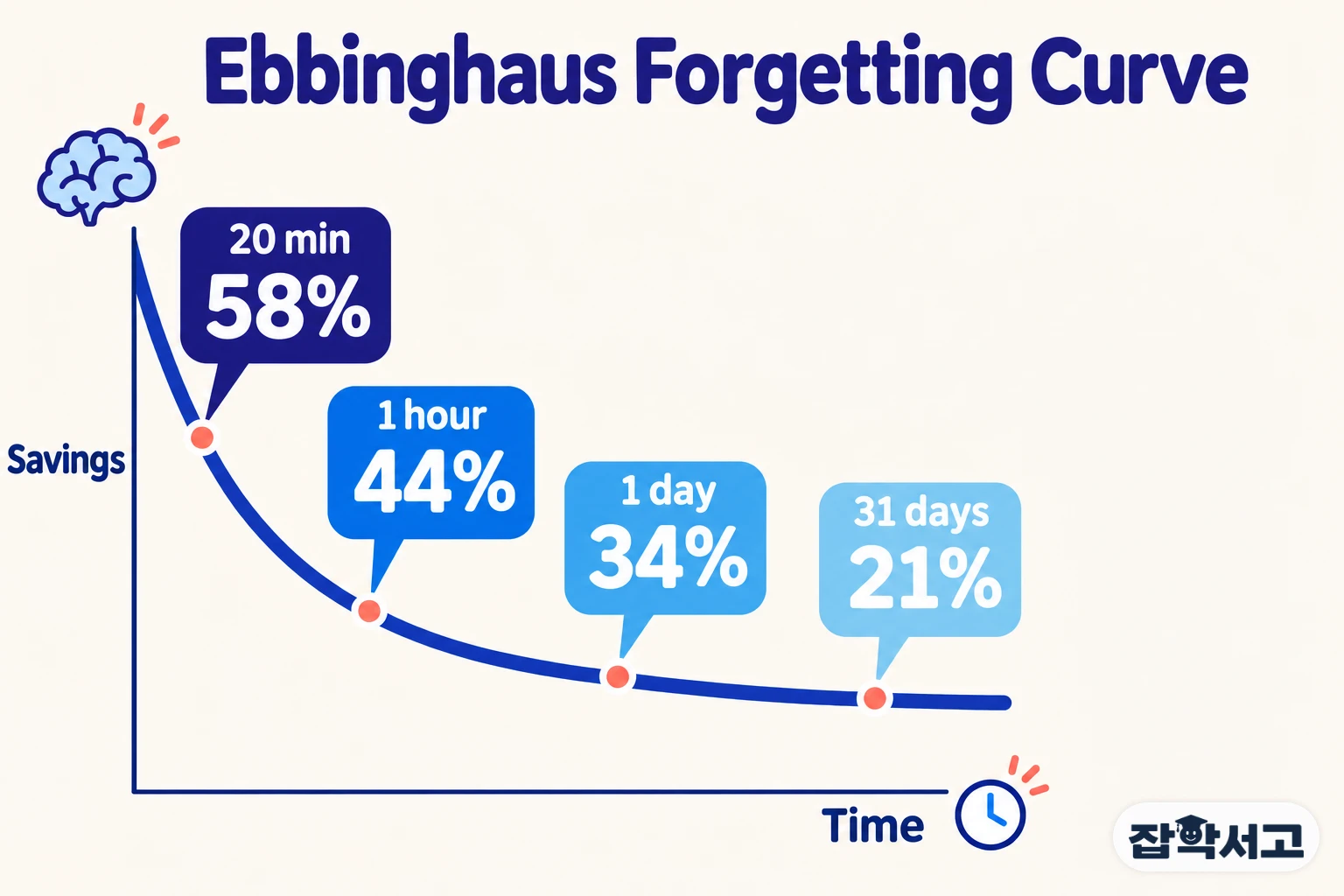
Ebbinghaus did not count how many items he could recall. He relearned the same list after some time had passed and measured how much less effort it took than the first time. This value is called savings, and every percentage in the infographic below is a savings figure.
2,300 — Memory Measured with Meaningless Syllables
Experimenting with familiar words lets meaning and associations help memory, which makes it hard to measure memory itself. So Ebbinghaus built meaningless consonant-vowel-consonant syllables such as “DAX” and “BUP” and threw out any that brought a meaning to mind. About 2,300 syllables were left.
He grouped the syllables into rows of 13, read them at a steady pace and repeated them until he could recite them without error. The only subject was Ebbinghaus himself. The data behind the curve came from seven months of experiments, often up to three sessions a day. Begun around 1879, the work was published as a book in 1885 and appeared in English in 1913 as Memory: A Contribution to Experimental Psychology.
58% — Effort Saved After 20 Minutes
Savings is calculated like this. If you first needed 25 readings to learn a list and later needed only 20 to relearn it, you saved 5 readings, so savings is 20%. If you have to spend the full original effort again, it is 0%. Ebbinghaus preferred measuring time rather than repetitions, so he calculated savings from the time it took to relearn.
In Ebbinghaus’s records, savings after 20 minutes was 58.2%. That means he had to spend about 42% of the original effort again. The popular line “you forget 42% in 20 minutes” is a shortened form of this figure, but strictly speaking it measures the work of relearning, not the number of items remembered.

34% — The Curve Bends Within a Day
Savings was 44.2% after 1 hour, 35.8% after about 9 hours and 33.7% after one day. It fell 14 percentage points in the 40 minutes between 20 minutes and 1 hour, but only a little over 10 points in the 23 hours from then to one day. Between 9 hours and one day, it dropped just 2.1 points.
That is why the curve starts like a cliff. Forgetting is fastest right after learning and slows down as time passes. Even within a single day, the first hour takes away the most.
21% — A Floor That Remains After a Month
27.8% after two days, 25.4% after six days, 21.1% after 31 days. After the first day the decline slows noticeably, and over the 25 days from day six to one month it fell by only a little over 4 percentage points.
It also matters that savings did not reach zero even after a month. Even a list that was hard to recall right away was easier to relearn than the first time. Traces of what you studied once last longer than you might think. Across the whole curve, the drop on the first day (from 58.2% to 33.7%, about 24 points) is nearly twice the drop over the following month (from 33.7% to 21.1%, about 13 points).
70 Hours — A Replication 130 Years Later
Can we trust the results of one man experimenting on himself? In 2015, a team led by Jaap Murre at the University of Amsterdam in the Netherlands tried the same method again. One of the co-authors, then 22 years old, served as the subject, learning and relearning meaningless syllables for about 70 hours.
The experiment ran for 75 days, from December 2011 to February of the following year. The team used 70 lists, each made of 104 syllables in eight rows of 13, and measured the effort needed to relearn them at the same seven intervals Ebbinghaus used, from 20 minutes to 31 days.
The results were similar to Ebbinghaus’s curve. The biggest difference was at 31 days: Ebbinghaus recorded 21.1%, while the replication found only 4.1%. The study, published in the journal PLOS ONE, also noted that the curve seems to step up slightly at the 24-hour point. Some explain this as sleep consolidating memory, but the team said this alone was not enough to conclude that sleep was the cause.
The Principle Behind the Numbers
Put the numbers together and the principle is simple. Forgetting is fast at first and slow later, and relearning takes less effort than learning the first time. So it pays to review early and in several sessions rather than once, late and long.
Ebbinghaus was also the first to report that spreading the same repetitions over several days works better than cramming them into one day. This is called the spacing effect, and it connects to desirable difficulty, the idea that reviews which take a little effort to recall last longer. He was also the first to draw a learning curve, in which learning speed rises most at the start of repetition and then gradually levels off.

There are caveats when applying these numbers directly. What Ebbinghaus memorized were meaningless syllables, and material you understand and can connect to other ideas tends to be forgotten more slowly. The more deeply you learn something at first, the flatter the curve becomes.
Popular review schedules such as “after 10 minutes, a day, a week and a month” also turn the shape of this curve into a practical rule of thumb; they are not numbers found in Ebbinghaus’s tables.
What the forgetting curve offers is less the fact that forgetting cannot be stopped than a clue about when revisiting something takes the least effort. Looking over what you learned today one more time before the day ends is the easiest way to push back against that curve.
Related reading