Even when learners study the same materials for the same amount of time, their results differ markedly. In the past, academics often dismissed these differences as simply a matter of intelligence quotient (IQ) or innate memory ability. However, contemporary research in cognitive psychology and education identifies a key factor that predicts learning outcomes far more accurately than IQ. That factor is metacognition (Metacognition).
Simply put, metacognition means 'awareness of one's own cognitive processes,' or 'the ability to monitor and regulate what one knows and does not know.' Learners who study hard but see little improvement in their grades often move on to the next stage under the mistaken impression that they have fully understood a concept—a metacognitive error. By contrast, high-achieving learners accurately identify gaps in their understanding and take strategic action to address them.
This material systematically covers the academic conceptual structure of metacognition, the mechanisms through which it operates in actual learning situations, and practical strategies that can dramatically improve metacognition in educational settings.
The Structure of Metacognition and Strategies for Putting It into Practice
The 2 Main Components of Metacognition: Knowledge and Regulation
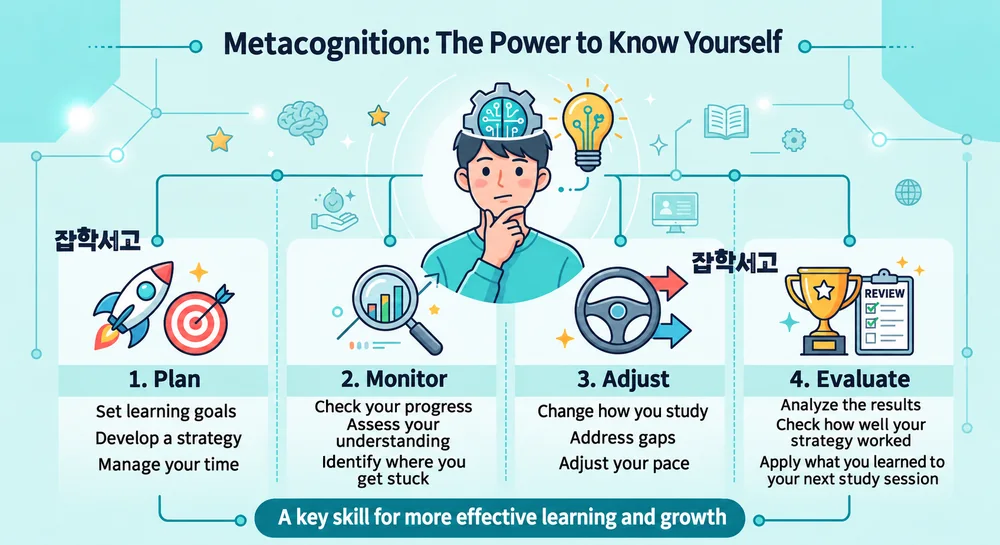
Metacognition, introduced by the American developmental psychologist John Flavell, consists broadly of two dimensions: 'metacognitive knowledge (Metacognitive Knowledge)' and 'metacognitive regulation (Metacognitive Regulation).'
1) Metacognitive Knowledge (Metacognitive Knowledge)
This is the information one knows about one's own cognitive characteristics, tasks, and strategies.
- Person Knowledge (Person Knowledge): An understanding of one's own learning style. (Example: "I memorize material for memorization-heavy subjects better in the evening than in the morning.")
- Task Knowledge (Task Knowledge): An understanding of a task's difficulty and characteristics. (Example: "This passage contains philosophical concepts, so it will take longer to read.")
- Strategy Knowledge (Strategy Knowledge): Knowledge of methods for achieving goals. (Example: "When memorizing complex formulas, the blank-page review method is more effective than summary notes.")
2) Metacognitive Regulation (Metacognitive Regulation)
This is the practical process of managing and modifying cognitive activities in real time.
- Planning (Planning): The stage of setting learning goals and planning the necessary strategies and allocation of time
- Monitoring (Monitoring): The stage of continually monitoring, "Am I properly understanding this material right now?" as learning progresses
- Evaluating (Evaluating): The stage of checking learning outcomes and reflectively examining the effectiveness of the strategies used
The Role of Metacognition from the Perspective of Information Processing Theory

In information processing theory (Information Processing Theory), which explains how the human brain receives and outputs information, metacognition serves as a 'central administrator' that controls the flow of information between working memory and long-term memory.
When an external stimulus passes through sensory memory and enters working memory, metacognition is the higher-level control mechanism that determines whether to let this information simply pass by or transfer it to long-term memory through elaboration (Elaboration) and encoding (Encoding).
An Example to Aid Intuitive Understanding: 'Reading with Your Eyes' vs. 'Trying to Explain'
To understand intuitively how metacognition works, let us compare the cases of two learners.
- Learner A (Low Metacognition):
This learner has read the textbook 3 times. Because the material reads smoothly when read with the eyes, the learner mistakenly believes they know all of it. In psychology, this is called the 'illusion of familiarity (Illusion of Explanatory Depth).' However, when the learner closes the book and faces an exam paper, they cannot write down the correct answers. This is because they have mistaken what they have 'seen' for what they 'know.' - Learner B (High Metacognition):
After reading the textbook 1 time, this learner closes the book and writes the key structure of what they have just read on a blank sheet of paper, as if explaining it to themselves (the blank-page review method). When they get stuck during this process, they immediately recognize (monitoring), "Ah, I don't understand the connections in this section." They then reopen the book and focus on relearning only the parts where their understanding is lacking (regulation).
Ultimately, learners with strong metacognition excel at clearly identifying gaps in their knowledge (Knowledge Gap).
Strategies for Strengthening Metacognition in the Classroom and Everyday Life

Unlike innate intelligence, metacognition is a capability that can be substantially improved through training. The following are 4 representative techniques that can be used in educational settings and self-directed learning.
1) Retrieval Practice (Self-Testing)
Learners should avoid studying through rereading (Re-reading) and consistently practice retrieving knowledge from their brains through quizzes, problem-solving, summarizing, and similar activities. The 'difficulty' experienced when attempting retrieval itself provides a precise measure of one's level of metacognition.
2) Feynman Technique (Feynman Technique)
This involves imagining that you are explaining a concept you have learned in simple terms to a young child or someone who knows nothing about the field. If you get stuck on a sentence or reach a point where you cannot express a technical term in simple language, that is precisely where a gap in your understanding lies.
3) Learning Journals and Analysis of the Reasons for Incorrect Answers (Learning Journal)
This is the habit of tracing your thought process backward and recording it in writing by asking, "Why did I choose this incorrect answer as the correct one?" rather than merely checking the correct answer to a question you got wrong and moving on. This is highly useful for identifying patterns of cognitive errors.
4) Predictive Assessment of Understanding (Predictive Monitoring)
This method involves writing down the score you expect before taking an exam or assessment and then checking the gap between that prediction and your actual score. As the discrepancy between predicted and actual results decreases, it indicates that your metacognition is becoming more refined.
A Paradigm Shift toward Education Centered on Metacognition

With the 4th Industrial Revolution and advances in artificial intelligence (AI), the value of simply accumulating knowledge is gradually declining. What matters now is not 'how much information you have memorized,' but 'knowing what information you need and how you will take charge of the process of learning the knowledge you need.'
Metacognition is the foundation of meta-learning (Meta-learning, learning how to learn) and a core indicator of the self-directed learning ability essential in the era of lifelong education.
Both educators and learners must move beyond simply transmitting and instilling knowledge and create environments in which learners can observe and improve their own cognitive processes. Only when metacognitive experiences of asking questions, discovering one's own errors, and revising strategies accumulate does deep learning (Deep Learning) in the true sense take place.