Pygmalion, a sculptor in Greek mythology, sincerely loved “Galatea,” the beautiful ivory statue of a goddess that he had carved. He tenderly cared for the statue and longed for it to become a living woman, and Aphrodite, the goddess of love, was moved by his devotion and breathed life into it.
The “Pygmalion Effect,” named after this myth, refers to a psychological phenomenon in which other people’s expectations or attention positively change a person’s behavior and performance. In education, this phenomenon receives particular attention for its significant educational implication: “Teachers’ positive expectations for students actually improve their academic achievement and growth.”
How, then, does the Pygmalion effect differ from simple “positive thinking” or “mind control”? From an educational perspective, we will take an in-depth look at the scientific evidence and specific mechanisms behind the Pygmalion effect, as well as how teachers should apply it in educational settings.
The Mechanisms of the Pygmalion Effect and Its Application in Education
Rosenthal and Jacobson’s Empirical Study

The decisive turning point that established the Pygmalion effect as a central topic in psychology and education was the 1968 study by psychologist Robert Rosenthal and elementary school principal Lenore Jacobson.
The researchers administered an intelligence test (IQ Test) to all students at an elementary school in San Francisco. Regardless of the test results, however, they gave teachers a list of randomly selected students comprising 20% of the student body and told them the following.
“The students on this list have exceptional potential and are highly likely to show rapid increases in intelligence and academic achievement.”
Although the students had actually been selected at random and were no different from the others, the teachers trusted the list. When the same intelligence test was administered again 8 months later, a remarkable change emerged. The IQ scores and academic achievement of students on the “exceptional potential” list had improved significantly more than those of other students.
This study was recorded as a representative example of scientific evidence demonstrating that teachers’ expectations directly influence students’ growth.
4 Mediating Processes That Turn Expectations into Reality

How can a teacher’s simple mindset lead to actual student performance? Professor Rosenthal explains how the Pygmalion effect occurs through the following 4 mechanisms.
Emotional Atmosphere (Climate)
Teachers frequently send warmer, friendlier nonverbal signals, such as eye contact, smiles, and nods, to students for whom they have high expectations.
Input / Provision of Learning Materials (Input)
They provide students for whom they have high expectations with more difficult, higher-level learning materials and give them more frequent opportunities to answer questions.
Opportunities to Speak and Respond (Output)
They give students more time to respond to questions and encourage them to think for themselves and find the answers.
Feedback (Feedback)
They actively provide specific feedback on results and constructive advice, going beyond simple praise.
Classroom Examples to Aid Understanding
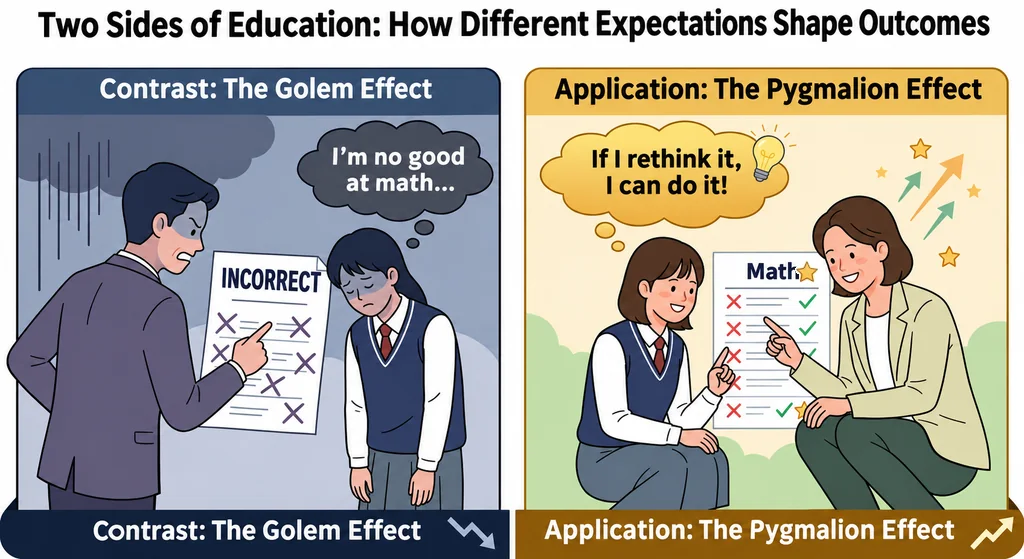
To help clarify this, let us compare two situations in an actual mathematics class.
Contrasting Example: When the Labeling Effect (Golem Effect) Is at Work
After asking student A, who usually struggles with mathematics, to solve a question on a unit assessment, the teacher hears an incorrect answer, sighs, and says, “You always get stuck on this type of problem. Go back and review the basic concepts step by step,” before giving another student a turn. Student A develops the self-concept “I am a child who is bad at mathematics” and gives up trying.
Application Example: When the Pygmalion Effect Is at Work
In the same situation, the teacher says this to the same student, B. “This problem requires you to apply a concept, so everyone finds it confusing at first. But B, in the last class, you kept working through a similar concept until you understood it, didn’t you? If you think about it for just 10 more seconds, you’ll be able to find the answer.”
Sensing the teacher’s confident attitude, student B becomes absorbed in solving the problem and, after answering correctly, gains a sense of achievement and confidence in learning.
Considerations and Limitations When Applying the Pygmalion Effect
The Pygmalion effect is clearly a powerful educational tool, but it also has limitations that require attention.
- The Risk of Unrealistic Expectations: Excessive expectations that disregard a student’s current abilities or developmental level can cause feelings of pressure and anxiety.
- Guarding Against the Labeling Effect (Golem Effect): Teachers’ negative stereotypes or attitudes that lower expectations can produce the “Golem effect,” which hinders students’ potential.
- Distinguishing Expectations from Simple Praise: Empty, unconditional praise has no educational effect; the key is sincere expectations grounded in the process of students’ actual efforts.
Education That Awakens the “Galatea” Within Every Student

The central message the Pygmalion effect conveys to us is clear. A learner’s growth is largely determined by the educator’s view of and expectations for that learner, more than by innate intelligence or environment.
In educational settings, teachers should go beyond simply delivering knowledge and serve as supporters who help students believe in their own possibilities.
- Look for each student’s strengths and potential.
- Provide specific, positive feedback focused on the learning process.
- Communicate the belief that learners can get back on their feet even after failure.
The warm, earnest expectations an educator holds are the most powerful catalyst for changing a student’s life. Today, the warm, trusting gaze we offer the students we encounter will be the first step toward awakening the boundless potential sleeping within them.