Some students who breeze through equations in math class freeze when the same formula shows up in science class. On the other hand, someone who has played the piano for years may pick up typing quickly. What we learn in one place sometimes pays off somewhere else, and sometimes goes completely unused. The term for this phenomenon is “transfer of learning.”
Put simply, transfer of learning means “the influence that previously learned knowledge or skills have on learning and problem solving in a new situation.” For what is learned at school to be used outside the exam room, transfer has to happen, so transfer is closely tied to the question of what education ultimately exists for.
In this piece, we will look in turn at the concept and origins of transfer of learning, the various types of transfer, an experiment showing that transfer happens less often than we might think, and teaching methods that support transfer.
How Learning Crosses Over to Other Places
What Is Transfer of Learning?

Until the early 20th century, a belief called “formal discipline” was widespread in schools. It was the idea that studying difficult subjects such as Latin or geometry trains mental faculties like memory and attention across the board, much as exercise builds muscle.
The first to put this belief to an experimental test were the American psychologists Edward Thorndike and Robert Woodworth. In a 1901 paper, the two reported that people trained to estimate the areas of certain shapes did not improve as much on shapes of a different form.
(1) Theory of Identical Elements
Thorndike held that the more identical elements two tasks share, the more readily transfer occurs. Practicing writing the alphabet helps with writing words because the two share many of the same movements.
(2) A Rebuttal to the “Mental Muscle” Theory
This research badly shook the idea that simply studying hard subjects makes the mind better in general. It showed that people learn something far more specific than a vague general ability.
Types of Transfer of Learning

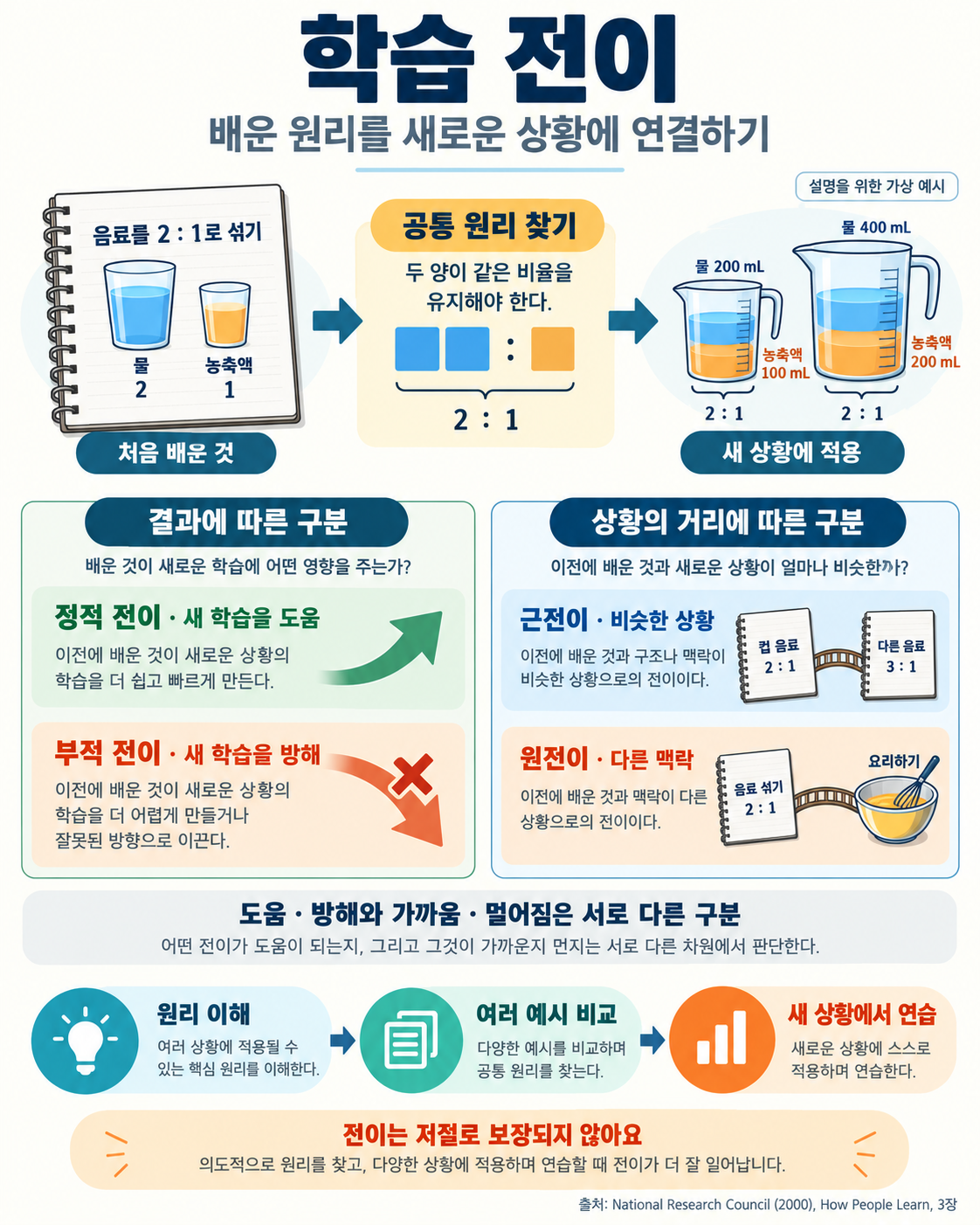
Transfer is divided into several kinds according to its direction and distance.
- Positive transfer: when earlier learning helps new learning (e.g., someone who can ride a bicycle easily keeps their balance on a motorcycle).
- Negative transfer: when earlier learning actually gets in the way (e.g., a driver used to a right-hand-traffic country keeps drifting into the wrong lane in a left-hand-traffic country).
- Near transfer: applying learning to situations similar to the one in which it was learned (e.g., solving a problem that differs from a textbook example only in its numbers).
- Far transfer: applying learning somewhere that looks very different from the original situation (e.g., recalling the chess principle of controlling the center when thinking about business strategy).
The American education scholar David Perkins and the Israeli educational psychologist Gavriel Salomon described two routes by which transfer happens. One is the “low road,” where a well-practiced behavior springs up automatically in a similar situation; the other is the “high road,” where a common principle is consciously abstracted and connected to a new situation. When someone drives a small truck for the first time and their feel for driving a car carries straight over, that is an example of the low road.
Why Does Transfer So Often Fail to Happen?
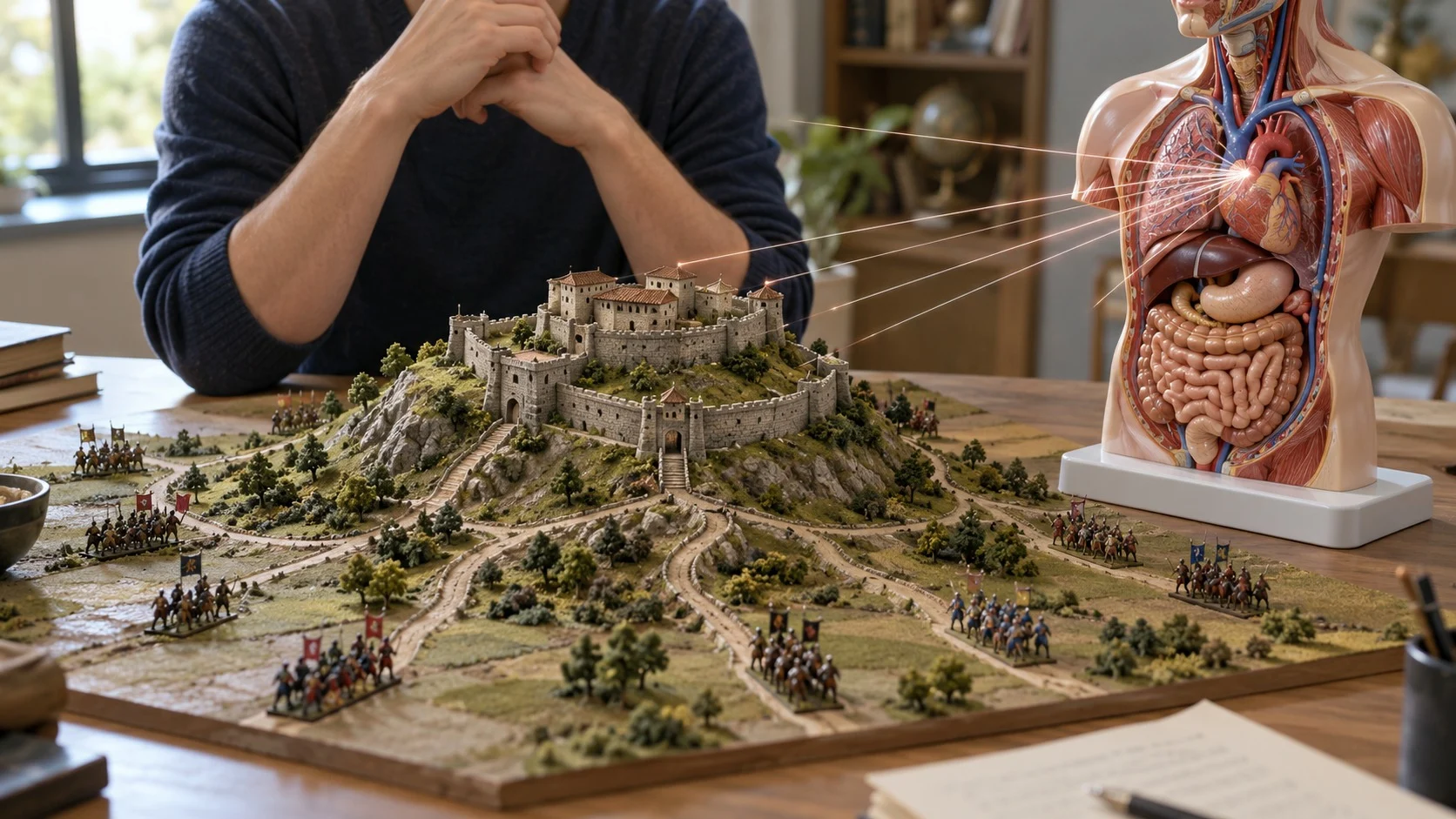
There is an experiment that clearly shows transfer is harder than we think.
[Experiment] The Fortress Story and the Tumor Problem
Mary Gick and Keith Holyoak, researchers at the University of Michigan in the United States, first had participants read a story about a general who captured a fortress by dividing his army into small groups that converged on it simultaneously from several roads. They then asked how to treat a tumor when a single strong ray of radiation would also damage healthy tissue. The answer is to converge many weak rays on one point from all directions.
According to the two researchers’ studies published in the early 1980s, about 75% of participants who were given a hint to use the story found this solution, but without the hint only about 30% did. Since about 10% of people who never read the story found the answer anyway, few people actually noticed the similarity on their own.
(1) The Habit of Getting Stuck on Surface Features
When things look different on the surface, like a military story and a medical problem, people often fail to connect them even if their underlying structure is the same.
(2) Knowledge Bound to Context
Knowledge learned only within a particular classroom or a particular type of problem does not easily come to mind once you step outside that context.
Teaching Strategies That Boost Transfer

Transfer is not something to expect to happen on its own but a goal that has to be designed for deliberately. Perkins and Salomon recommended using two methods together.
(1) Hugging
Make the learning situation as close as possible to the situation where it will actually be used. Doing mock interviews instead of listening to a lecture on interview tips is one example, and it mainly supports low-road transfer.
(2) Bridging
Have learners put the general principle of what they learned into words, and ask where else it could be used in other fields. This is a way to open up high-road transfer.
(3) Varied Examples and Comparison
Placing several examples that look different side by side and having learners find what they have in common trains them to see structure rather than surface.
(4) Reflection and Metacognition
Having learners look back on which principle they used after solving a problem makes it more likely that the principle will come to mind in the next situation.
Transfer of learning is the bridge that keeps learning from being locked inside the classroom and carries it into life. Just as important as what and how much you learned is how far you can take what you learned and put it to use.
Asking yourself how you might use one thing you learned today somewhere else is the first step toward learning that stays alive.