Have you ever taken out a tub of ice cream that had been sitting in a corner of the freezer for a few weeks and scooped a spoonful? Ice cream that was smooth when you bought it is suddenly full of crunchy, sand-like ice grains. Even though you never opened it to eat any, its texture changed because of a chemical phenomenon in which small crystals disappear and only large crystals keep growing. This is known as ‘Ostwald ripening’.
Simply put, Ostwald ripening means ‘a phenomenon in which small particles in a solution dissolve and disappear, and their material moves onto large particles, which grow even larger.’ It is named after the chemist Wilhelm Ostwald, who first recorded it in 1896 while working at Leipzig University, and today it is an important concept in almost every field that handles small particles, such as food, pharmaceuticals, new materials, and analytical chemistry.
In this article, we will look in turn at how Ostwald ripening was discovered and explained by theory, why small particles dissolve first, ripening in ice cream, beverages, and rocks, and finally how this phenomenon is put to use or prevented.
The Competition Among Crystals: Small Ones Vanish, Large Ones Grow
1. The Discovery of Ostwald Ripening and LSW Theory
Ostwald ripening was first noticed by chemists observing precipitates and crystals in the laboratory. The starting point was the fact that, over time, the sizes of the particles in the same solution change on their own.
(1) Wilhelm Ostwald’s Observation
Ostwald was a pioneer of physical chemistry who received the 1909 Nobel Prize in Chemistry for his work on catalysis, chemical equilibrium, and reaction rates. In 1896 he recorded that small crystals in a solution dissolve while large crystals grow, and the process later came to be called Ostwald ripening after him.
(2) A Change That Happens on Its Own
This phenomenon proceeds by itself, even if no one stirs or heats the solution. When small particles shrink and large particles grow, the total surface area decreases and the system reaches a more stable state. In theory, if you wait long enough, the particles move toward gathering into a single large lump.
(3) LSW Theory
In 1958, Ilya Lifshitz and Vitaly Slyozov in the Soviet Union, and in 1961, Carl Wagner in Germany, each described this phenomenon mathematically. The two studies, produced separately on opposite sides of the Iron Curtain, were combined into LSW theory after Kahlweit showed in 1975 that they were the same theory. It is well known for the result that, when diffusion is slow, the average particle radius grows in proportion to the cube root of time.
2. Why Small Particles Dissolve First
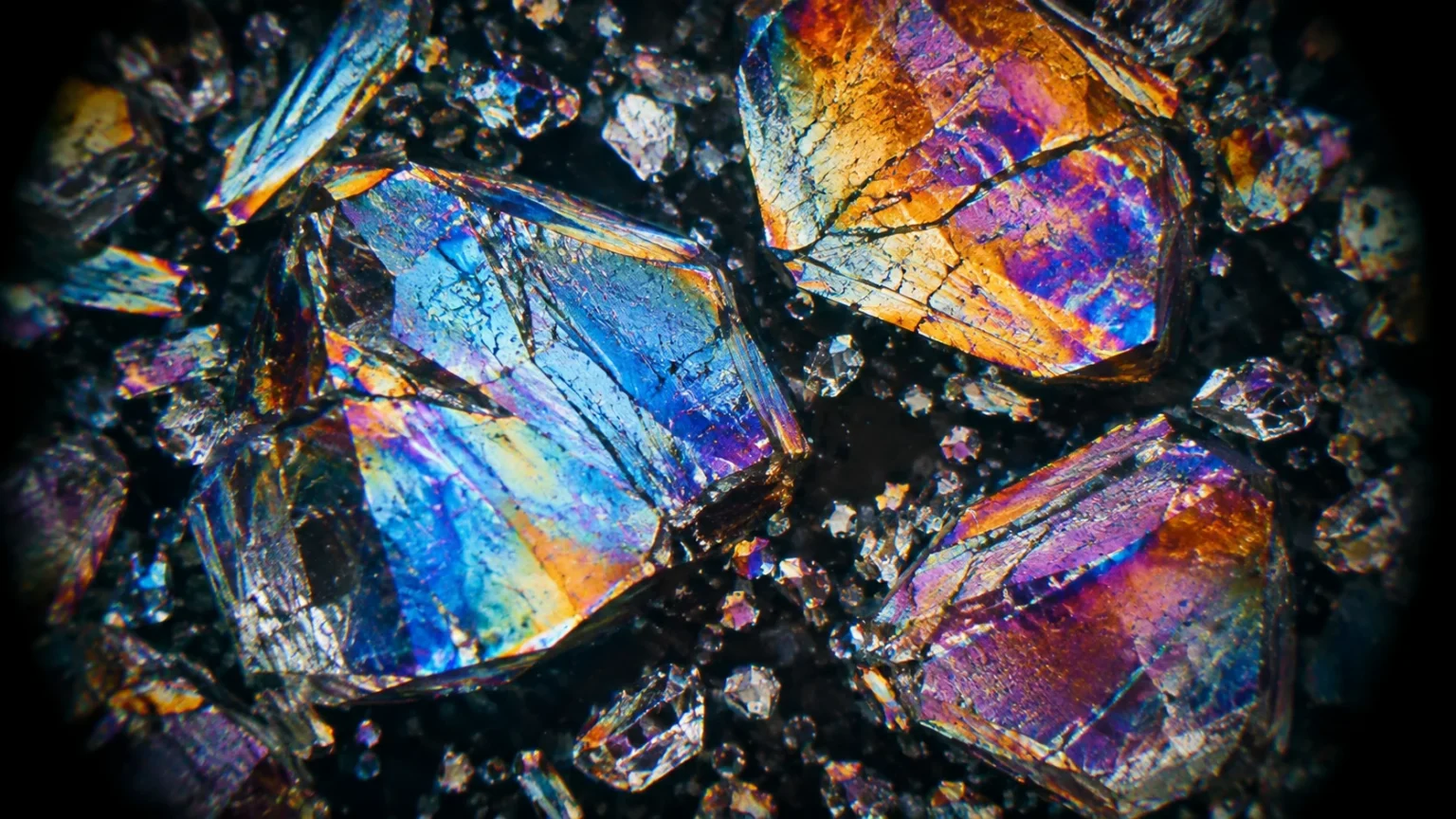
Why do only the small particles dissolve and disappear, even though they are the same substance? The answer lies at the particle surface. The smaller a particle is, the larger the share of its molecules exposed on the surface, and surface molecules are less stable than interior ones because they have fewer neighbors holding them in place. For example, an atom inside a cubic crystal has 6 neighbors, while an atom on the surface has 5 or fewer.
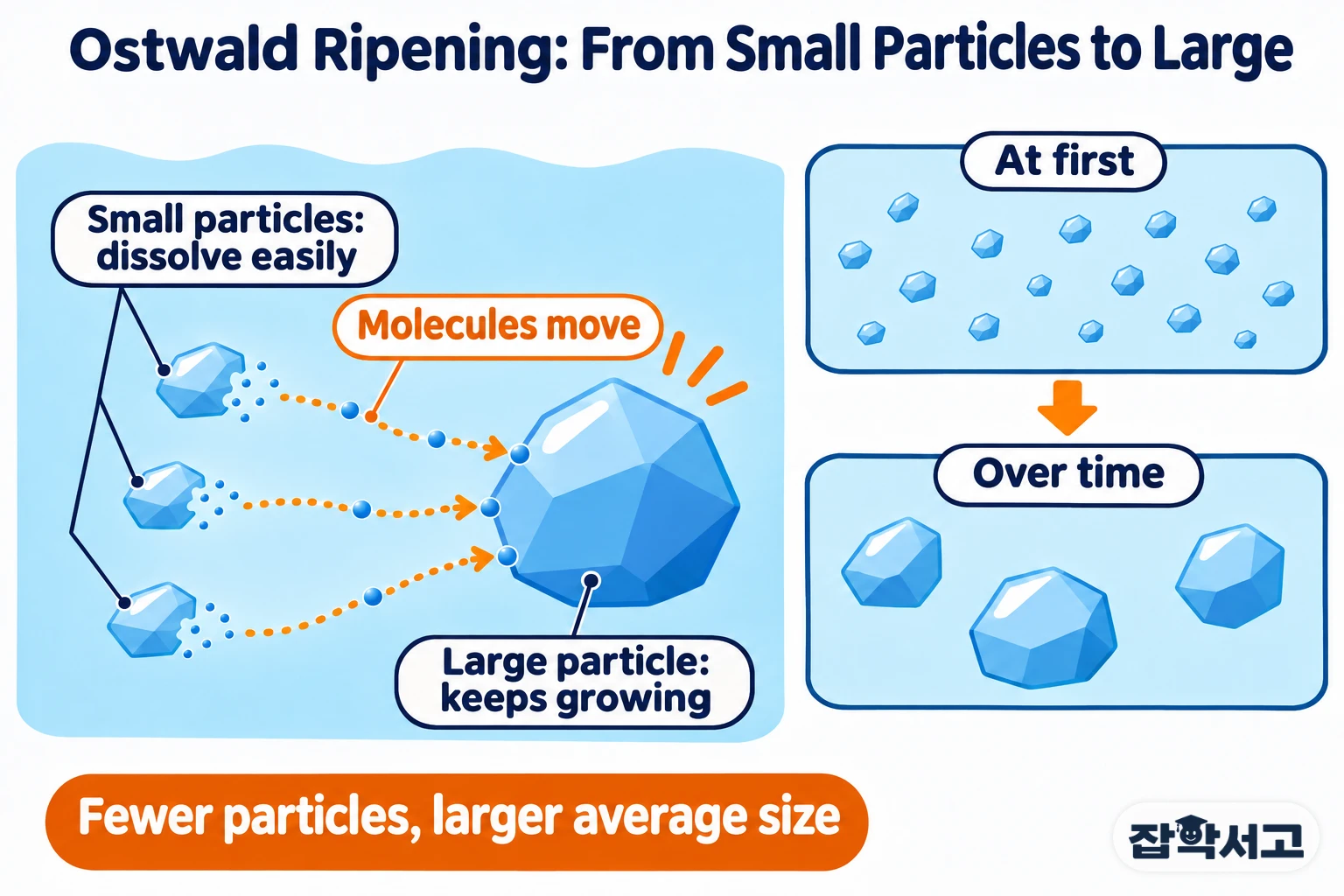
- Surface Energy: The extra energy that molecules on the surface have compared with those inside; the smaller the particle, the larger the share of this energy relative to its volume.
- Kelvin Equation: An equation describing the relationship between how curved a surface is (its radius of curvature) and chemical potential; it shows that small, highly curved particles dissolve or evaporate more easily.
- Equilibrium Concentration: The concentration of a substance that can stay dissolved around a particle; it is higher around small particles than around large ones.
- Diffusion: The spreading of molecules from where the concentration is high to where it is low; according to Fick’s First Law, dissolved material moves from the small particles toward the large ones.
Because small particles keep dissolving and shrinking while large particles keep growing by taking in the dissolved material, the number of particles decreases and the average size increases over time. You could call it the chemical version of the saying ‘the rich get richer.’
3. From Ice Cream to Rocks: Ostwald Ripening in Everyday Life
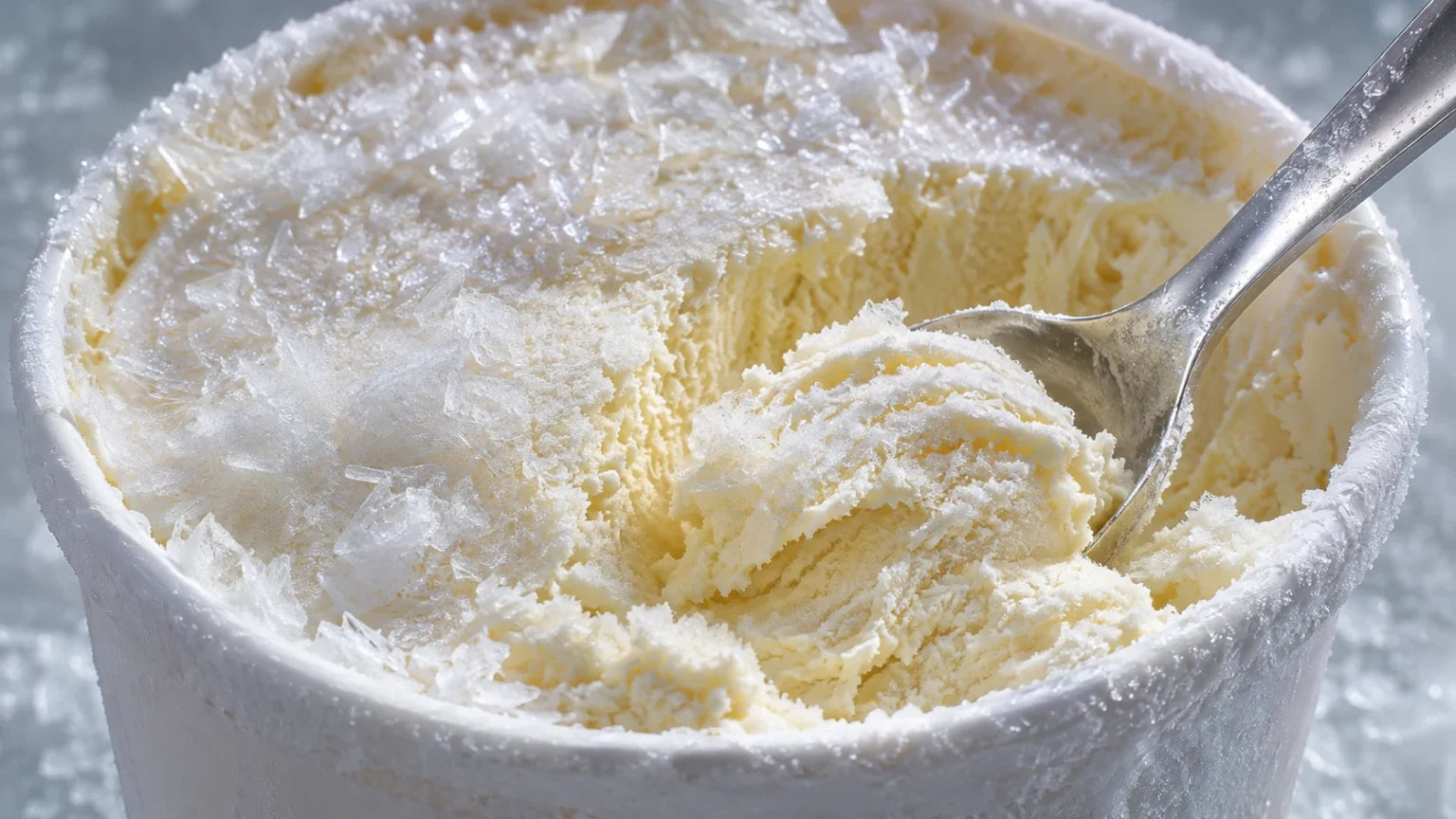
Ostwald ripening also happens frequently outside the laboratory. In any material that contains a mix of small particles, it proceeds quietly everywhere, from desserts in the freezer to rocks underground.
(1) Why Ice Cream Turns Crunchy
One gram of freshly made ice cream contains millions of ice crystals with an average diameter of about 50 µm (micrometers), so the tongue cannot feel the grains. During storage, however, recrystallization takes place in which small crystals shrink and large crystals grow. Especially when the temperature rises and falls, such as when the freezer door is opened and closed or the defrost function runs, small crystals melt and then refreeze onto larger crystals, making the texture coarse.
(2) Emulsions and Beverages
In emulsions of water and oil as well, molecules from small droplets pass through the surrounding liquid to larger droplets, so the droplets gradually grow. The tiny droplets of ouzo, the Greek spirit that turns cloudy when water is added, also grow this way, and beverage flavor emulsions sometimes include an oil that hardly dissolves in water to slow this process.
(3) Large Crystals in Rocks
In geology, Ostwald ripening is used to explain how crystals coarsen inside solid rock after magma has solidified. It is often cited as one of the causes of the large orthoclase crystals embedded in rocks.
4. How Ostwald Ripening Is Used and Prevented
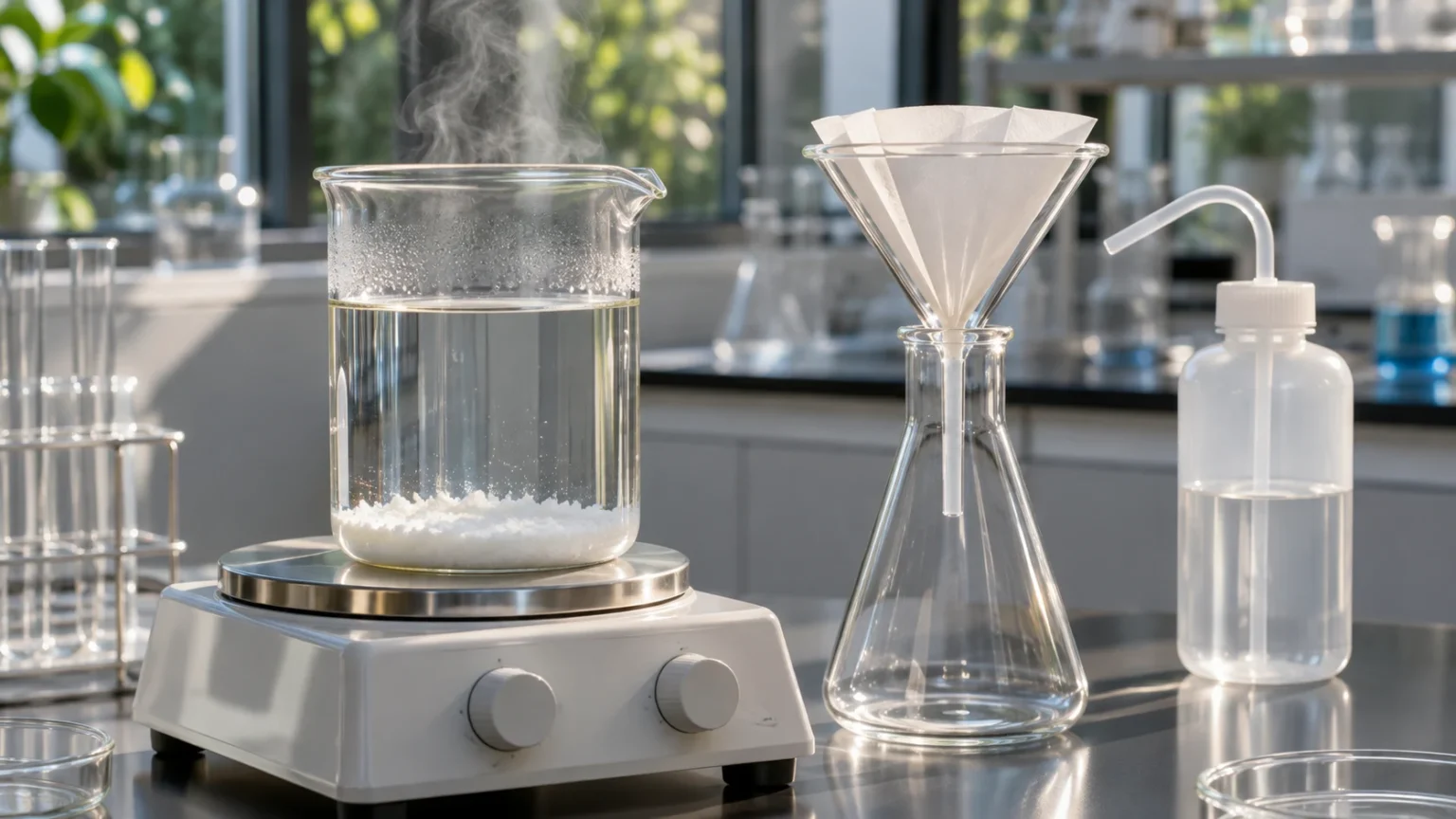
Depending on the situation, Ostwald ripening can be a welcome guest or a nuisance. That is why scientists and engineers sometimes trigger it on purpose and, at other times, try hard to slow it down as much as possible.
(1) Ripening Precipitates
In gravimetric analysis, which measures the amount of a substance by weight, a freshly formed precipitate is left in its mother liquor or heated so that it ripens. As material moves from small particles onto large ones, the precipitate becomes coarse crystals that do not pass through filter paper, making it easier to filter and wash and yielding a purer precipitate.
(2) Controlling the Size of Quantum Dots
When quantum dots, semiconductor nanocrystals whose emitted color changes with their size, are made in solution, suppressing ripening is essential. If ripening proceeds, the particle sizes drift away from the desired value, making it difficult to obtain the target color precisely.
(3) Techniques for Slowing Ripening
Ice cream contains stabilizers such as locust bean gum and guar gum to reduce the movement of water, and it is stored at a low, constant temperature to slow the growth of ice crystals. In pharmaceutical crystals, polymers such as polyvinylpyrrolidone (PVP) form a net-like film on the crystal surface to block growth, and emulsions are given a small amount of an ingredient that is almost completely insoluble in water so that small droplets cannot dissolve away.
If you want to keep the ice cream in your freezer tasting good for a long time, not opening the door too often is the easiest way to prevent ripening. The simple idea that small things dissolve and large things grow—that is the first step to understanding Ostwald ripening.