How do scientists work out when a piece of wood from a tree that died thousands of years ago was cut down? The secret lies in the carbon atoms inside the wood. Even the same carbon contains a small share of slightly heavier forms, and some of them disappear at a steady rate. It is as if each atom carries a clock inside it.
Atoms like these, which belong to the same element but differ in weight, are called ‘isotopes’. Their chemical properties are almost identical, but because the number of neutrons in the nucleus differs, some stay stable forever while others give off radiation and turn into a different element.
In this article, we will look in turn at what isotopes are and how atoms are built, the difference between stable and radioactive isotopes, how carbon is used to measure time, and how isotopes are used in medicine, energy and climate research.
Twin Atoms with Different Weights: How Isotopes Work and What They Are Used For
Different Atoms in the Same Place
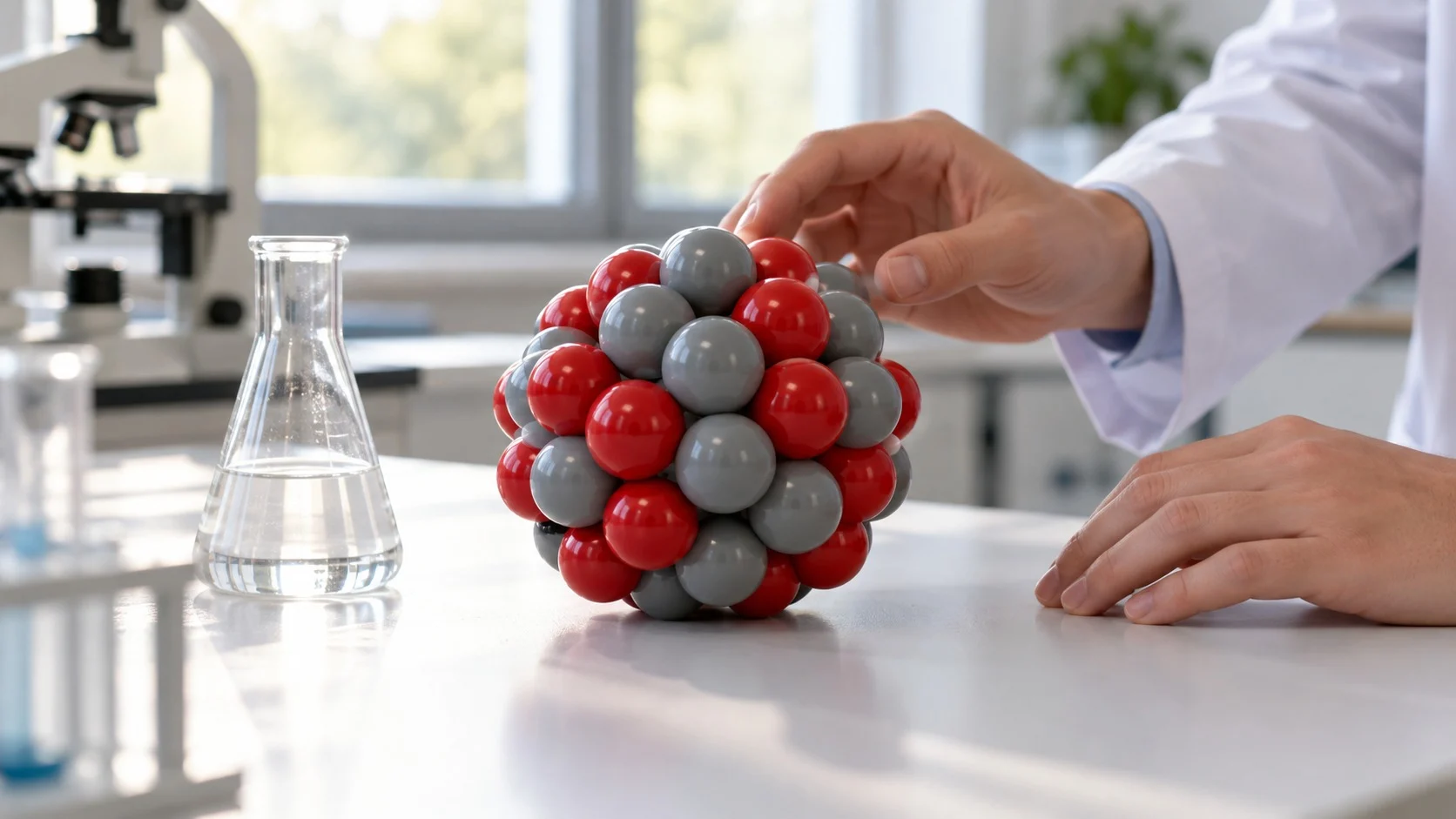
An atom is made up of a nucleus at its centre and electrons moving around it, and the nucleus is in turn made of protons and neutrons. What decides which element an atom is, is the number of protons. With 6 protons it is carbon; with 8 it is oxygen.
- Atomic Number: The number of protons in the nucleus, which determines which element an atom is.
- Mass Number: The total number of protons and neutrons, which roughly indicates the weight of an atom.
- Isotope: Atoms that have the same number of protons but different numbers of neutrons, and therefore different mass numbers.
Because chemical reactions are mainly driven by electrons, isotopes with the same number of electrons react in almost the same way. The word isotope comes from the Greek isos, meaning ‘same’, and topos, meaning ‘place’. It means they occupy the same box in the periodic table. The British chemist Frederick Soddy put forward the idea in 1913, and the name was suggested by Margaret Todd, a Scottish doctor and writer with whom he was talking.
Stable Atoms and Changing Atoms

Isotopes fall into two broad groups depending on whether their nucleus is stable. Hydrogen is the best example.
(1) Stable isotopes
These are isotopes that do not change over time. Ordinary hydrogen has no neutron, but deuterium, which has one neutron, is twice as heavy. Deuterium was discovered in 1931 by the American chemist Harold Urey. Most carbon is likewise carbon-12, and about 1.1% is carbon-13, which has one extra neutron.
(2) Radioactive isotopes
These are isotopes whose nucleus is unstable, so they give off radiation and change into a different atom. Tritium, which has two neutrons, turns half of its amount into helium in about 12 years.
(3) The clock called half-life
The time it takes for a radioactive isotope to fall to half of its original amount is called its half-life. A half-life hardly changes even when temperature or pressure changes, which makes it an accurate clock for measuring time. After one half-life, half remains; after two, a quarter; after three, an eighth, and so on at a steady rate.
How Carbon Tells Time

High in the sky, cosmic rays arriving from space collide with the air and constantly produce carbon-14, a radioactive form of carbon. Plants take in this carbon through photosynthesis, and animals build it up in their bodies by eating plants.
When Breathing Stops, the Clock Starts
While a living thing is alive, the proportion of carbon-14 in its body stays close to that in the atmosphere. Once it dies, however, no new carbon comes in, and the remaining carbon-14 halves about every 5,730 years. So by measuring how much is left, we can work backwards to calculate when that living thing died.
A Discovery That Changed Archaeology
This radiocarbon dating method was developed in the late 1940s by Willard Libby at the University of Chicago in the United States, and he received the 1960 Nobel Prize in Chemistry for it. However, the older a sample is, the less carbon-14 is left, so the limit of reliable measurement is usually about 50,000 years ago.
Isotopes in Everyday Life and Science

Isotopes are widely used outside the laboratory as well. The fact that they share the same chemical properties and differ only in weight or radiation is exactly what makes them useful.
(1) Medicine that finds and treats disease
If a small amount of a radioactive isotope is put into the body, imaging can track where it gathers. Technetium-99m, with a half-life of about 6 hours, is widely used in diagnostic tests, and iodine-131 is used to treat the thyroid.
(2) Fuel for nuclear power
In natural uranium, only about 0.7% is uranium-235, the form that readily undergoes nuclear fission. So to use it as power-plant fuel, it goes through an enrichment process that raises this proportion.
(3) Ice that reads past climates
Water containing heavy oxygen-18 evaporates less readily than lighter water and falls first as rain or snow. So by measuring the ratio of oxygen isotopes in Antarctic ice, we can estimate the temperature around the time that snow fell.
(4) A label that reveals origin
The isotope ratios in plants and animals vary slightly depending on the water, soil and climate of the region where they grew. Analysing these differences can reveal whether foods such as honey or wine have been mixed with cheap ingredients, and whether they were really produced in the region on the label.
Isotopes show us that atoms which look identical on the outside each carry a different story when we look inside. A difference of a few neutrons reveals the age of ancient artefacts, finds disease inside the body, and even tells us about the weather hundreds of thousands of years ago.
Knowing that atoms with the same name can hold different weights and different times is the first step towards a deeper understanding of the invisible world of atoms.