
We get up at seven in the morning, choose our clothes, leave home and head to work, meet friends on weekends, and go on vacation in the summer. It is a day so natural to us that we have never even stopped to think about it. Yet until just a few decades ago, many people with disabilities could not enjoy such an ordinary day. It was common for them to live together in large institutions, all getting up at the same set time, wearing the same clothes, and spending their entire lives with almost no contact with the world beyond the walls.
The idea that emerged to challenge this reality is the 'Normalization Principle.' Put simply, the normalization principle holds that people with disabilities should be able to live as close as possible to the lifestyles and conditions enjoyed by ordinary people in their society. This principle is regarded as the starting point that changed the direction of services not only in disability welfare but in social welfare as a whole.
This article walks step by step through the background from which the normalization principle was born, its eight criteria for everyday life, the changes this idea brought about, and the common misunderstandings and limits surrounding it.
The Birth and Practice of the Normalization Principle
The Right to an Ordinary Life, Born in Northern Europe
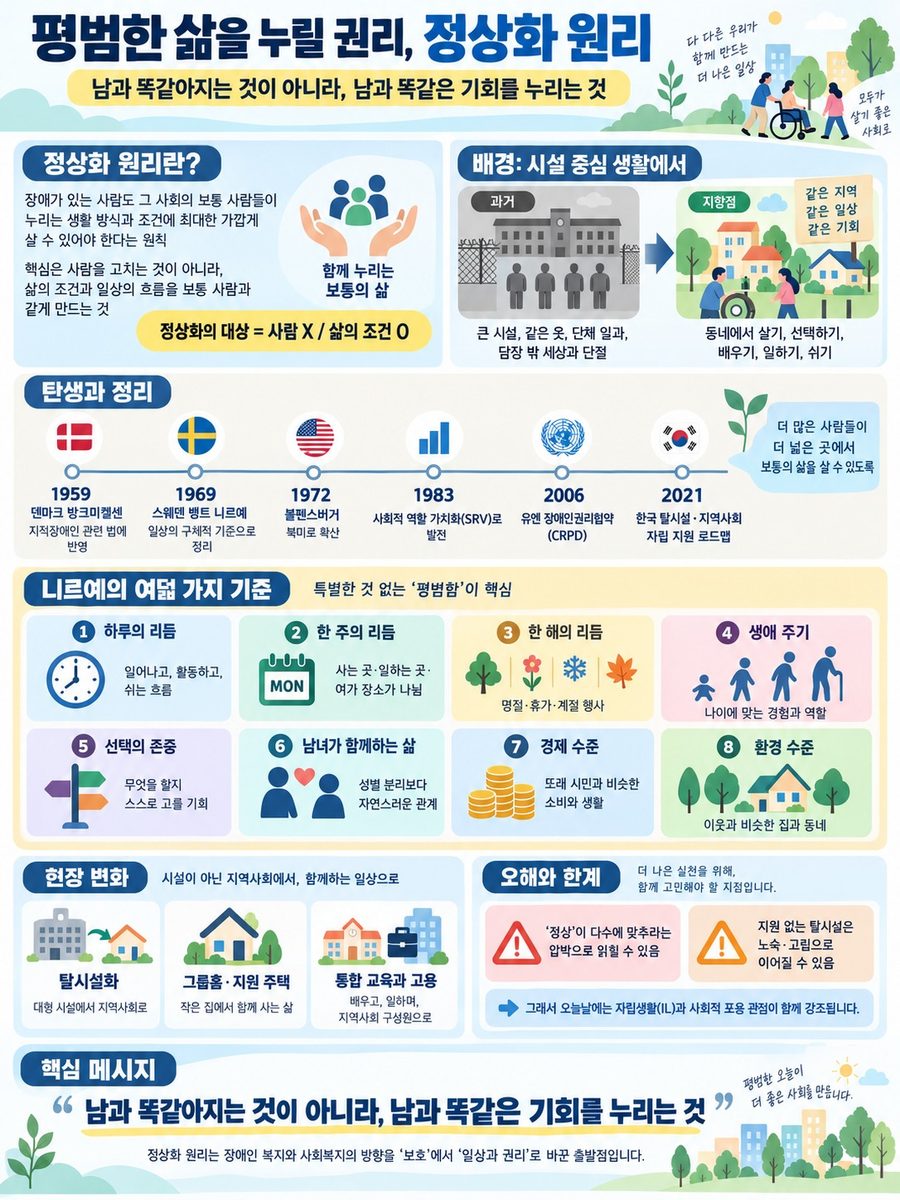

The normalization principle took root in Northern Europe in the 1950s and 60s. Niels Erik Bank-Mikkelsen, an official in Denmark's Ministry of Social Affairs, led the effort to include in Denmark's 1959 act on people with intellectual disabilities the aim of 'letting people with intellectual disabilities live a life as close to normal as possible.' For this reason, he is often called the father of the normalization principle.
The person who refined this idea into a systematic principle was Bengt Nirje of Sweden. Working for the Swedish association of parents of children with intellectual disabilities, he saw the reality of institutions up close, and in a paper published in 1969 he spelled out the normalization principle as concrete criteria for everyday life.
The important point here is that what is 'normalized' is not the person but the conditions of life. The idea is not to fix people with disabilities so they become like ordinary people, but to make the environment they live in and the flow of their daily lives the same as those of ordinary people.
Nirje's Eight Criteria

Nirje explained what an ordinary life is by dividing it into eight areas. These criteria are still often used today to evaluate welfare services.
- Rhythm of the Day: Instead of following a fixed group schedule, people get up, get dressed, and eat their meals the way ordinary people do.
- Routine of the Week: The places where people live, work, and enjoy their leisure are separate from one another.
- Rhythm of the Year: People share in holidays, vacations, and the events that come around each season.
- Life Cycle: People have experiences that suit childhood, adolescence, adulthood, and old age.
- Choices and Wishes: People's own wishes and decisions are respected.
- Living with Both Sexes: People are not separated by sex and have opportunities for friendship, romance, and marriage.
- Economic Standards: People are guaranteed income and economic lives at a level similar to that of ordinary people.
- Environmental Standards: The size, location, and appearance of homes and facilities are similar to the typical homes of their neighbors.
Looking at the list, there is nothing special in it at all. That very ordinariness is the point. The role of these criteria is to ask whether the everyday life everyone takes for granted is missing simply because a person has a disability.
The Shift from Institutions to Communities

The normalization principle crossed over to North America and spread even more widely. Wolf Wolfensberger, a German-born scholar who worked in the United States, published a book on the normalization principle in 1972 and applied the idea not only to people with disabilities but to many socially marginalized groups. In 1983 he developed it into a theory called 'Social Role Valorization,' which holds that people are respected when they take on roles that society values.
This movement led to major changes in practice.
(1) Deinstitutionalization
A movement to reduce large institutions where hundreds of people lived together and to move people into small homes within the community.
(2) Group Homes and Supported Housing
Housing arrangements in which a few people live together in an ordinary house and receive only as much help as they need have increased.
(3) Inclusive Education and Employment (Inclusion)
Rather than being confined to special schools or sheltered workshops, people have gained wider opportunities to learn and work together in regular schools and workplaces.
The Convention on the Rights of Persons with Disabilities (CRPD), adopted by the United Nations in 2006, also set out the right of people with disabilities to decide for themselves where and with whom they live and to be included in the community. South Korea has also ratified this convention, and in 2021 the government announced a roadmap to support deinstitutionalization and independent community living for people with disabilities.
Misunderstandings and Limits of Normalization

The normalization principle brought about great change, but criticism and misunderstanding followed along with it.
First, the word 'normal' itself can be a problem. If the lifestyle of the majority is taken as the standard, it can be read as pressure on people with disabilities to fit into that mold. In fact, there were cases where the principle was mistakenly taken to mean that people must be fixed to become ordinary, ignoring their individuality or culture. For people who wish to preserve their own language and culture, such as the Deaf community, the demand to conform to the majority can actually be hurtful.
Moreover, an ordinary life does not appear automatically just because people leave institutions. When the United States sharply reduced the number of psychiatric hospital beds from the mid-20th century onward, critics point out that housing and treatment support in the community did not keep pace, driving many people into homelessness or isolation. Deinstitutionalization becomes meaningful only when a support system is put in place alongside it.
That is why today, while building on the normalization principle, perspectives such as Independent Living and Social Inclusion, which put greater emphasis on people's own choices and diversity, are stressed as well.
Not becoming the same as everyone else, but enjoying the same opportunities as everyone else: that is the first step toward a society where everyone lives together.