At the height of World War II, one of the biggest worries of the Allied command was how many tanks Germany was producing each month. Spy reports, prisoner interrogations and aerial reconnaissance were all brought to bear, but the figures were all over the place and mostly far higher than reality. Surprisingly, the most accurate answer came from a handful of serial numbers stamped on tanks captured on the battlefield.
Put simply, the German tank problem means ‘estimating how many items there are in total by looking at the numbers on only some of them, when the items are numbered in order starting from 1’. In statistics it is treated as a classic estimation problem that uses the largest value in a sample to infer the maximum of the population, and it got its name from the remarkable results it produced when actually used during the war.
In this article, we will look in turn at why the Allies turned their attention to serial numbers, the principle behind a simple estimation formula, how the results compared with actual records, and the uses and countermeasures that continue to this day.
Estimating the Whole from a Few Numbers
A Statistics Problem Born on the Battlefield
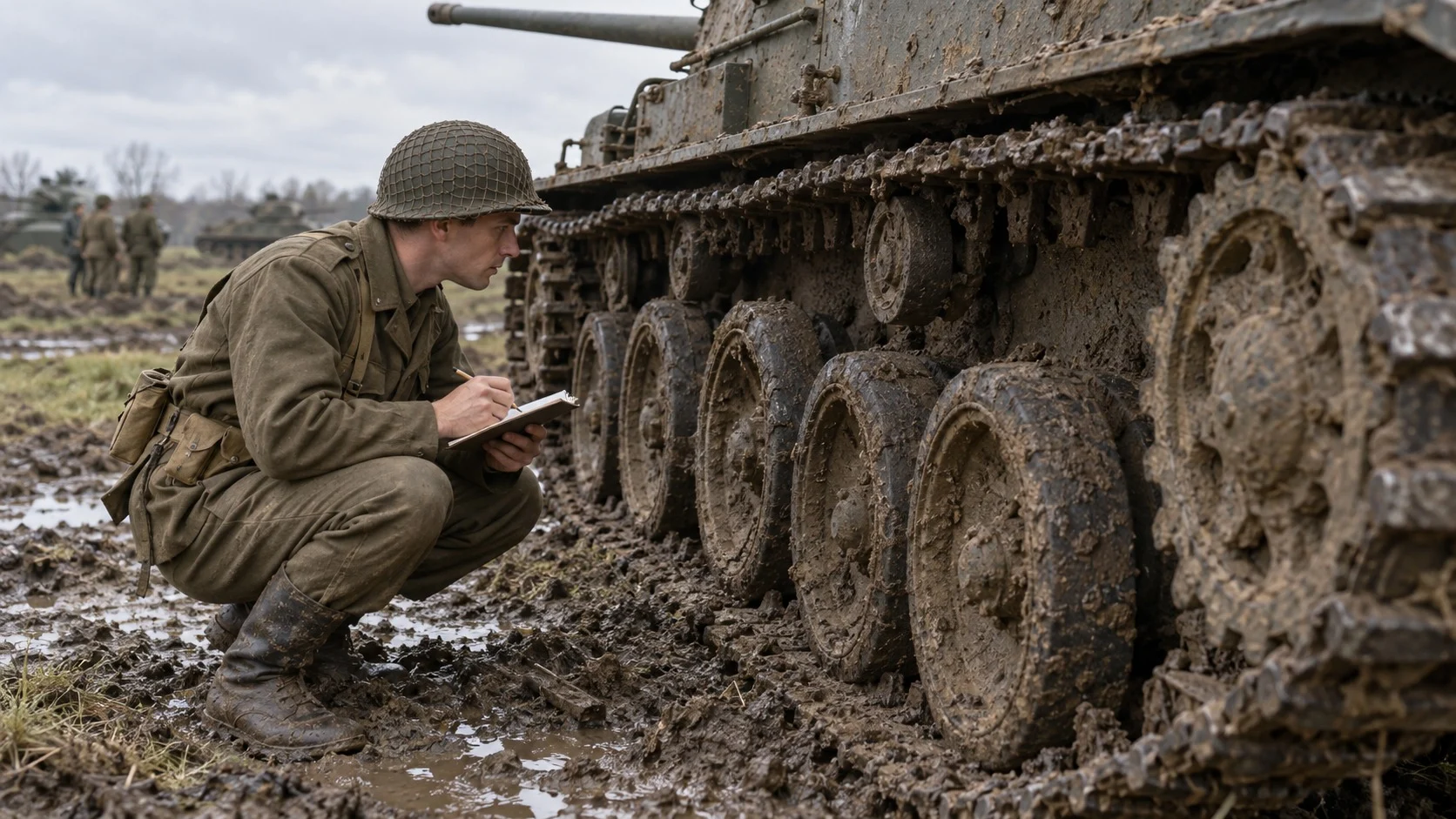
When Germany built tanks, it gave each component, such as the hull, engine, gearbox and wheels, serial numbers that increased in sequence. It was an ordinary habit for factories and the army to keep track of parts, but it became a valuable clue for Allied economic analysts.
- Source of the clues (Serial Numbers): The Allies examined tanks destroyed or captured in battle and carefully recorded the numbers stamped on gearboxes, hulls and engines. Gearbox numbers in particular ran without gaps, so they were used most in the analysis.
- The secret of the wheels (Road Wheels): From the numbers on the wheels, analysts worked out how many moulds were used to make them, and by asking British wheel manufacturers they calculated how many wheels those moulds could produce in a month.
- Growing alarm (Panther Rumors): Ahead of the 1944 Normandy landings, rumours spread that the new Panther tank was being used in large numbers, making it even more urgent to know the exact production figures.
Add the Average Gap to the Largest Number

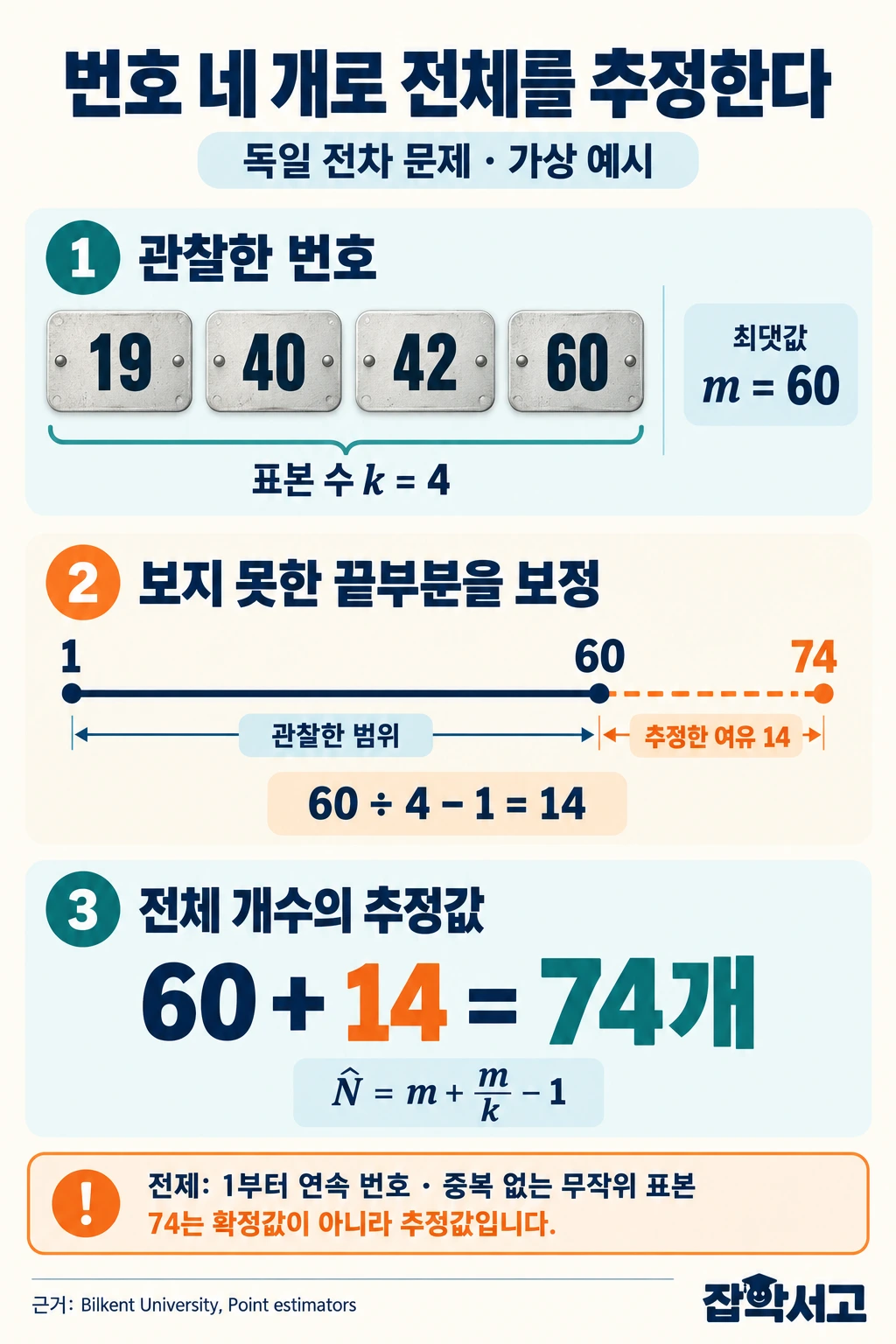
How can you know the total from just a few numbers? The principle is simpler than you might think. Suppose four tanks have been captured, numbered 19, 40, 42 and 60.
(1) The largest number is the starting point
There are at least 60 tanks in total. But since it is rare to see only a few at random and happen to catch the very last number, using the largest number as the answer tends to underestimate the true figure.
(2) Add the average gap
If the four numbers are spread evenly between 1 and 60, the gaps between the observed numbers average about 14. So it is natural to assume there is one more gap of about that size after 60.
(3) A simple formula
Written as a formula, this becomes ‘estimate = largest number + largest number ÷ number captured – 1’. Plugging in the example above gives 60 + 60 ÷ 4 – 1 = 74 tanks. This method is known to be, among methods that do not lean to one side of the true value on average, the one with the smallest margin of error.
Numbers More Accurate Than Intelligence

After the war, when the production records of the German armaments ministry fell into Allied hands, it became possible to check how accurate the statistical estimates had been.
Intelligence Inflated the Figures More Than Fivefold
For Germany’s average monthly tank production from June 1940 to September 1942, conventional intelligence put the figure at about 1,400. The estimate calculated from serial numbers, by contrast, was 246 a month, and the actual records confirmed after the war showed 245. Statistics corrected the numbers that fear had inflated.
Production Pinned Down by Two Tanks’ Wheels
Analysis of the numbers on 64 wheels taken from two Panther tanks put production in February 1944 at 270. That was far more than had previously been assumed, and the actual production recorded in German records was 276.
Uses Today and Ways to Hide

Serial number analysis did not stop at tanks. During the war it also achieved great success in estimating V-2 rocket production, and it was used to gauge the number of factories, parts supply chains and the consumption of resources such as rubber.
(1) Uses beyond the military
The same formula was used to estimate sales of the Commodore 64, a home computer released in the 1980s, and the result of about 12.5 million units matched the low end of industry estimates. The same principle is still used today to gauge scale from product numbers or membership numbers.
(2) Countermeasures that hide the numbers
Conversely, if you want to conceal the scale of production, you simply do not number items in order. If numbers are chosen at random from a range far larger than actual production, seeing a few of them makes it hard to guess the overall scale.
(3) The smaller the sample, the more caution
If you have seen only one or two numbers, the margin of error of the estimate is very wide. Because the range narrows quickly as more numbers are observed, an estimate made from little data should always be interpreted with some leeway.
The German tank problem shows that even numbers that look trivial on the surface can hold information for gauging the whole. Calmly weighing the small evidence in hand came closer to the truth than vague fears or rumours.
Reading the size of the whole from a small sample is the first step in statistics for measuring an uncertain world with numbers.