Analysis of variance (ANOVA, Analysis of Variance) is one of the essential analytical techniques in statistics and is widely used across many fields. By testing differences in the means of multiple groups, this technique plays an important role in determining whether there are significant differences in the data.
This material will explain the basic concepts of analysis of variance and examine its historical development. It will also discuss how analysis of variance is applied in statistical analysis and the specific benefits this technique offers across various industries. Finally, it will consider the changes that data analysis using analysis of variance may bring about in the future.
Basic Concepts and Background of Analysis of Variance

The Concept and Role of Analysis of Variance
Analysis of variance (ANOVA) is a statistical method that compares differences in the means of multiple groups to evaluate how the data vary across groups. This technique analyzes the variance of data collected across two or more groups and is used to determine whether the differences between the groups are significant. Variance represents how widely the data are spread, and comparing between-group variance with within-group variance helps analyze the causes of the differences.
The History and Development of Analysis of Variance
Analysis of variance was developed in the early 20th century by the British statistician Ronald A. Fisher. In the 1920s, Fisher demonstrated that analysis of variance could be used in various experimental designs to draw meaningful conclusions from complex data. It was initially applied mainly to agricultural experiments, but later expanded into fields such as biology, medicine, and the social sciences. Fisher's research made an important contribution to laying the foundations of modern statistics.
One-Way ANOVA and Two-Way ANOVA
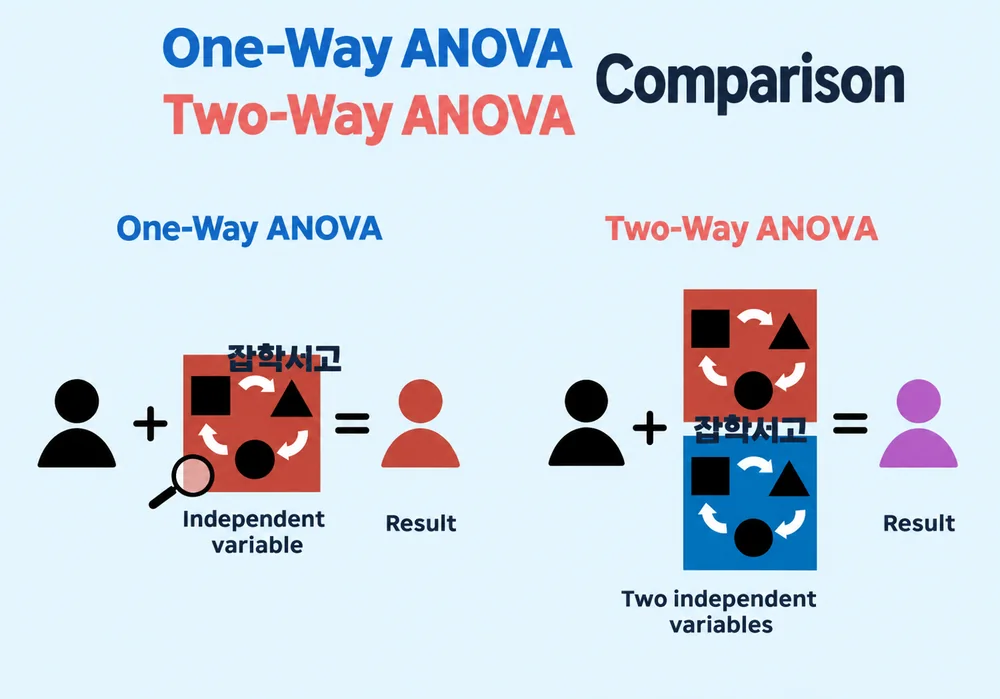
Analysis of variance is primarily divided into one-way analysis of variance (One-Way ANOVA) and two-way analysis of variance (Two-Way ANOVA). One-way ANOVA is used to compare differences between groups when there is one independent variable, while two-way ANOVA analyzes the effects of two independent variables on a response variable. These two techniques can be adapted and applied as appropriate to the research situation.
Addressing the Multiple Comparison Problem and the Efficiency of Analysis of Variance
Analysis of variance is very useful for addressing the multiple comparison problem. It is used to minimize errors that may arise when simultaneously testing hypotheses across multiple groups. This technique increases the reliability of research and reduces the possibility of errors, allowing experimental results to be evaluated more accurately.
Understanding Data Through Visualization
Analysis of variance also plays an important role in data visualization. Relationships in the data can be represented visually through box plots (Box Plot), interaction plots, and other tools. This visual analysis makes the data easier to understand intuitively and helps identify important patterns in complex datasets.
Using Analysis of Variance Across Various Industries
Today, analysis of variance is widely used as an important tool in various areas of research and industry. In particular, it has become a central technique for statistical testing in modern society, where large-scale data analysis is required. It is essential for understanding data in depth and using them effectively, and provides researchers and data analysts with a powerful analytical tool.
Analysis of variance is a very important technique in statistics, playing a key role in comparing differences between multiple groups and identifying significant patterns in data. It helps improve the accuracy of research and maximize efficiency across various industries, and will continue to serve as a core tool supporting data-driven decision-making.
How to Calculate and Apply Analysis of Variance
An Overview of Analysis of Variance Calculations
Calculating analysis of variance is a process of quantitatively evaluating differences between groups. First, analysis of variance requires calculating the mean of each group and comparing it with the overall mean. An important part of the calculation process is obtaining two types of variance. One is between-group variance (SSB, Sum of Squares Between Groups), and the other is within-group variance (SSW, Sum of Squares Within Groups). Comparing these two variances allows us to evaluate whether the differences between groups are due to chance or are actually meaningful.
Between-Group Variance and Within-Group Variance
First, to calculate between-group variance, the mean of each group must be compared with the overall mean, the difference squared, and the result multiplied by the number of observations in that group before the results are summed. This helps determine the overall variance through differences in the group means. In contrast, calculating within-group variance involves determining how much individual data points within each group differ from the group mean. This allows us to evaluate how widely the data are scattered within the same group.
Calculating the F-Value and Assessing Significance
Next, these two variances are used to calculate the F-value. The F-value is obtained by dividing between-group variance by within-group variance, and the larger it is, the more likely it is that the differences between groups are large. In other words, a larger F-value means a higher probability that the differences between groups are significant. The F-value is compared with a specific threshold, the critical value, to determine whether there is a significant difference. If the F-value is greater than the critical value, we can conclude that the differences between groups are significant.
Considerations When Applying Analysis of Variance
When applying analysis of variance, it is first necessary to collect data and divide them into appropriate groups. More accurate results can be obtained when the sample sizes of the groups are similar. It is also important to check whether the data follow a normal distribution and whether the variances of the groups are equal. If these conditions are not met, the results of analysis of variance may be distorted.
Practical Applications of Analysis of Variance
Analysis of variance is applied in practice across various fields. For example, when comparing the effectiveness of multiple advertising campaigns in marketing, analysis of variance can be used to evaluate differences in purchase rates between groups of consumers exposed to each campaign. In manufacturing, it is also used to analyze quality differences between processes when comparing the quality of products produced through different processes. Analysis of variance has also become an important statistical technique in various other fields, including psychology, biology, and medicine.
Examples of Analysis of Variance Applications in Statistics

Uses and Applications of Analysis of Variance
Analysis of variance is an important tool in statistics for testing various research hypotheses. It is particularly useful in experimental design, allowing data to be compared under different conditions to identify which factors affect experimental results. For example, when evaluating the effects of a drug in a clinical experiment, analysis of variance is used to analyze how different doses of the drug affect patients' health. This makes it possible to identify differences in the data more clearly and draw meaningful conclusions.
Analysis of Variance in Quality Control
Analysis of variance is also used very frequently in quality control. When analyzing how different processes affect the final quality of a product during production, analysis of variance can be used to evaluate differences between those processes. For example, two-way ANOVA is used to identify the combined effects of different manufacturing processes or raw material suppliers on product quality. This enables the selection of optimal processes and suppliers and helps improve product quality.
Analysis of Variance in Education
In education, analysis of variance is used to evaluate students' academic achievement and analyze the effectiveness of teaching methods. For example, this technique is useful when comparing how different teaching methods affect students' test scores. Analysis of variance allows the effects of each teaching method to be evaluated quantitatively, providing important insights for improving the quality of education and identifying directions for improvement.
Analysis of Variance in the Social Sciences
Analysis of variance is also widely used in social science research. In studies comparing the behavior of different population groups, analysis of variance can be used to analyze differences in the effects of specific factors across groups. For example, consumer behavior research uses this technique to analyze how various marketing campaigns affect consumers' purchasing decisions. This enables companies to compare the effectiveness of each marketing strategy and develop more effective campaign strategies.
Analysis of Variance in Psychological Research
Analysis of variance also plays an important role in psychological research. For example, when analyzing how different psychotherapy methods affect patients' anxiety levels, differences between the therapies can be evaluated to identify which method is most effective. This makes it possible to understand the effects of psychotherapy more clearly and improve treatment approaches.
Analysis of Variance in Medical Research
In medical research, analysis of variance is frequently used to compare the effectiveness of different treatments. For example, it can be used to evaluate how various treatments affect patients and analyze which treatment is most effective. Such analysis plays an important role in developing treatment approaches tailored to individual patients and improving the quality of healthcare services.
Analysis of variance is an essential statistical technique for clearly analyzing differences in experimental results and data across various fields and drawing meaningful conclusions based on those differences. It helps researchers understand patterns in the data and make better decisions in their respective fields.
Analyzing the Benefits of Applying Analysis of Variance Across Various Industries

Using Analysis of Variance in Manufacturing
Analysis of variance is used as an important tool for maximizing production efficiency in manufacturing. It is used to analyze the main factors affecting product quality at each stage of a process and, based on that analysis, identify areas for improvement. This process can increase the precision of quality control and help reduce defect rates and production costs. Analysis of variance is particularly essential in precision industries such as electronics and automotive manufacturing, where meticulous quality control is required.
Analysis of Variance in Finance
In finance, analysis of variance can be used to evaluate the effectiveness of various investment strategies. By analyzing how different investment portfolios affect returns, it becomes possible to identify which strategy is most effective. This enables investors to make more rational and reliable decisions and plays a major role in strengthening competitiveness in financial markets. Analysis of variance is also used as an important analytical tool in areas such as risk management and asset allocation.
Using Analysis of Variance in Agriculture
Analysis of variance is also very useful in agriculture. This is because analyzing the various factors that affect crop yields makes it possible to identify optimal growing conditions. This can help increase productivity and improve crop quality. For example, analyzing how different fertilizers affect soil and plant growth makes it possible to identify which fertilizer is most effective. In agriculture, analysis of variance is an essential tool for improving the efficiency of agricultural production by optimizing crop management.
Analysis of Variance in Drug Development
Analysis of variance also plays an important role in drug development. When developing a new drug, this analysis is used to evaluate how different administration methods and doses affect patients' responses. In clinical trials, analysis of variance allows the efficacy and side effects of a drug to be evaluated precisely, helping increase the likelihood of a new drug's success and minimize side effects. Analysis of variance has become an essential tool in the pharmaceutical industry, where data-driven decision-making is important.
Using Analysis of Variance in Marketing
In marketing, analysis of variance is used to understand consumer behavior and develop effective marketing strategies. By analyzing how various advertising campaigns affect consumers' purchasing decisions, it becomes possible to identify which campaign is most effective. This enables companies to allocate marketing resources efficiently and develop strategies that can generate the greatest revenue. The results obtained through analysis of variance make more systematic and sophisticated marketing strategies possible.
Analysis of Variance in the Automotive Industry
In the automotive industry, analysis of variance also plays an important role in improving quality and reliability. By analyzing how different designs and components affect vehicle safety and performance, optimal design conditions can be identified. This can enhance product safety and increase consumer satisfaction, ultimately helping strengthen competitiveness in the market. Analysis of variance can provide scientific and reliable data on the design and performance of automotive components.
Future Prospects for Data Interpretation Through Analysis of Variance

The Continued Development and Scalability of Analysis of Variance
Analysis of variance continues to develop as an essential technique in modern statistics. In an era when the complexity and volume of data are steadily increasing, analysis of variance plays a central role in data interpretation. In particular, it is essential for clearly analyzing differences between multiple groups and identifying significant patterns within data. It has thus become an important tool that can support data-driven decision-making across various fields.
Combining Big Data and Analysis of Variance
In a big data environment, effectively processing and analyzing vast amounts of data is essential. Analysis of variance is a very useful tool for analyzing interactions between variables and identifying important differences within large datasets. This offers major benefits to companies in making data-driven decisions and can be applied in various areas, including market analysis, product development, and predicting customer behavior. These characteristics of analysis of variance are becoming increasingly important in handling big data.
Analysis of Variance in Artificial Intelligence and Machine Learning
As artificial intelligence (AI) and machine learning (ML) advance, the role of analysis of variance is gradually expanding. Analysis of variance can be combined with machine learning algorithms to automatically detect data patterns and help improve the accuracy of predictive models. As the analysis process becomes automated and optimized, this is opening the way to explore more complex relationships in data. This suggests that analysis of variance has the potential to develop beyond conventional statistical techniques into an important technology that drives the automation and optimization of data analysis.
Advances in Analytical Tools and Improved Accessibility
Analysis of variance is expected to become even more accessible in the future. As various software applications and analytical tools advance, an environment is emerging in which even non-specialists can easily use analysis of variance. This allows various organizations, including companies, governments, and educational institutions, to receive decision-making support through analysis of variance even without specialized knowledge of data analysis. These advances in analytical tools will spread a culture of data analysis and greatly strengthen analytical capabilities across various industries.
Contributions to Society and Applications in Policy
Analysis of variance can have a positive impact on society as a whole as well as on companies. For example, analysis of variance enables a data-driven approach to evaluating the effectiveness of public policies or solving complex social problems. This can help address social problems more transparently and efficiently, improve policy efficiency, and enhance the quality of public services. Data-driven social change will ultimately contribute to social development and the public good.
Analysis of Variance Leading the Future of Data Interpretation
In conclusion, analysis of variance is an important technique leading the future of data interpretation and use. It will play an essential role in deepening analysis across various fields and generating new insights. The continued development of analysis of variance will encourage innovation through data and support better decision-making across companies and society as a whole.
Analysis of variance has become an indispensable tool for identifying significant differences in data and drawing important conclusions across many fields. It can increase the reliability of statistical testing and greatly improve the efficiency of decision-making processes across various industries.
Analysis of variance is expected to develop further and lead innovation in data interpretation and analysis. Through this development, it will establish itself as a core technique supporting data-driven decision-making across various fields.