Have you ever plucked two guitar strings tuned to the same note and heard the sound swell and fade, “wow—wow—”? As you turn the tuning peg little by little to bring the notes together, this wobble slows down, and it disappears the moment the two notes become exactly the same. This periodic change in loudness that appears when two sounds of slightly different frequencies overlap is called a ‘beat’.
Simply put, a beat means ‘the wobble in sound created when two slightly different rhythms drift in and out of step’. It is a kind of interference in which two waves alternately reinforce and cancel each other, and it is a physical principle used in more places than you might expect, from tuning musical instruments to aircraft propellers and radio receivers.
In this article, we will look in turn at how beats arise, how to calculate the number of beats, beats in instrument tuning, and finally their uses in technology and phenomena that are easily confused with them.
The Breath of Sound Made by Two Waves Drifting Apart
1. How Do Beats Arise?
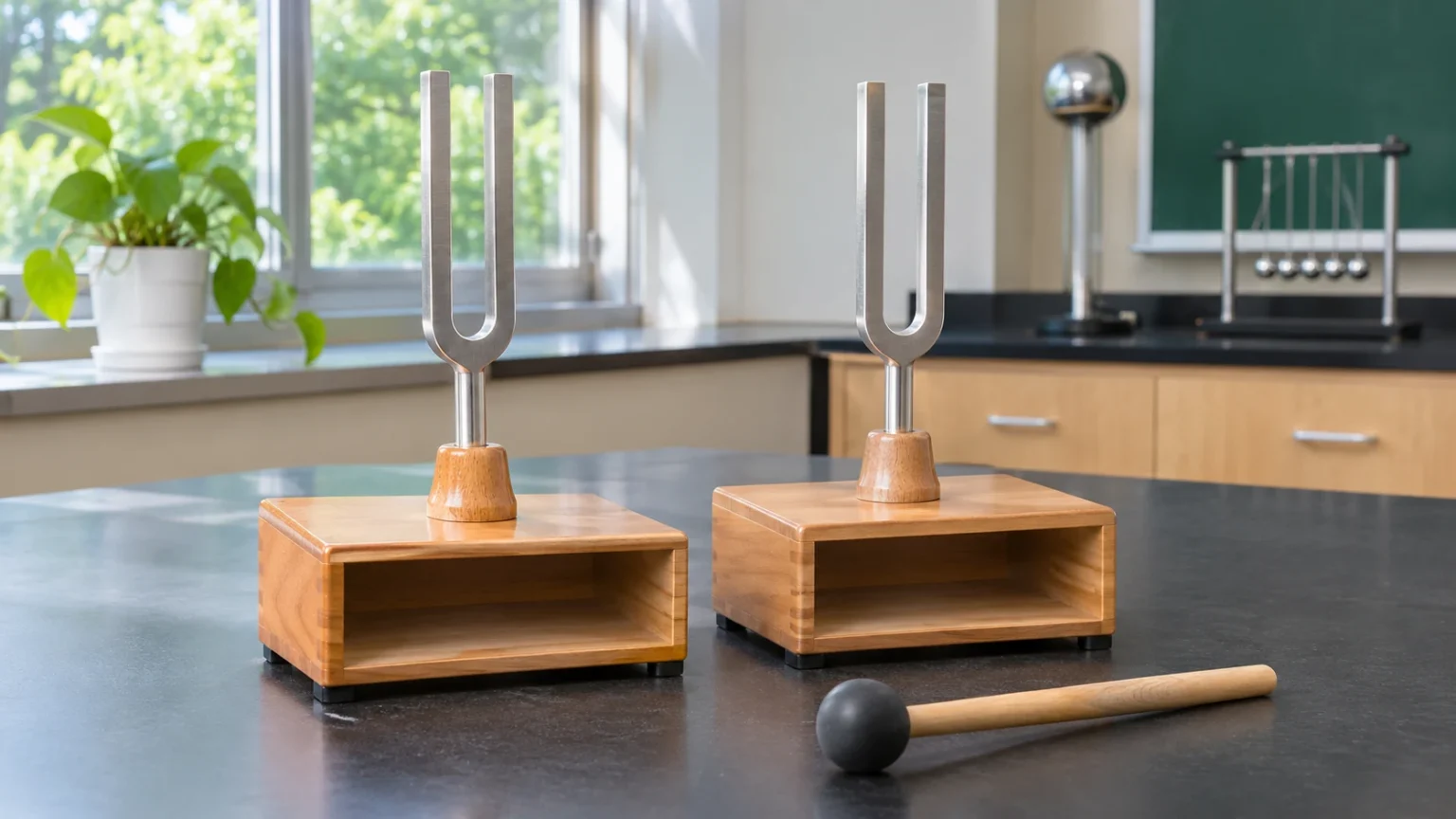
To understand beats, we have to start from the fact that sound is a wave that spreads as air pressure rises and falls. When two sounds ring at the same time, the two waves simply add together in the air, which is called the superposition of waves (Superposition).
(1) When they are in step and when they drift apart
When crest meets crest, the amplitude grows and the sound gets louder, which is constructive interference; when crest meets trough, they cancel each other out and the sound gets softer, which is destructive interference. If the frequencies differ slightly, the two waves start in step, gradually drift apart, and then come back into step, over and over again.
(2) The outline of a sound that swells and fades
As a result, the amplitude of the combined sound is not constant but swells and narrows like a slow ripple. The outline of this slow change in loudness is called the envelope (Envelope), and the “wow—wow—” wobble we hear is exactly this envelope.
(3) The pitch you hear is the average of the two notes
When beats are heard, the pitch that reaches the ear is close to the average of the two frequencies. For example, if 440Hz and 442Hz sound together, you hear a tone of about 441Hz that grows louder and softer twice every second.
2. How Do You Calculate the Number of Beats?

The speed of beats can be found with a very simple formula. The number of times per second the sound swells and fades, that is, the beat frequency, is equal to the difference between the frequencies of the two sounds.
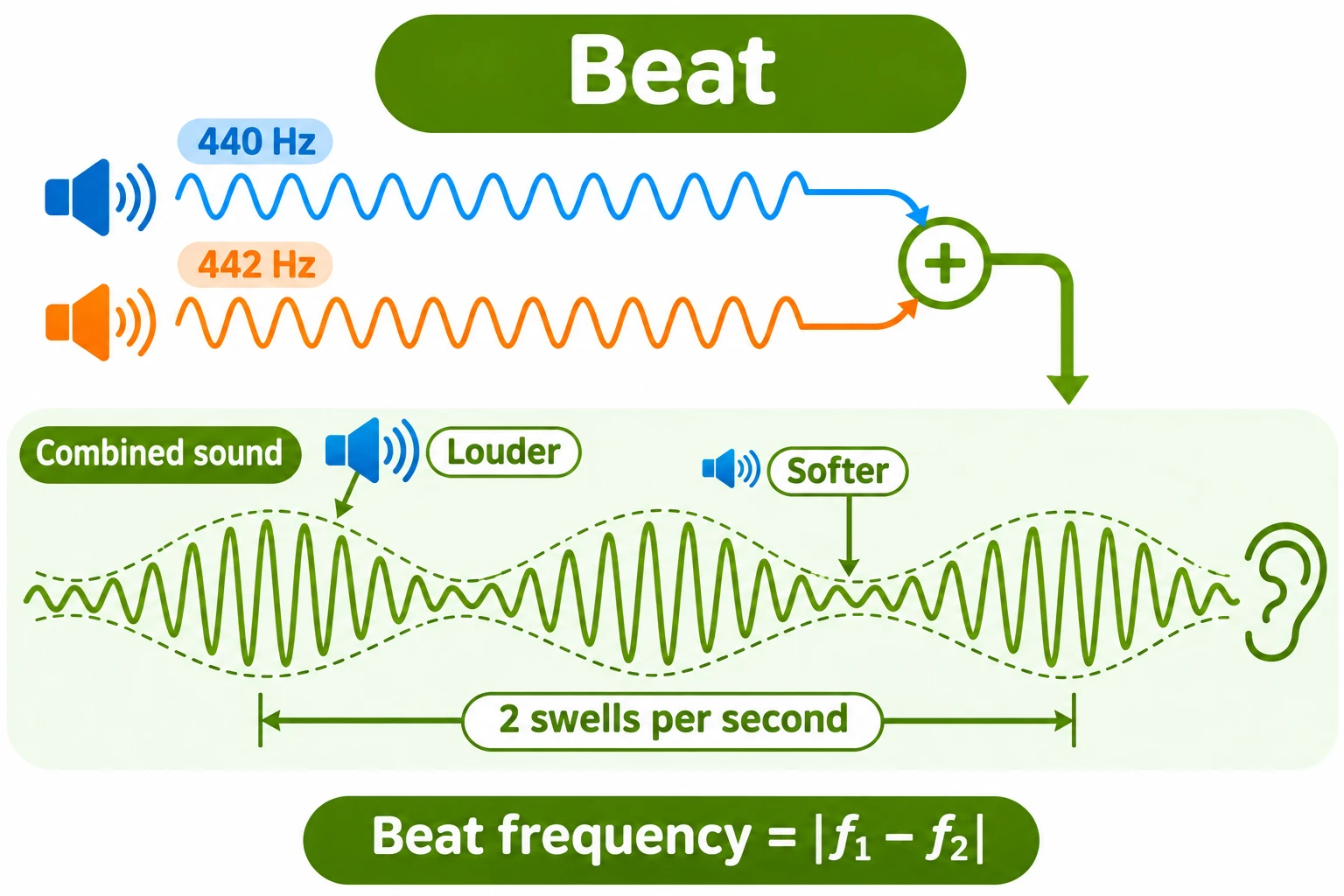
- Frequency: the number of times a wave repeats in one second, measured in hertz (Hz).
- Superposition: the property by which, when several waves meet at one place, their displacements simply add together.
- Envelope: the slow outline that connects the peaks of a rapidly vibrating wave.
- Beat Frequency: the number of beats per second, found as |f₁ − f₂|.
(1) The smaller the difference, the slower the beats
Sounding 500Hz and 496Hz together gives four wobbles per second, while 500Hz and 499Hz give one per second. When the two frequencies become equal, the beat frequency drops to 0 and the wobble disappears completely.
(2) It does not tell you which note is higher
The number of beats tells you only the size of the difference, not which note is higher. That is why, when tuning, you tighten the string slightly and listen to whether the beats slow down or speed up to judge which way to turn.
(3) There is a range that is easy to count by ear
Beats are heard as a distinct wobble when the two notes differ by roughly 15Hz or less. When the difference grows larger, the wobble becomes so fast that it sounds rough, and eventually the sound is heard as two separate notes.
3. Beats in Instrument Tuning
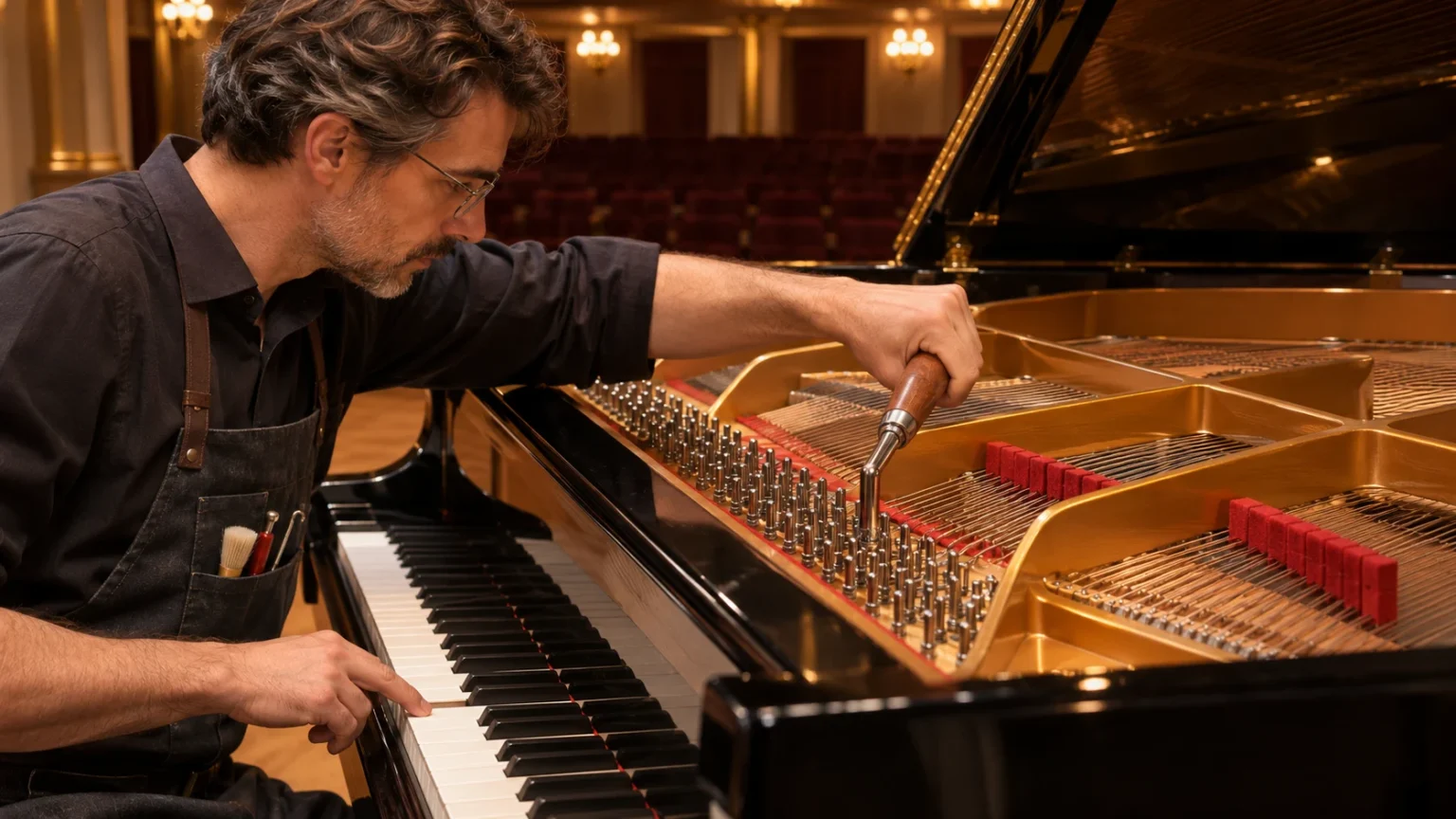
The place where beats have been used the longest and most widely is instrument tuning. Even before electronic tuners existed, players and tuners could match notes precisely by ear alone, and the secret was listening to beats.
(1) Unison tuning that removes beats
A piano has two or three strings for each key, so the strings that sound the same note are adjusted until the beats between them disappear. A guitarist playing the same note on two neighboring strings and finding the point where the wobble stops is using the same method.
(2) Interval tuning by counting beats
When piano tuners set intervals such as fifths or fourths, they deliberately leave beats at a set speed. In equal temperament, which divides an octave evenly into 12 semitones, these intervals differ slightly from pure intervals, so tuners set the spacing by counting how many times per second the sound wobbles.
(3) A wobble made on purpose
The céleste (Céleste) stop of a pipe organ sounds pipes tuned slightly apart together to create beats intentionally. This gives the sound a warm quality, as if it were gently shimmering.
4. Beats in Technology and Easily Confused Phenomena

Beats are used outside the music room as well. Throughout technology there are tasks that either make use of the slow change that arises when two vibrations are slightly out of step or, on the contrary, must eliminate it.
(1) Propeller synchronization
In aircraft with several propellers, even a small difference in rotational speed creates a droning beat noise in the cabin. That is why they are fitted with propeller synchronization (Propeller Synchronization) systems that automatically match rotational speeds and reduce passenger discomfort.
(2) Radio and zero beat
The heterodyne (Heterodyne) method used in radio receivers mixes two frequencies to obtain their difference frequency, which shares the same roots as beats. Amateur radio operators listen for the ‘zero beat’, where the beats drop to 0, to tune precisely to the frequency of the other station’s signal.
(3) Binaural beats created by the two ears
In 1839, the German physicist Heinrich Wilhelm Dove discovered that a wobble can be felt even when slightly different tones are played separately to each ear. These binaural beats (Binaural Beats) are not interference in the air but an auditory phenomenon produced by the brain, and claims that they change brain waves remain uncertain because research results are mixed.
In the end, beats are a phenomenon that lets us hear, as sound, that two vibrations which are not exactly the same keep falling into and out of step. The simple idea that a slowing wobble means the notes are getting closer and a stopped wobble means they are the same, that is the first step to understanding beats.