In modern society, educating children is one of parents' greatest concerns. Although school education plays an important role, education at home is essential for children's holistic growth and development.
The home is the first place where children interact with society, and the values and attitudes they learn there influence them throughout their lives.
This article will explore the importance and necessity of education at home, effective methods for educating children at home, communication between parents and children, and ways to connect education at home with school education.
The aim is to provide specific guidance on the roles parents should play in educating their children successfully and how they can put these roles into practice.
The Importance of Education at Home: Why Is It Necessary?
 The Importance of Education at Home: Why Is It Necessary?
The home is the first educational setting children encounter, and the importance of education there is evident in several ways. This is because children learn at home the fundamental values of life and social norms that cannot be learned at school.
1. Developing Basic Values
The home is where children first learn social values and moral standards. Parents should teach children basic values such as honesty, responsibility, and respect. These values greatly influence children's character and behavior and remain with them throughout their lives.
2. Stable Emotional Development
The home is where children feel emotionally secure. Parents' love and support boost children's self-esteem and confidence and help them grow in an emotionally healthy way. A stable home environment plays an important role in helping children overcome stress and anxiety and develop a positive attitude toward life.
3. Learning Social Skills
The home is where children can first practice and learn social skills. Through interactions with parents and siblings, children learn social skills such as communication, cooperation, and conflict resolution. These skills also play an important role at school and in social life.
4. Developing Learning Attitudes and Habits
The home plays an important role in helping children develop positive attitudes and habits toward learning. Parents can teach children about the enjoyment and importance of learning and help them develop consistent study habits. This has a positive influence on both school grades and lifelong learning.
5. Establishing Personal Identity
The home is an important place for children to discover and establish their identity. Parents should help children understand their strengths and weaknesses and support the process of building their own identity on this basis. This helps children accept themselves positively and develop a healthy self-image.
In these ways, education at home plays an important role in children's overall growth and development. As parents, we should recognize the importance of education at home and work to instill sound values in children.
Effective Methods for Educating Children at Home
 Parents should be role models for their children.
Effective methods for educating children at home are specific strategies and actions parents can put into practice to help children learn various abilities and values at home. These support children's holistic growth and help them develop positive learning and lifestyle habits through the home environment.
1. Consistent Rules and Daily Routines
Parents should maintain consistent rules and routines so that children feel secure and learn responsibility. Consistent routines provide a predictable environment that gives children a sense of security, while rules are important for teaching responsibility and discipline.
2. Setting an Example Through Behavior
Parents should demonstrate behavior that sets an example for children. Because parents' behavior greatly influences children, it is important for them to put values such as honesty, responsibility, and respect into practice themselves. Children naturally learn these values through their parents' behavior.
3. Active Listening and Conversation
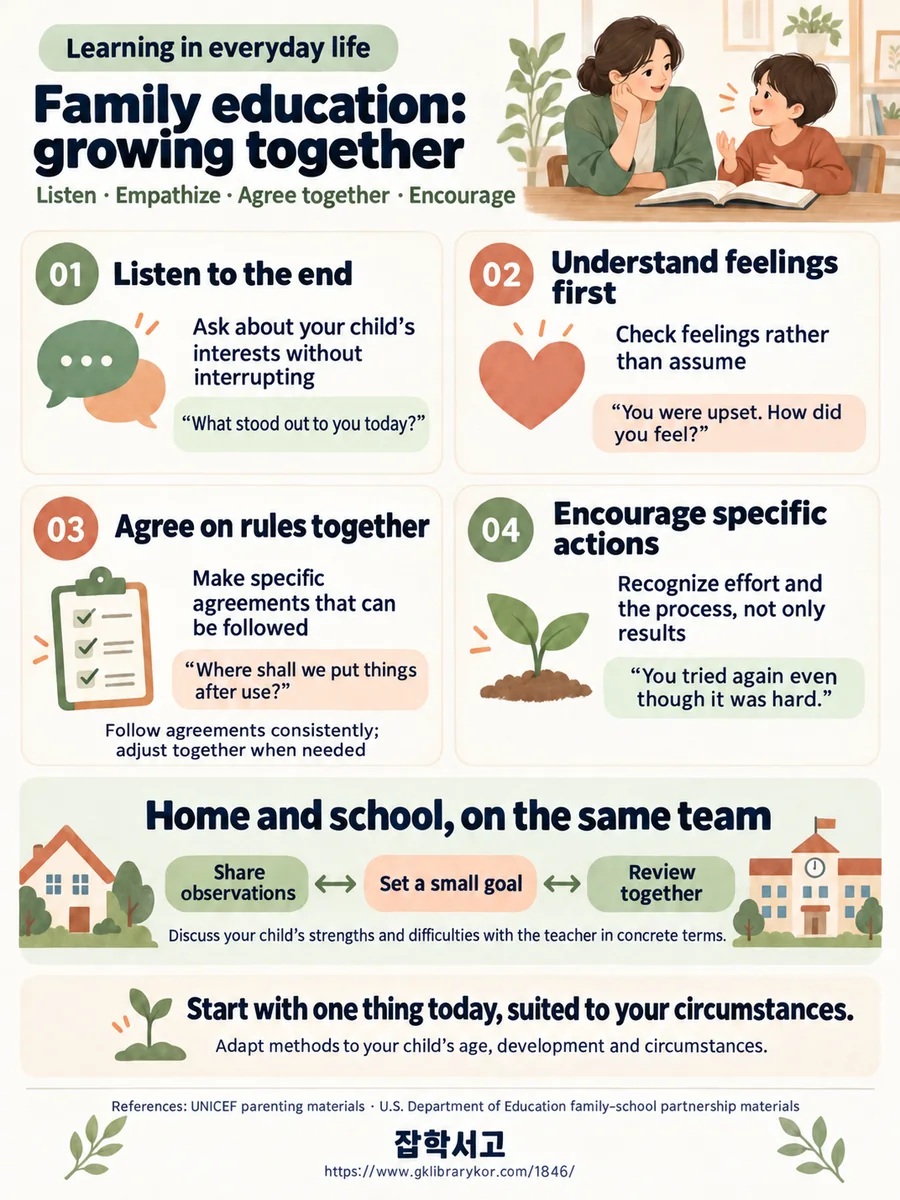
Parents should listen attentively to children and communicate with them through open conversation. This helps children express their thoughts and feelings and build trust with their parents. Active listening is important for boosting children's self-esteem and strengthening emotional bonds.
4. Positive Reinforcement and Praise
It is important to praise children immediately for things they do well and motivate them through positive reinforcement. Praise builds children's confidence and encourages better behavior. However, praise should be specific and sincere, and care should be taken to avoid excessive praise.
5. Reading and Learning Activities
Parents should read books with children and take part in various learning activities together. This helps children become interested in learning and build knowledge. Through reading and learning activities, parents and children can grow together.
6. Giving Appropriate Responsibilities
Giving children appropriate responsibilities can develop their independence and sense of responsibility. Having them participate in household chores or small family tasks helps them feel responsible and recognize their role.
7. Teaching Emotional Management and Ways to Cope with Stress
Parents should teach children how to express and manage their emotions, how to cope with stress, and other related skills. This plays an important role in helping children respond positively even in difficult situations and grow in a mentally healthy way.
These effective methods for educating children at home are easy for parents to put into practice in everyday life and greatly help support children's overall growth and development.
Methods for Smooth Communication Between Parents and Children
 How Can the Parent-Child Relationship Be Strengthened?
Smooth communication between parents and children is one of the core elements of education at home, building mutual understanding and trust and promoting children's emotional stability. Smooth communication allows children to express their feelings and thoughts freely and strengthens their relationship with their parents.
1. Listening Skills
Parents should listen sincerely to their children and demonstrate active listening through actions such as avoiding interruptions and making eye contact. When listening to what their children have to say, it is important to express interest and understanding and show empathy. This helps children feel respected and allows them to communicate more honestly.
2. Using Open-Ended Questions
Parents should use open-ended questions in conversations with their children to help them think and express themselves more deeply. For example, a question such as "What was the most fun thing that happened at school today?" can elicit a richer response than "What did you do at school today?"
3. Providing Positive Feedback
Giving positive feedback about children's behavior or words is very important. This helps children feel confident about their behavior and encourages them to repeat positive behaviors. Feedback should be specific and communicated sincerely.
4. Constructive Criticism Instead of Blame
When children behave inappropriately, parents should help them learn through constructive criticism rather than blame. For example, it is better to offer a specific alternative, such as "I think doing it this way would be better in this situation. Let's try this next time," rather than "Why are you always like this?"
5. Expressing and Sharing Emotions
Parents should express their own emotions honestly and encourage their children to express theirs. Expressing emotions instead of hiding them helps children grow in an emotionally healthy way. Sharing emotions also allows them to understand each other more deeply.
6. Making Time for Conversation in Daily Life
It is important to make time to talk with children even amid busy daily lives. Parents should create opportunities for natural conversation during family meals, before bedtime, and through weekend activities. This time can strengthen their bond with their children.
7. The Importance of Nonverbal Communication
Along with words, nonverbal communication such as body movements, facial expressions, and gestures is also important. Nonverbal expressions such as parents' warm smiles, encouraging gestures, and hugs greatly influence children. Nonverbal communication helps children feel their parents' sincerity and build greater trust.
These methods can help make communication between parents and children smoother. Smooth communication greatly supports children's emotional stability and healthy growth and creates deep bonds between parents and children.
Connecting Education at Home with School Education
 Connecting education at home with school education can create synergy.
Connecting education at home with school education is essential for children's holistic growth and development. More effective educational outcomes can be achieved by providing children with consistent guidance as the two educational settings cooperate with and complement each other.
1. Consistent Values and Expectations
It is important for the home and school to convey consistent values and expectations to children. When the values taught at home match those emphasized at school, children can follow consistent behavioral guidelines without confusion. For example, when both the home and school emphasize honesty and responsibility, children recognize them as important values.
2. Regular Communication
Regular communication between parents and teachers is important for supporting children's academic achievement and social development. Parent-teacher conferences, emails, and phone calls can be used to share information about children's academic progress and behavior and to respond promptly when problems arise.
3. Participating in Joint Educational Programs
It is important for parents to actively participate in parent involvement programs, workshops, and seminars offered by schools. These programs help parents become more deeply involved in their children's education and understand the school's educational policies and methods.
4. Creating a Learning Environment for Children
It is also important to create an environment at home that resembles the learning environment at school. For example, it is helpful to provide a quiet, tidy study space and set regular study times. This helps children concentrate on learning at home as well.
5. Setting Shared Goals
Parents and teachers need to set educational goals for children together and cooperate to achieve them. For example, they can set goals to improve children's achievement in a particular subject or improve specific behaviors and provide consistent support and guidance at home and at school to achieve these goals.
6. Cooperating to Solve Problems
When children experience academic or behavioral problems, it is important for the home and school to work together to solve them. For example, if children struggle with learning, parents can follow teachers' advice to provide additional learning support at home. When behavioral problems arise, the home and school can also solve them together through consistent discipline and guidance.
7. Extending Learning at Home
It is important to review and practice at home what children have learned at school. Parents can maximize the effectiveness of learning by helping with their children's homework and providing opportunities to apply what they have learned at school in daily life. For example, children can try out scientific concepts learned at school through experiments at home or experience the content of history lessons through family trips.
When education at home and school education are connected and work together in this way, children can grow in a more stable and consistent educational environment. Parents and teachers can support children's holistic development by actively participating in and cooperating on their education together.
Education at home plays an important role in shaping children's character, supporting academic achievement, and developing social competence. As parents, we have an important responsibility to instill sound values in children and help them develop a healthy sense of self.
The importance and methods of education at home presented in this article, along with communication between parents and children and connections between home and school, can help support children's successful growth.
Our small efforts will be the key to opening a bright future for children. We hope this will help you continue growing alongside your children and building a happy home.