Education is a powerful means of changing the world and plays a central role in the development of our society and the renewal of culture. One way to deliver this education more effectively and bring innovation to it is through educational technology.
Educational technology encompasses all efforts to combine the essential value of education with technology and deliver it in richer, more advanced ways.
This article will explore the origins of the concept of educational technology, its classifications and domains, and its future prospects.
What Is Educational Technology?
 How can we introduce technology into education and make the most of it?
Simply put, educational technology is an academic field born from the meeting of education and technology. Just as we use smartphones and computers in everyday life, it began with attempts to make learning more effective by using various technologies in education.
Examples include e-books, online lectures, and education using virtual reality. Educational technology studies how these technological tools can be used effectively in education and how technology can improve the effectiveness of learning.
In other words, it refers to the process of finding better educational methods through the meeting of education and technology.
Classifications of Educational Technology
 Three Perspectives on Educational Technology
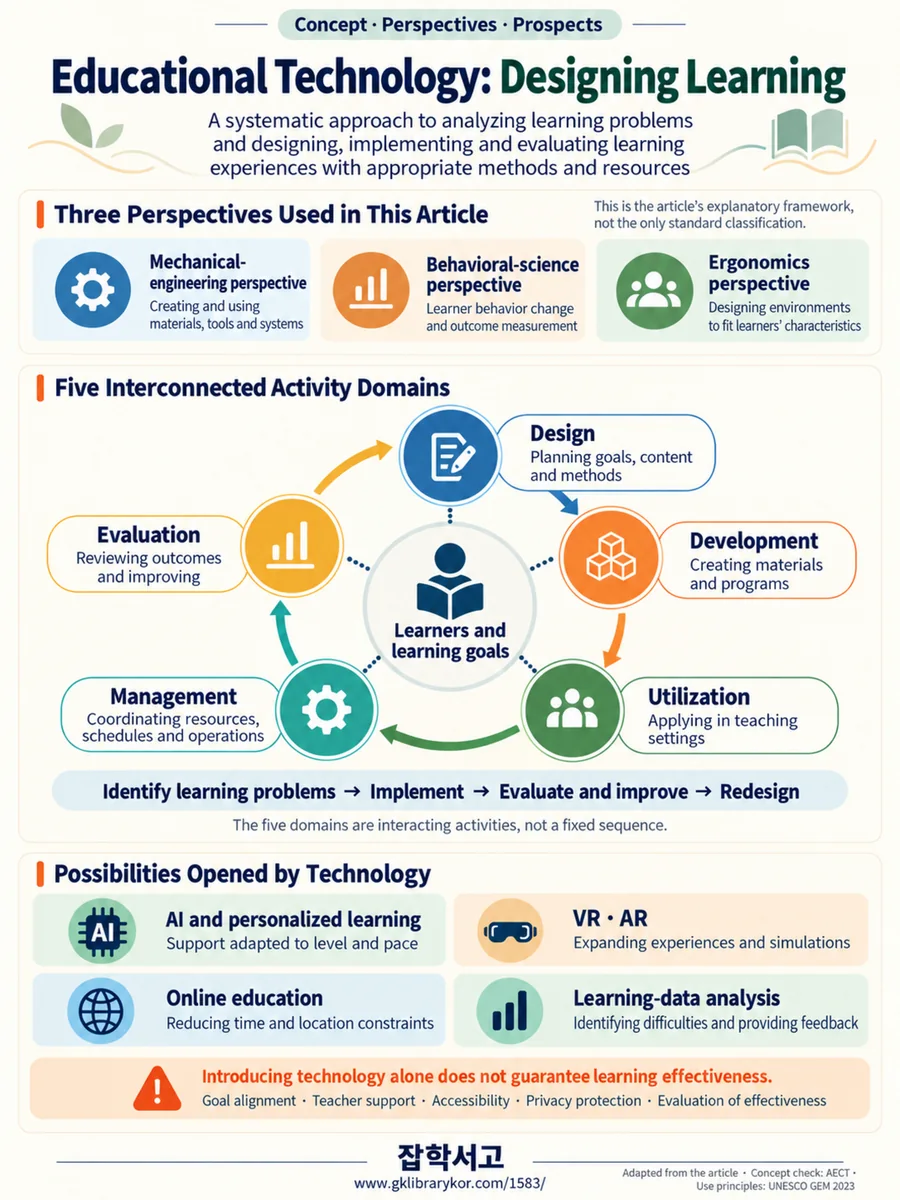
Educational technology is an academic field born from the meeting of education and technology, and it can be classified according to various methodologies and perspectives. This article will explain educational technology through three main classifications: mechanical engineering, behavioral science, and ergonomics.
Educational Technology from a Mechanical Engineering Perspective
Educational technology from a mechanical engineering perspective attempts to express educational content and methods in forms such as machines or devices. Here, a machine does not refer only to an actual machine, but also to a system that operates according to certain rules and principles.
This focuses on producing learning materials, designing educational programs, and developing learning systems. It also emphasizes making the learning process more efficient through technological tools and devices.
Educational Technology from a Behavioral Science Perspective
Educational technology from a behavioral science perspective centers on changes in learners' behavior during and as a result of education. Behavioral science refers to the academic field that studies human behavior, and this approach applies it to education.
This studies how to measure changes in learners' behavior and the educational methodologies or technologies that can maximize those changes. For example, it examines how particular educational technologies affect learners' behavior and how specific learning activities change that behavior.
Educational Technology from an Ergonomics Perspective
Educational technology from an ergonomics perspective is an approach that designs curricula and environments to fit learners' characteristics. Ergonomics refers to the academic field that designs products and environments with consideration for people's physical and cognitive characteristics.
This optimizes educational environments, tools, and content to suit learners' characteristics and needs. It also focuses on learner-centered educational design, providing individualized learning experiences, and developing educational methodologies that improve convenience and efficiency for learners.
Domains of Educational Technology
 Let Us Explore the Domains of Educational Technology
Educational technology is an academic field that combines education and technology, with applications and research taking place across many different domains. Here, we will examine its scope and activities through five main domains: design, development, utilization, management, and evaluation.
1. Design (Design)
The design domain is the stage of planning and structuring curricula, learning materials, and educational programs. It includes setting learning objectives, organizing learning content, and selecting educational methods, and determines the overall structure and direction of education.
2. Development (Development)
The development domain is the stage of actually producing and implementing what was planned during the design stage. Producing online lecture materials, developing educational software, and creating educational multimedia content belong to this domain. This is where educational materials and tools take concrete form.
3. Utilization (Utilization)
The utilization domain is the stage of using developed educational materials and programs in actual educational settings. It examines practical ways to use educational materials and strategies for applying educational technology. For example, it considers efficient ways to use online lectures and strategies for using educational apps.
4. Management (Management)
The management domain is the stage of effectively operating and managing curricula, materials, and technologies. It includes operational plans for educational programs, methods for storing and distributing educational materials, and updates and maintenance for educational technologies.
5. Evaluation (Evaluation)
Finally, the evaluation domain is the stage of measuring and analyzing the effectiveness and outcomes of educational programs and technologies. It includes measuring learners' achievement, evaluating the effectiveness of educational programs, and surveying satisfaction with educational technologies. Evaluation establishes the effectiveness and efficiency of education and identifies areas that need improvement.
These five domains represent the main scope of activities in educational technology. They are interconnected and collectively contribute to improving the quality of education.
Prospects for Educational Technology
 How Will Educational Technology Develop?
Educational technology, as an academic field that integrates education and technology, is expected to have a major influence on changes in future educational environments.
The development of this field is closely connected to rapidly changing technological trends and is expected to bring innovation to the quality and methods of education in various ways.
Digitalization and the Personalization of Education
Advances in digital technology will promote the personalization of education. For example, AI-based learning management systems will be able to provide customized learning experiences according to learners' tendencies and needs. This is expected to create an environment in which each student can learn at their own pace and in their own way, improving overall learning efficiency.
Expanded Use of Virtual Reality and Augmented Reality
VR and AR technologies will also see increasing use in education. For example, just as students in a history class might wear VR equipment to experience historical settings from the past firsthand, these technologies will provide educational experiences that resemble reality and enhance students' understanding and interest.
Continued Expansion of Online Education
During the spread of the coronavirus in the past, the importance of online education quickly came to the fore, and even afterward, the need for and usefulness of distance education have continued to be recognized as society and technology change.
This trend has also become a central part of the prospects for educational technology. For example, various online education platforms and content continue to be developed and disseminated so that students can receive high-quality education regardless of time or location.
Data-Based Educational Analysis
Advances in big data technology will also have a major impact on education. For example, it will become possible to develop more effective educational strategies by analyzing data such as students' learning patterns, achievement, and feedback.
These prospects show the kinds of innovation that educational technology can bring to future educational environments and methods. With the help of technology, education in the digital age is expected to take place in more diverse and effective ways.
Educational technology is an innovative field born at the intersection of education and technology, enriching learners' experiences and helping educators make the most of their capabilities.
Technological advances are continuing without interruption and are contributing to improvements in the quality of education.
Understanding the importance and value of educational technology, and continuing to follow and support its development, will be essential conditions for the advancement of education in our society.