Modern educational methodology is continually changing and undergoing innovation. From traditional educational methods to the introduction of digital technology, education has developed in a variety of ways.
This article aims to explore in depth the historical background and development of modern educational methodology, the introduction of digital technology and innovation in modern education, the importance of student-centered education, and various teaching methods and effective approaches to them.
The Historical Background and Stages of Development of Modern Educational Methodology

The Emergence and Early Development of Modern Educational Methodology
Modern educational methodology underwent rapid changes from the late 19th century to the early 20th century. This was a period when large-scale public education systems were introduced following the Industrial Revolution, and education began to occupy an important place in society. At the time, lecture-based instruction was the predominant educational method, centered on teachers taking the lead in conveying knowledge. Students served as passive learners whose role was to accept the content conveyed by teachers as presented. This approach was well suited to managing large numbers of students and conveying knowledge effectively, but students' active participation in their own learning was limited.
The Emergence of Student-Centered Education and Progressive Education
By the middle of the 20th century, the importance of student-centered education had come to the forefront. During this period, educational scholars moved away from conventional teacher-led education and emphasized learners' active participation. Progressive educators such as John Dewey argued that students should take a leading role in class and emphasized experience and participation in the learning process. These changes brought about a shift beyond simply transmitting knowledge toward educational methods designed to develop students' critical thinking and problem-solving abilities. This played a significant role in cultivating students' ability to gain firsthand experience, think independently, and solve problems during the learning process.
The Introduction of Cognitive Psychology and Personalized Learning
By the 1970s and 1980s, advances in cognitive psychology had brought significant changes to educational methodology. Educational methods that considered students' cognitive processes and learning styles were developed, laying the foundation for personalized learning in education. The theories of Jean Piaget and Lev Vygotsky emphasized that learners learn through their respective developmental stages and social interactions, prompting teachers to focus on providing education suited to each student's developmental stage. As a result, environments were created in which students could learn at their own pace, and the personalization of education became increasingly important.
The Introduction of Digital Technology and Changes in Education
With the arrival of the information society in the 1990s, digital technology began to be introduced into education on a broad scale. Advances in computers and the internet gave rise to online learning and Blended Learning, providing flexible learning environments free from constraints of time and place. These changes offered new opportunities for students to learn independently beyond conventional classroom-centered education. In particular, greatly improved access to information through the internet enabled learners to learn from diverse sources of information instead of relying solely on textbooks.
The Diversification of Modern Teaching Methods and the Integration of Technology
From the 2000s onward, various teaching methods were tried as education became more diversified. Among them, educational methods involving student participation, such as Flipped Learning, attracted attention. In this approach, students study the material before class and use class time for deeper learning or discussions based on that material, helping increase their motivation to learn and their participation. In addition, the introduction of educational assessment and feedback systems using big data and artificial intelligence (AI) greatly improved educational efficiency. These technologies immediately analyze learners' performance and provide appropriate feedback, enabling education to become more individualized and effective.
Continued Development and the Future of Education
Modern educational methodology has continually changed as it has developed over the past several centuries. Advances in technology have further improved the quality of education and created environments in which students can realize their full potential. The importance of digital technology and student-centered education will continue to be emphasized, and various teaching and assessment methods will develop accordingly. If these changes continue, education will move in a better direction, creating creative and innovative environments in which learners can take charge of their learning.
The Introduction of Digital Technology and Innovation in Modern Education

The Introduction of Digital Technology and Changes in Learning Environments
Advances in digital technology have brought fundamental changes to modern education. In particular, the widespread availability of computers and the internet has provided environments in which students can learn anytime and anywhere beyond the classroom, dramatically improving access to education. Learning environments no longer confined to physical classrooms allow students to take charge of their learning at their own pace through online learning platforms, driving the spread of personalized learning.
The Advantages of Online Learning and the Role of Learning Management Systems (LMS)
Online learning using digital technology gives students opportunities to learn at a pace and in a way that suits them. This allows students to advance through their learning according to their own progress, while digital tools such as learning management systems (LMS) monitor and analyze learners' achievement in real time. LMS allow teachers to understand students' learning status at a glance and help them adjust learning content. They have become important tools for maximizing educational efficiency and providing detailed support for each student's learning.
Expanding the Diversity of Educational Content
Advances in digital technology have greatly expanded the diversity of educational content. In the past, learning materials were primarily text-based, but learners are now offered materials in various formats, including videos, animations, and interactive quizzes. This diversity of content helps spark students' interest and provide more immersive learning experiences. Visual and experiential materials help students understand learning content more easily, thereby maximizing the effectiveness of learning.
The Expansion of Collaborative Learning and Education in the Global Era
Digital technology has also greatly increased opportunities for collaborative learning. Students can work on projects with other students around the world through online forums, chats, and video conferences. Such collaborative learning is highly effective in improving the collaboration and communication skills essential in the global era. International exchanges and collaboration that are difficult to experience in traditional classroom lessons can be achieved easily online, providing a foundation for students to develop into global talent.
The Use of AR and VR Technologies and Innovation in Learning
Advances in digital technology are adding a new dimension to learning through AR (augmented reality) and VR (virtual reality) technologies. These technologies make it possible to experience situations virtually that would be difficult to experience in real life, improving the quality and depth of learning. For example, students can explore ancient cities through virtual reality in history classes, while in science classes they can visualize molecular structures in 3D to understand the learning content more clearly. Such immersive learning makes students' learning experiences more vivid and provides opportunities to understand even complex concepts easily.
Changes in Teachers' Roles and Personalized Guidance
The introduction of digital technology has also brought major changes to teachers' roles. Whereas teachers previously focused mainly on conveying knowledge, their roles as learning facilitators, counselors, and mentors have now become more important. In learning environments that use digital tools, teachers can gain a more detailed understanding of students' learning processes and provide personalized guidance accordingly. This makes it possible to tailor guidance to each student's needs and characteristics, contributing to better learning outcomes.
Educational Innovation Driven by Digital Technology
The introduction of digital technology has transformed the forms education takes in innovative ways. Students can now learn more independently and effectively through various learning materials and methods, while teachers support learning by providing more individualized guidance. Digital technology expands the possibilities of education and continually develops environments in which students can have better learning experiences. The integration of technology and education will continue to drive new innovations, further accelerating improvements in educational quality and learners' growth.
Student-Centered Education: The Importance of Personalized Learning

The Concept and Necessity of Student-Centered Education
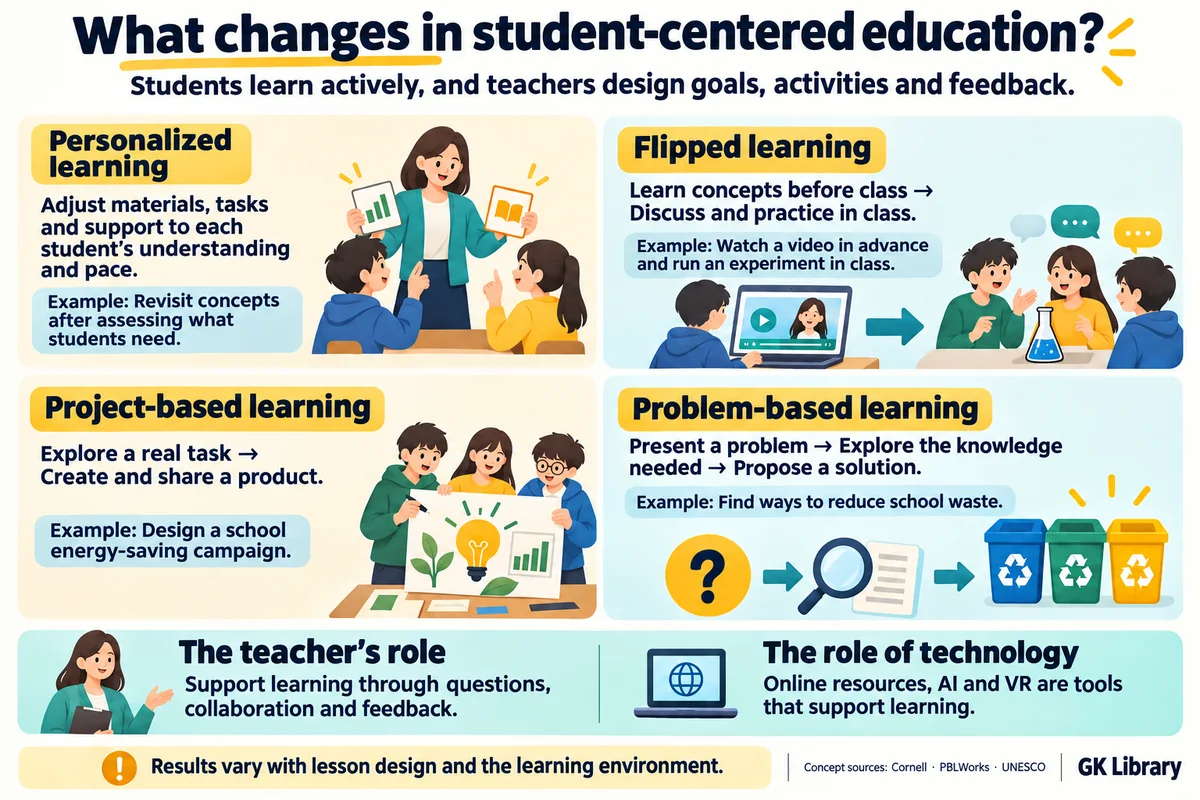
Student-centered education is a core philosophy of modern education that emphasizes personalized learning reflecting each student's needs and interests. Whereas traditional teacher-centered education transmits knowledge in a one-way manner, student-centered education helps students take ownership of their learning, participate actively, and regulate their own learning processes. By giving students greater control over their learning, this approach helps improve learning efficiency and interest.
The Importance and Effects of Personalized Learning
Personalized learning adjusts educational content to students' learning styles and pace, and is important because it can maximize the effectiveness of learning. It is particularly helpful for students who experience learning difficulties, supporting them in achieving their goals step by step at their own pace. Personalized learning gives students opportunities to achieve better results and build confidence in their learning during the process.
Research has found that students' motivation to learn and achievement improve substantially when they learn in ways that suit them. This goes beyond simply transmitting knowledge, enabling students to better understand and regulate themselves during the learning process and, further, greatly helping them develop the qualities of lifelong learners.
Improving Self-Directed Learning Skills
Self-directed learning is a core element of student-centered education and refers to students setting their own learning goals, making plans to achieve them, and monitoring their learning processes. This ability is a highly important competency in a society of lifelong learning, providing a foundation for students to continue learning and growing independently in the future. Self-directed learning also helps develop students' problem-solving abilities and critical thinking, while increasing their sense of achievement in learning.
Strengthening Interest and Motivation to Learn
Student-centered education is highly effective in stimulating students' interest and motivation. Students are given opportunities to explore in depth topics they enjoy or fields that interest them, naturally inspiring a passion for learning. When learners study fields that interest them, the learning process becomes more immersive and enjoyable, resulting in better learning outcomes.
Such motivation to learn goes beyond achievement alone, shaping positive attitudes toward learning and inspiring a sustained desire to learn over the long term. It is an essential factor in helping students accumulate diverse learning experiences and engage in deeper learning.
The Changing Roles and Importance of Teachers
Teachers play a very important role in student-centered education. Teachers must understand each student's learning style and needs and provide a variety of materials and learning methods accordingly. This calls for teachers' creativity and professional expertise, as well as the ability to respond attentively to each student's needs. Teachers must move beyond simply conveying knowledge and act as learning facilitators, guiding students to learn independently and providing appropriate feedback when needed.
The Importance of Collaborative Learning and the Development of Social Competencies
Collaborative learning is an important part of student-centered education. During the learning process, students work with their peers to solve problems, share their thoughts, and grow together. Through this collaboration, students develop social skills and the ability to collaborate, which are essential competencies in modern society. Collaborative learning gives students opportunities to respect each other's opinions and understand others' perspectives, and further develops their ability to find solutions with teammates in various problem situations.
The Future of Student-Centered Education
Student-centered education goes beyond a learning method alone and plays an important role in creating environments in which students can develop into self-directed learners. Through personalized learning, it can meet each student's needs, and through collaboration with teachers, it can further strengthen their motivation to learn. Approaches such as collaborative learning help students improve their social skills and ability to collaborate, which will become increasingly important competencies in the future.
Analyzing the Diversity of Teaching Methods and Effective Approaches

The Diversity and Necessity of Teaching Methods
A diversity of teaching methods has become an essential element of modern education. Because students have different learning styles and needs, it is important to use various teaching methods. Traditional lecture-based education was limited to one-way transmission of knowledge, but introducing diverse approaches improves learning efficiency and enables students to participate more actively in learning.
The Effects and Applications of Flipped Learning
Flipped Learning, one of the teaching methods attracting attention in modern education, involves students studying learning materials before class and then using them as the basis for discussions or practical activities during class. This teaching method helps students actively participate in the learning process and think critically, rather than passively receive knowledge. By offering opportunities to deepen their understanding of the material during class and develop practical problem-solving abilities with teachers' guidance, it significantly increases students' motivation to learn and their achievement.
The Advantages of Project-Based Learning (PBL)
Project-Based Learning (PBL) is a teaching method in which students learn through the process of solving real-world problems, combining theory and practice to help them gain practical experience. PBL helps students develop collaboration and communication skills and cultivates their ability to solve problems creatively through their own projects. This approach is especially useful in classes dealing with topics connected to everyday life, giving students opportunities to apply theoretical knowledge in practice.
The Importance of Problem-Based Learning
Problem-Based Learning (PBL) is an approach in which students learn around problems, and it is effective in developing their critical thinking and problem-solving abilities. This teaching method creates environments in which students can discover and construct knowledge themselves, helping them move beyond passive learning and actively acquire knowledge. It also provides learning experiences that involve considering different perspectives and collaborating with teammates during the problem-solving process and that can be applied in real-world situations.
Education Using Virtual Reality (VR) and Augmented Reality (AR)
Teaching methods using virtual reality (VR) and augmented reality (AR) provide students with immersive learning experiences. These technologies give students opportunities for firsthand experiences beyond traditional learning materials. For example, students can explore ancient civilizations through virtual reality in history classes, while in science classes they can use augmented reality to visualize molecular structures or astronomical phenomena, supporting a deeper understanding. In this way, AR and VR technologies make learning more vivid and are effective in helping students understand complex concepts with visual clarity.
The Importance of Feedback and Learning Efficiency
Feedback is an important element in monitoring and improving students' learning progress. When students receive regular feedback during the learning process, it helps them understand their performance and improve areas where they fall short. In this process, teachers can provide personalized guidance tailored to each student's needs and support learners' continued growth. Regular feedback is an essential process for sustaining learners' motivation to learn and helping them achieve better results.
Effective Education Through Diverse Teaching Methods
A diversity of teaching methods is an essential element of modern education and plays an important role in maximizing students' learning outcomes. Various teaching methods, such as flipped learning, project-based learning, problem-based learning, and the use of virtual and augmented reality technologies, can be applied according to each situation and students' needs, allowing students to gain more immersive and efficient learning experiences. In addition, when regular feedback is combined with teachers' personalized guidance, students will be able to learn more effectively and feel a sense of achievement.
Modern educational methodology is changing rapidly, and these innovations improve the quality of education and enrich students' learning experiences. The introduction of digital technology, the importance of student-centered education, and the use of diverse teaching methods are key elements driving these changes.
Education is moving beyond simply transmitting knowledge toward helping students take charge of their learning and realize their full potential. When these changes and innovations continue, it will be possible to build better educational environments.