Statistics is a discipline that draws important conclusions through data analysis, and it is widely used in many fields. Among its concepts, variables play a central role in statistics. Variables form the foundation of data analysis, and without properly understanding and using them, it is difficult to obtain accurate results.
In this article, we aim to take an in-depth look at the concept and definition of variables in statistics, the differences between independent and dependent variables and examples of their application, methods and criteria for selecting variables in statistical analysis, and correlation and causation between variables.
The Concept and Definition of Variables: Why Do They Matter in Statistics?
 What is a variable?
Definition and Role of Variables
In statistics, a variable refers to an element that can be measured or observed in relation to a particular phenomenon or experiment. It is an essential element in collecting and analyzing data, and variables can take various forms depending on the purpose of the research. For example, a person's height, weight, and age can all be treated as variables. These variables can be quantified, which makes it possible to carry out data analysis.
Importance of Variables
The importance of variables is directly linked to the accuracy of data analysis. If the right variables are not selected and properly managed, the results of the analysis can be significantly affected. For example, if a researcher overlooks an important variable in data obtained through an experiment, problems arise with the validity and reliability of the results. Therefore, defining and selecting variables is very important.
Types of Variables
In statistics, variables can be broadly divided into two types: qualitative variables and quantitative variables. Qualitative variables are categorical data, such as sex and blood type. Quantitative variables, on the other hand, are numerical data, such as height and weight. The method of analysis also differs depending on the type of variable.
Independent and Dependent Variables
Variables can also be classified as independent variables and dependent variables. An independent variable is a variable that the researcher manipulates or controls, and it serves as the cause in an experiment. Conversely, a dependent variable is a variable that is affected by the independent variable and is used to measure the outcome. It is important to clearly understand these roles of variables.
Understanding and Using Variables
Clearly understanding the definition and concept of variables is like laying the foundation of research. It is the starting point of data analysis and an important factor that determines the overall direction of research. Therefore, it is necessary to deeply understand the concept and definition of variables and to have the ability to use them appropriately.
Understanding Variables Through Examples
Finally, it is also useful to look at various examples to highlight the importance of variables. For example, when analyzing the effect of a particular drug in medical research, the use or non-use of the drug is set as the independent variable, and the progression of the disease is set as the dependent variable. Such examples help us understand the importance and role of variables more clearly.
Independent and Dependent Variables: Differences and Examples of Application
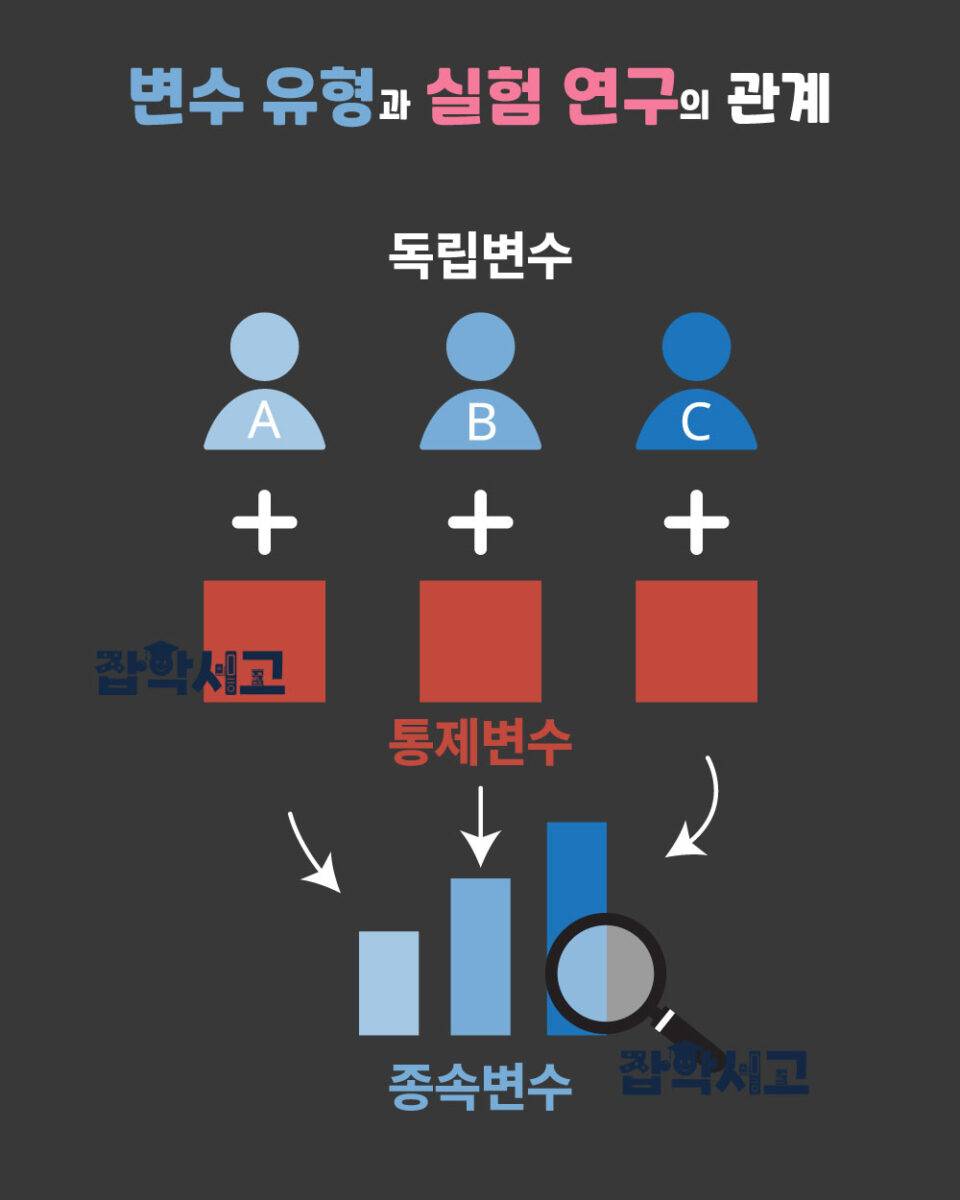 Types of variables and their relationship to experimental research
The Concept of Independent and Dependent Variables
Independent and dependent variables are among the most basic yet important concepts in statistics. An independent variable is a variable that the researcher manipulates or controls in an experiment or study. A dependent variable, on the other hand, is a variable that is affected by the independent variable. In other words, the independent variable provides the cause, and the dependent variable measures its effect.
Differences Between Independent and Dependent Variables
Understanding the difference between independent and dependent variables is essential for designing research and interpreting data. It can be easily understood through the following examples.
- Independent Variable: A variable that the researcher manipulates or controls. For example, the amount of a particular drug administered in an experiment.
- Dependent Variable: A variable that is affected by the independent variable. For example, the change in a patient's condition after the drug is administered.
Explaining the Concepts Through Examples
Education Research
- Independent variable: A particular educational program (e.g., a new math learning method).
- Dependent variable: Students' academic achievement (e.g., math test scores).
In this case, the researcher analyzes the effect of the new math learning method (independent variable) on students' math grades (dependent variable).
Medical Research
- Independent variable: Whether a particular drug is used (e.g., administration of antibiotics).
- Dependent variable: Change in the patient's condition (e.g., the degree of relief of infection symptoms).
In this case, the researcher evaluates the effect of antibiotic administration (independent variable) on the patient's infection symptoms (dependent variable).
Psychology Research
- Independent variable: A particular treatment (e.g., cognitive behavioral therapy).
- Dependent variable: The patient's anxiety level (e.g., anxiety scale scores).
In this case, the researcher examines the effect of cognitive behavioral therapy (independent variable) on the patient's anxiety level (dependent variable).
Marketing Research
- Independent variable: A particular advertising campaign.
- Dependent variable: Product sales.
In this case, the researcher analyzes the effect of the particular advertising campaign (independent variable) on product sales (dependent variable).
Social Science Research
- Independent variable: Government policy.
- Dependent variable: Citizens' quality of life.
In this case, the researcher studies the effect of government policy (independent variable) on citizens' quality of life (dependent variable).
Health Research
- Independent variable: An exercise program.
- Dependent variable: Fitness level.
In this case, the researcher evaluates the effect of a particular exercise program (independent variable) on fitness level (dependent variable).
Economic Research
- Independent variable: An interest rate cut policy.
- Dependent variable: Consumer spending.
In this case, the researcher analyzes the effect of the interest rate cut policy (independent variable) on consumer spending (dependent variable).
These examples help clarify the concepts of independent and dependent variables, and on this basis, more reliable research can be carried out.
What Is a Control Variable?
A control variable is a variable that is held fixed to ensure the fairness of an experiment. By managing control variables so that they do not change during the experiment, the effect of the independent variable on the dependent variable can be measured more accurately. For example, if the amount of sunlight is set as a control variable in a plant growth experiment, the amount of sunlight is kept constant while the effect of the amount of water (independent variable) on plant growth (dependent variable) is analyzed.
Correlation and Causation Between Variables: In-Depth Analysis and Understanding
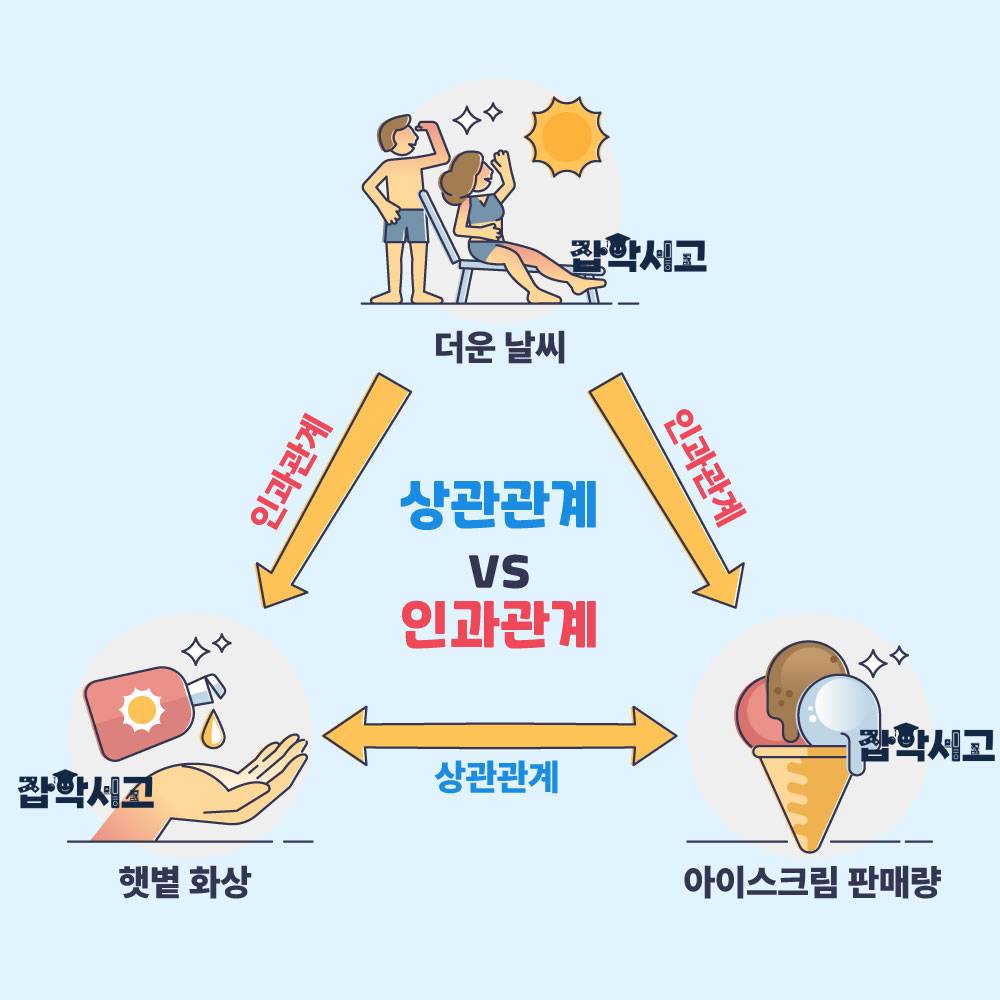 The concepts of correlation and causation, with examples
The Importance of Correlation and Causation
Correlation and causation between variables are important concepts in statistical analysis and are essential for understanding the relationship between two variables. Correlation describes the relationship between two variables, while causation refers to the direct effect of one variable on another. Clearly understanding and analyzing these two concepts is important for improving the accuracy of research.
The Concept of Correlation
Correlation expresses the relationship between two variables numerically. For example, the correlation coefficient indicates the strength and direction of the relationship between two variables and takes a value between -1 and 1. The closer the absolute value of the correlation coefficient is to 1, the stronger the relationship between the two variables; a value close to -1 indicates a strong negative correlation, and a value close to 1 indicates a strong positive correlation. The closer the correlation coefficient is to 0, the weaker the relationship between the two variables.
Uses of Correlation
Correlation is used in many studies and provides important information in the early stages of data analysis. For example, one can analyze the correlation between students' academic achievement and study time. In this case, a high positive correlation coefficient means that students who study more tend to have higher academic achievement. Such information helps researchers understand patterns in the data.
The Concept of Causation
Causation, on the other hand, refers to the direct effect of one variable on another. It is mainly dealt with in experimental research, which analyzes the direct relationship between independent and dependent variables. For example, one can analyze the effect of a particular drug (independent variable) on a patient's condition (dependent variable). This makes it possible to clearly evaluate the effectiveness of the drug.
Distinguishing Correlation from Causation
Correlation and causation can be confused, but they must be clearly distinguished. The existence of a correlation means that there is a relationship between two variables, but it does not necessarily mean causation. For example, a high correlation between ice cream sales and the number of water-related accidents does not mean that ice cream sales directly cause water-related accidents. It merely shows a correlation between the two variables.
Experimental Research for Analyzing Causation
Causation is mainly established through controlled experimental research. Experimental research is a method in which the researcher manipulates the independent variable and observes the resulting changes in the dependent variable. This makes it possible to clarify the direct relationship between the two variables. For example, experimental research can be conducted to analyze the effect of a particular educational program (independent variable) on students' academic achievement (dependent variable).
The Importance of Experimental Research
Experimental research is the most direct way to establish causation clearly. By manipulating the independent variable and observing the resulting changes in the dependent variable, the researcher can confirm the direct relationship between the two variables. This enables the researcher to draw more accurate conclusions.
Methods for Analyzing Correlation and Causation
There are several methods for analyzing correlation and causation. Correlation analysis expresses the relationship between two variables numerically, while experimental research confirms the direct effect between two variables. It is important to use these methods appropriately to improve the accuracy of research.
By analyzing correlation and causation separately, researchers can understand patterns in the data and clarify the relationship between two variables. Therefore, it is important to thoroughly understand the concepts of correlation and causation and the methods for analyzing them, and to apply them appropriately in research.
Selecting Variables in Statistical Analysis: Methods and Criteria
 How are variables selected in statistical analysis?
The Importance of Variable Selection
In statistical analysis, variable selection is an important process that determines whether research succeeds. Clearly establishing the methods and criteria for variable selection is essential for increasing the validity and reliability of research. Therefore, it is important to understand the various methods and criteria for variable selection and to apply them appropriately.
Relevance to the Research Purpose
The first criterion for variable selection is relevance to the purpose of the research. Researchers should select variables that can support the research questions or hypotheses they have set. For example, when analyzing the effect of smoking on the occurrence of lung cancer in health research, whether a person smokes and whether lung cancer occurs should be selected as the main variables. These variables fit the purpose of the research and are highly relevant.
Data Availability
The second criterion for variable selection is data availability. The data available to the researcher must be sufficient and reliable. To this end, it is necessary to clarify the data collection methods and sources and to review the quality of the data. For example, when collecting data through a survey, the sincerity of respondents and the consistency of the data should be checked.
Statistical Significance
The third criterion for variable selection is statistical significance. The selected variables should be able to yield statistically significant results. To this end, the distribution and relationships of variables should be identified through preliminary analysis, and statistical tests should be performed. For example, the relationship between independent and dependent variables can be examined through regression analysis, and significant variables can then be selected.
Avoiding Multicollinearity
The fourth criterion for variable selection is avoiding multicollinearity. Multicollinearity can undermine the reliability of analysis results due to high correlations among independent variables. To prevent this, the correlations among independent variables should be analyzed, and variables that avoid multicollinearity should be selected. For example, multicollinearity can be checked in regression analysis using the variance inflation factor (VIF).
Practical Validity
The fifth criterion for variable selection is practical validity. That is, the selected variables must actually be related to the subject of the research. This is an important factor that helps make research findings applicable to real-world situations. For example, when analyzing students' academic achievement in education research, variables that actually affect academic achievement should be selected.
An Iterative and Systematic Approach
Finally, the process of variable selection requires an iterative and systematic approach. Even if many variables are considered at first, appropriate variables should gradually be selected through analysis, and the optimal research design should be built on that basis. This process plays an important role in increasing the validity and reliability of research.
Examples of Applying the Variable Selection Criteria Together
Health Research
- Relevance to the research purpose: Select whether a person smokes and whether lung cancer occurs as the main variables.
- Data availability: Use hospital records and patient survey data.
- Statistical significance: Examine significant relationships through regression analysis.
- Avoiding multicollinearity: Analyze correlations among other lifestyle variables besides smoking.
- Practical validity: Select variables directly related to the occurrence of lung cancer.
Education Research
- Relevance to the research purpose: A particular educational program and students' academic achievement.
- Data availability: Use school records and grade data.
- Statistical significance: Perform statistical tests to verify the program's effect.
- Avoiding multicollinearity: Analyze correlations among students' background variables besides the educational program.
- Practical validity: Select variables that affect academic achievement.
Variable selection is an important process that determines the direction of research. Through it, researchers can collect reliable data and draw significant results. Thoroughly understanding and applying the various criteria for variable selection is the key to successful research.
Variables play a very important role in statistics. An in-depth understanding of the concept and definition of variables, the differences between independent and dependent variables and examples of their application, methods and criteria for selecting variables in statistical analysis, and correlation and causation between variables is essential for increasing the accuracy and validity of research.
Properly understanding and using variables is an important process that lays the foundation for data analysis. Therefore, it is necessary to always keep the importance of variables in mind and make an effort to apply them appropriately in research. Through continued study and understanding of variables, we will be able to carry out increasingly reliable data analysis.