When a news story reveals unsanitary conditions at a food factory or unfair dealings by a large corporation, people grow angry and the government responds with new measures. Today it is hardly unusual for a single story, doggedly pursued by a reporter, to change laws and institutions. But if we trace investigative reporting back to its roots, we meet a group of journalists in the United States more than 100 years ago who earned the unflattering nickname “men who rake the muck.”
They were the “muckrakers.” Put simply, muckrakers were reform-minded journalists and writers who, during America's Progressive Era from the 1890s to the 1920s, persistently investigated and exposed the dark side of society, such as political corruption, the abuses of monopoly corporations, and harsh working conditions.
In this article, we will look in turn at how the name “muckraker” came about, the historical background in which these journalists worked, their landmark exposés and their impact, and the legacy they left for investigative reporting today.
The Era of Reporters Who Exposed Corruption
A Name Given by a President
The name “muckraker” was not something the journalists chose for themselves; it came into wide use after a speech by the president of the day.
(1) The Man with the Muck-Rake in The Pilgrim's Progress
In The Pilgrim's Progress, published in 1678 by English writer John Bunyan, there appears a man holding a muck-rake. Even when offered a celestial crown above his head, he does not look up; he keeps his head down and only rakes together the filth on the floor.
(2) Roosevelt's 1906 Speech
In a speech in April 1906, President Theodore Roosevelt invoked this figure to criticize reporters who dwelt only on the bad side of society. In the same speech, however, he added that truthful exposure was essential to society.
(3) An Unwelcome Nickname
Most of the journalists strongly disliked the name, because they felt mocked by a president who had been leading reform alongside them. Yet the nickname soon spread widely, and today it is used for reporters who dig up wrongdoing by those in power.
The Age of Exposés Led by Magazines

The rise of cheap, widely read magazines played a major part in making the muckrakers' work possible.
- Mass Magazines: Magazines such as McClure's attracted a growing middle-class readership with a low price of 15 cents a copy and plenty of illustrations.
- Investigative Reporting: Journalists spent months or even years gathering documents and meeting people, writing long serialized articles rather than short news items.
- Reform Spirit: Whereas the earlier yellow journalism covered sensational events to sell more newspapers, the muckrakers aimed to correct flawed institutions.
(1) The January 1903 Issue
The January 1903 issue of McClure's is often cited as the official starting point of the muckraking era. That single issue carried three exposés, investigating business, city politics, and labor issues respectively.
(2) Poverty Shown in Photographs
Even before this, reporter Jacob Riis used flash photography to capture and publicize the miserable conditions in the tenements of New York's slums. He put before people's eyes a reality that words alone could hardly convey.
Landmark Exposés That Changed the World

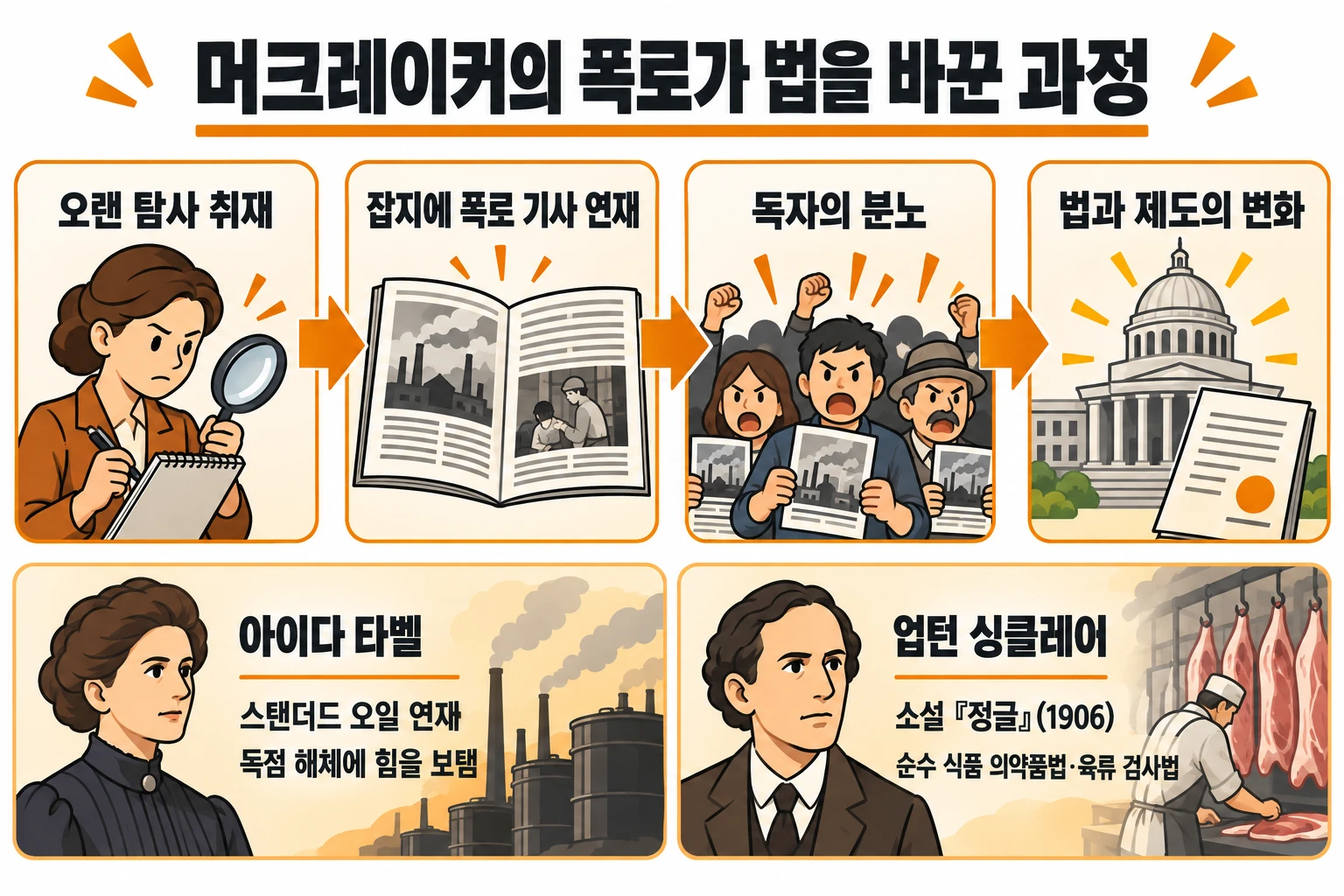
The muckrakers' articles stirred readers' anger, and that anger led to real changes in laws and institutions.
(1) The History of Standard Oil
From 1902 to 1904, Ida Tarbell published a series in McClure's on how the oil company Standard Oil drove out its competitors. The series lent momentum to the movement to break up giant monopolies and to pass laws preventing monopoly.
(2) The Shame of the Cities
Lincoln Steffens exposed the networks of bribery linking politicians and businessmen in St. Louis and several other cities, and collected his work in the book The Shame of the Cities.
(3) The Novel The Jungle and Food Laws
Upton Sinclair published the novel The Jungle in 1906, based on seven weeks of research in Chicago's slaughterhouses. The book was meant to expose the miserable lives of workers, but readers were far more outraged by the unsanitary meatpacking process. As a result, the Pure Food and Drug Act and the Meat Inspection Act were passed that same year. Sinclair famously remarked, “I aimed at the public's heart, and by accident I hit it in the stomach.”
The Legacy of the Muckrakers

The muckrakers' heyday did not last long, but the reporting methods they left behind have taken deep root in today's press.
(1) The Prototype of Investigative Reporting
Investigative reporting, which uncovers the wrongdoing of the powerful by gathering documents and building evidence over long periods, directly inherits the muckrakers' methods. Even today in the United States, investigative reporters are sometimes casually called muckrakers.
(2) The Press as a Watchdog
The idea that the press should act as a watchdog over government and business also gained strength in this era. Readers saw for themselves that articles could actually change society.
(3) The Task of Accuracy
As Roosevelt stressed, exposure has power only when it is truthful. Reporting that inflates unverified allegations ends up eroding trust in the press.
The muckrakers were reporters who followed uncomfortable truths to the very end. Despite criticism, they looked into the muck that no one else wanted to see, and thanks to them, society was able to take a step forward.
Remembering that the labor of raking the muck ultimately makes the world cleaner is the first step toward developing an eye for good journalism.