
Over the past several hundred thousand years, Earth has gone back and forth many times between bitterly cold glacial periods and relatively warm interglacial periods. About 20,000 years ago, when the last glacial period was at its peak, vast areas of North America and northern Europe were covered by thick ice, and because so much seawater was locked up as ice, sea level was more than 100 m lower than it is today.
Why such large climate changes keep repeating was long an unsolved mystery. The most widely accepted explanation today is that Earth's orbit around the Sun and its axis of rotation change very slowly but regularly. These regular changes are called the “Milankovitch Cycles,” after the scientist who worked them out.
This article walks step by step through the background from which the Milankovitch cycles emerged, the three changes that make them up, the evidence from the sea floor that supported the theory, and finally the theory's limits and what it means when we look at today's climate.
The Principles and Meaning of the Milankovitch Cycles
The Birth of the Theory and the Key Role of Summer Sunlight

Milutin Milanković was a Serbian mathematician and geophysicist. In the early 20th century, he spent decades calculating by hand, without a calculating machine, how the amount of sunlight received at each latitude changes as Earth's orbit and axis of rotation vary.
The idea that changes in the orbit bring on ice ages had itself appeared before him. In the 19th century, Joseph Adhémar of France and James Croll of Scotland put forward similar claims. Milanković refined this idea with precise calculations and summed up the results in 1941 in a book titled Canon of Insolation and the Ice-Age Problem.
The key he found was not the cold of winter but the sunlight of summer at high latitudes in the Northern Hemisphere. In regions with large land areas, such as those around 65 degrees north, when summer sunlight weakens, the snow that piled up over the winter cannot all melt and is left behind. When such years continue, snow builds up year after year and grows into huge ice sheets; conversely, when summer sunlight grows stronger, the ice sheets melt and retreat.
Three Changes Made by the Orbit and the Axis
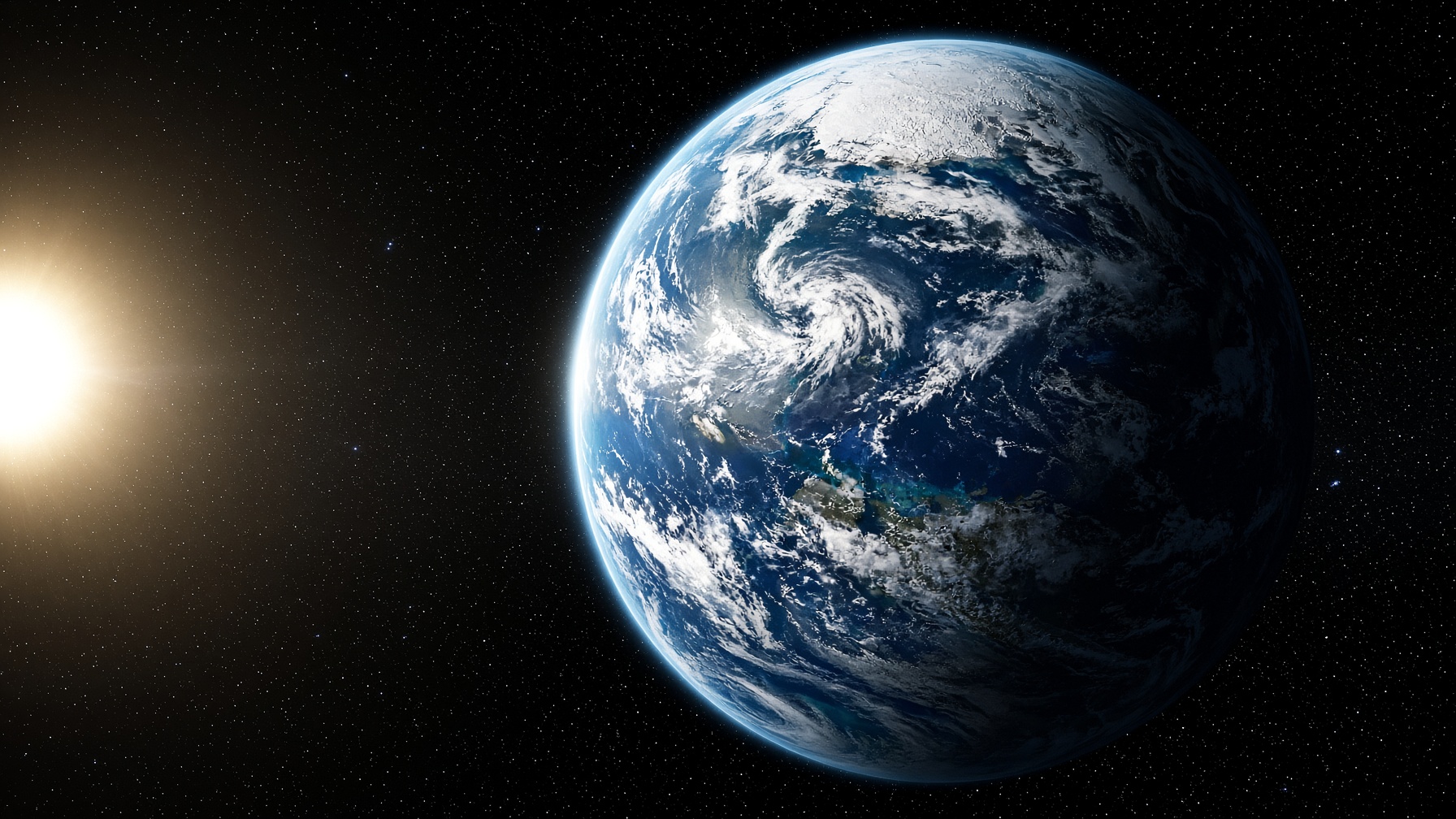
The Milankovitch cycles are produced by the overlapping of three changes that move to different rhythms.
(1) Eccentricity
Earth's orbit is not a perfect circle but a slightly flattened ellipse, and the degree of that flattening changes over cycles of about 100,000 years and about 400,000 years. The more elongated the orbit becomes, the greater the difference between the sunlight Earth receives when it is closest to the Sun and when it is farthest away.
(2) Axial Tilt (Obliquity)
Earth's axis of rotation is tilted relative to the plane of its orbit, and that angle swings between 22.1 and 24.5 degrees over a cycle of about 41,000 years. It is currently about 23.4 degrees and slowly decreasing. The greater the tilt, the hotter the summers and the colder the winters.
(3) Precession
The axis of rotation slowly traces a circle and changes direction, like a spinning top. Because of this, which season coincides with the time when Earth comes closest to the Sun changes over a cycle of about 23,000 years. At present, Earth comes closest to the Sun in early January, during the Northern Hemisphere's winter.
These three changes alter not so much the total amount of sunlight Earth as a whole receives over a year as how that sunlight is divided among the seasons and latitudes. It is precisely this change in distribution that determines whether ice sheets grow or shrink.
The Evidence Revealed by Mud on the Sea Floor

For a long time, Milanković's calculations remained a hypothesis that was hard to prove, because there was no way to accurately measure the climate of hundreds of thousands of years ago. What changed the situation was the mud that had accumulated at the bottom of the deep sea.
Sea-floor sediments contain layer upon layer of the shells of foraminifera, a type of tiny plankton. The ratio of oxygen isotopes contained in these shells serves as a record of how much ice there was on land at the time. In 1976, James Hays, John Imbrie, and Nicholas Shackleton analyzed this record and published their findings in the journal Science.
- A cycle of about 100,000 years: matched the rhythm of eccentricity.
- A cycle of about 41,000 years: matched the rhythm of axial tilt.
- Cycles of about 23,000 and 19,000 years: matched the rhythm of precession.
This paper called the changes in Earth's orbit the “Pacemaker of the Ice Ages,” and from then on the Milankovitch cycles became established as a key theory for explaining climate change. Records from ice cores drilled out of the Antarctic ice sheet also showed the same rhythms.
The Theory's Limits and Today's Climate

The Milankovitch cycles cannot explain everything. A prime example of an unsolved puzzle is the so-called “100,000-year problem.” Over the past 800,000 years or so, glacial and interglacial periods have alternated mainly to a 100,000-year rhythm, yet the change in sunlight caused by eccentricity is the smallest of the three changes. In the period before that, the 41,000-year rhythm was more prominent, and why the rhythm shifted is also still under debate.
Scientists believe that changes in the orbit act as a trigger, and that feedbacks within the Earth system amplify their effect.
- Ice-albedo feedback: The more white ice spreads, the more sunlight it reflects, and the more Earth cools.
- Greenhouse gases: Ice core records show that there was less carbon dioxide in the atmosphere during glacial periods and more during interglacial periods.
- Ocean circulation: When the flow of seawater changes, the way heat is distributed around the globe also changes.
The Milankovitch cycles act slowly, over thousands to tens of thousands of years. For this reason, they cannot explain the rapid rise in temperature over the past 100 years or so, for which greenhouse gases emitted by humans are considered the main cause. Understanding the slow rhythm of the orbit also makes it clearer just how fast and unusual today's changes are.
In the end, the Milankovitch cycles remind us that Earth's climate is deeply connected to Earth's place in space. Reading the slow rhythm of the heavens together with the feedbacks within Earth is the first step toward understanding the long history of climate.