The forces of nature have a great influence on our lives, and among them the movement of the sea plays an especially important role. Tides, that is, low tide and high tide, refer to the periodic rise and fall of sea level.
Tides go beyond the simple rise and fall of seawater and play an important role in many fields, such as port operations, fishing, and marine sports.
In this article, we will take a detailed look at everything from the principles of tides to the differences between low tide and high tide, tidal cycles and the factors that change them, and how to read tide times in Korea.
The Principles of Tides (High Tide/Low Tide)
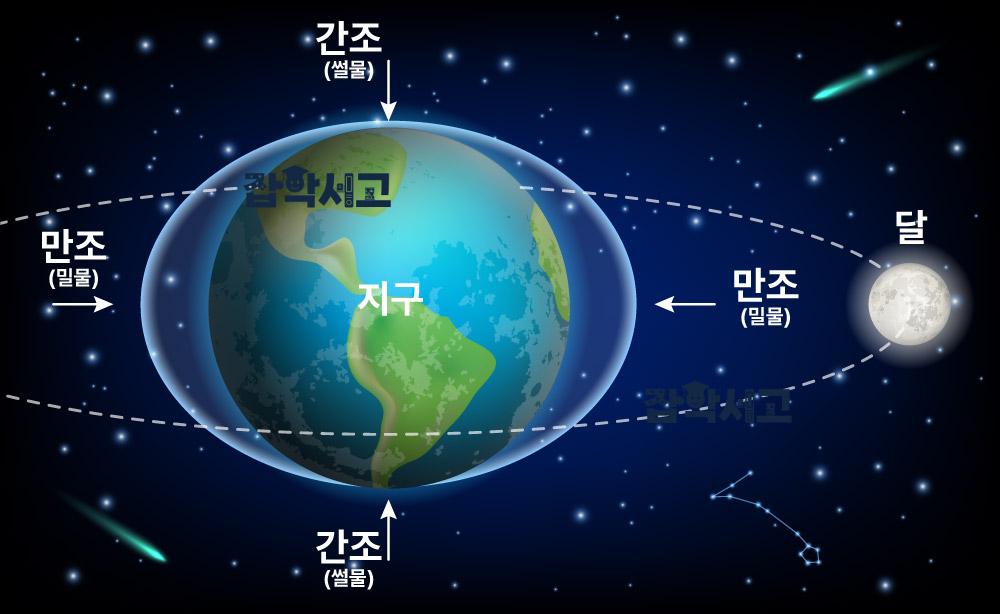 The principles of tides (high tide/low tide)
Tides are the periodic rising and falling of the Earth's seawater, a process caused mainly by the gravity of the Moon and the Sun. The main principles of tides are as follows.
Gravity and Tides
The biggest cause of tides is the Moon's gravity. Although the Moon is small compared to the Earth, it is very close to the Earth and therefore exerts a powerful gravitational effect. The Moon's gravity pulls on the Earth's seawater, so the water rises on the side of the Earth facing the Moon, producing a high tide. At the same time, on the opposite side of the Earth, seawater also rises because of centrifugal force, creating another high tide. At the points midway between these two regions, the water drops and a low tide occurs.
The Sun's Influence
The Sun also affects tides. The Sun is much larger than the Moon, but because it is much farther from the Earth, it does not exert as strong a gravitational effect as the Moon. However, when the Moon and the Sun are in the same direction or in exactly opposite directions (that is, at new moon and full moon), tides become stronger; this is called a 'spring tide.' Conversely, when the Moon and the Sun form a right angle, tides become weaker; this is called a 'neap tide.'
Tidal Force
Tides cannot be explained simply by the gravitational pull of the Moon and the Sun alone. Tidal force is the force that arises from the difference in the Moon's and the Sun's gravity across the Earth's surface. This force changes the Earth's sea level and triggers tides.
The Earth's Rotation and Tides
The Earth's rotation also plays an important role in the tidal cycle. The Earth rotates once a day, and in the process each point on the Earth's surface is periodically subjected to the gravitational influence of the Moon and the Sun. As a result, high tide and low tide each repeat twice a day.
Regional Variations in Tides
Tides do not appear the same everywhere on Earth. The size and cycle of tides can vary depending on local factors such as ocean depth, the shape of the coastline, and the topography of the seabed. For example, tides can appear more dramatically in narrow bays or deep ocean trenches.
In this way, tides are a natural phenomenon produced by the combined action of several factors, including the gravity of the Moon and the Sun, the Earth's rotation, and the topography of the ocean. Understanding these principles helps us better grasp how tides occur, and on that basis we can plan and carry out a variety of marine activities.
Differences Between Low Tide and High Tide
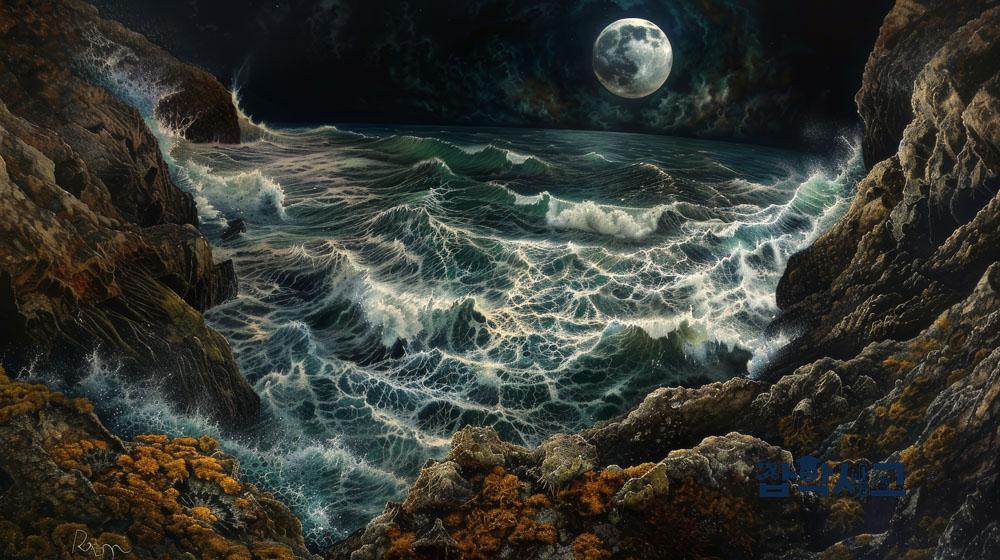 What are the differences between high tide and low tide?
Low tide and high tide, the main elements of tides, refer respectively to the periodic lowering and raising of sea level. These two phenomena differ clearly in many ways and have an important impact on the marine environment and human activities.
Definitions and Causes
- High Tide: High tide is the moment when seawater rises to its highest level. It occurs mainly at the point where the Moon is closest to the Earth and on the opposite side. As the Moon's gravity pulls on the Earth's seawater, the sea level rises.
- Low Tide: Low tide is the moment when seawater drops to its lowest level. It occurs mainly at the points midway between the two points where high tide occurs, and at these times the influence of the Moon's gravity and centrifugal force is small, so the water level drops.
Cycle and Frequency
- Cycle: High tide and low tide each occur twice a day, repeating at intervals of about 12 hours and 25 minutes. This results from the combination of the time it takes the Moon to orbit the Earth and the Earth's rotation period.
- Frequency: It is common for two high tides and two low tides to occur in a single day. This is called a 'semidiurnal tide.'
Changes in Water Level
- High tide: At high tide, the sea level rises and the coastline becomes submerged. As the sea surface rises, areas close to the shore are flooded.
- Low tide: At low tide, the seawater recedes and the sea level drops, exposing parts of the coastline that are normally underwater. Tidal flats and reefs along the shore are exposed and can easily be seen.
Effects and Uses
- Effects of high tide: High tide has various effects on marine ecosystems and human activities. At high tide, navigation becomes easier and fishing activities can become more active. Coastal erosion can also occur, and marine sports and tourism activities that take advantage of high tide increase.
- Effects of low tide: Low tide provides favorable conditions for exploring tidal flats and surveying coastal organisms. In fishing, it becomes easier to gather seaweed and harvest from tidal flats. Low tide is also sometimes used for cleaning and maintenance work in coastal areas.
Ecosystems and the Environment
- Ecosystems at high tide: At high tide, marine organisms can move about or breed at the higher water level. As the water rises, nutrient-rich seawater flows toward the shore, enriching the ecosystem.
- Ecosystems at low tide: At low tide, tidal flats and reef areas are revealed, exposing a wide variety of marine life. At this time, you can easily observe many creatures such as clams, crabs, and turban shells.
As shown above, low tide and high tide are two major phenomena related to changes in sea level, and understanding the characteristics and effects of each plays an important role in planning marine activities and protecting the environment.
Tidal Cycles and the Factors That Change Them
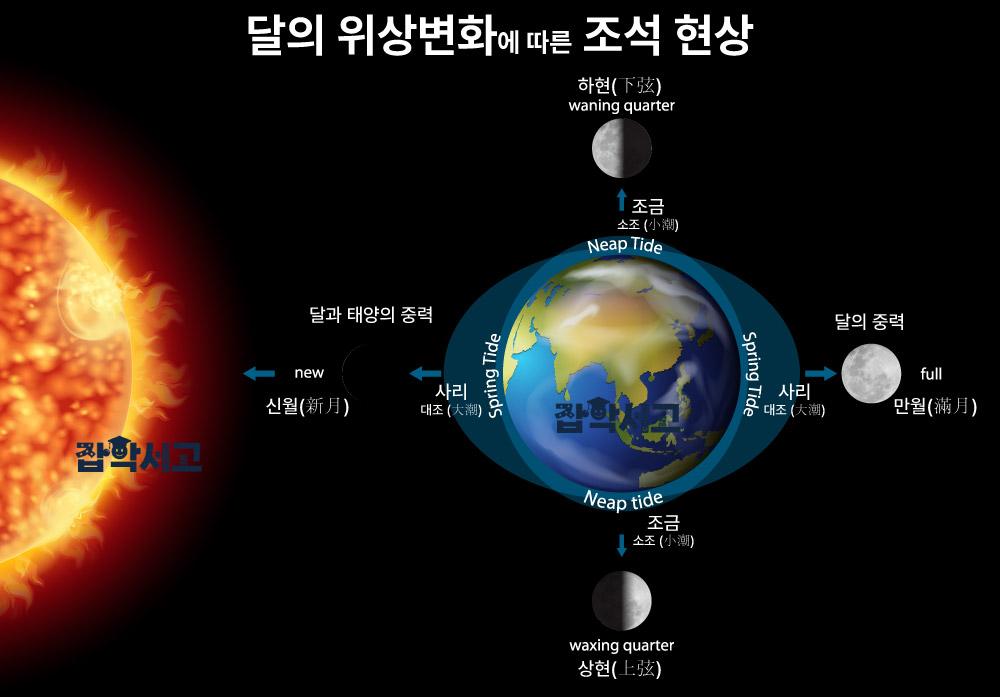 The phases of the Moon and tides
Tides occur periodically due to the gravitational interaction among the Earth, the Moon, and the Sun. This cycle follows a regular pattern and can vary due to a number of factors. Understanding these cycles and the factors that change them is very important for predicting and making use of tides.
Tidal Cycles
- Semidiurnal tide: In general, this is the cycle in which two high tides and two low tides occur each day. It repeats about every 12 hours and 25 minutes, the result of the Moon's orbital period combined with the Earth's rotation period.
- Diurnal tide: In some areas, there is only one high tide and one low tide a day. This occurs due to particular topographic conditions or the characteristics of the Moon's orbit.
- Monthly cycle: Following the phases of the Moon, tides go through spring tides, when they become stronger, and neap tides, when they become weaker, twice each month. Spring tides occur at new moon and full moon, and neap tides occur at the first quarter and last quarter.
Factors of Variation
- Position of the Moon: The closer the Moon is to the Earth (perigee), the larger the tidal range, and the farther away it is (apogee), the smaller the tidal range. At perigee, stronger high and low tides occur, while at apogee the difference shrinks.
- Position of the Sun: The Sun also affects tides. At perihelion, when the Earth is closest to the Sun, the tidal range becomes larger, and at aphelion it becomes smaller. When the Sun and the Moon line up (at new moon and full moon), the tidal difference is greatest, and when they form a right angle (at the first and last quarter), the tidal difference is smallest.
- Earth's rotation and revolution: The Earth's rotation is an important factor that shapes the tidal cycle over the course of a day. In addition, as the Earth orbits the Sun and the positions of the Sun and the Moon change, the cycle and strength of the tides also vary.
- Topographic factors: Topographic factors such as the shape of the coastline, the seabed topography, and water depth have a big influence on tidal variation. For example, the tidal difference can appear more dramatically in narrow bays or deep ocean trenches.
- Climate and weather conditions: Weather conditions such as wind, air pressure, and storms also affect tides. For example, when a storm occurs, seawater can rise higher or fall lower.
- Interaction of tidal waves: In the open ocean, multiple tidal waves interact with one another to form complex tidal patterns. These interactions create diverse tidal characteristics from region to region.
In this way, tidal cycles and the factors that change them are determined by a variety of factors, including the positions of the Moon and the Sun, the Earth's rotation and revolution, topographic characteristics, and weather conditions. Understanding these factors as a whole allows us to predict tides more accurately and plan marine activities effectively.
How to Read Tide Times in Korea
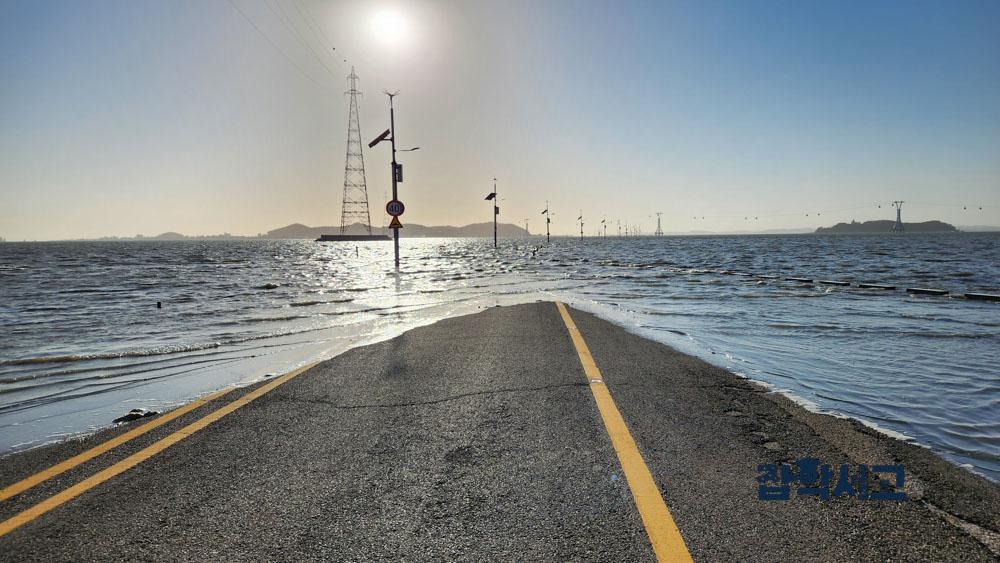 A path opening up with the rise and fall of the tide
In Korea, understanding and using tide times (multtae) is very important for a variety of activities, such as fishing, navigation, and marine sports. Tide times refer to the times when the height of seawater changes due to tides, and knowing them accurately is essential for safe and efficient marine activities. Let's look at how to read tide times in Korea.
Using Tide Tables
- What is a tide table?: A tide table is a chart that organizes the times during the day when the sea level changes, recording in detail the times of high and low tide and the water levels at those times. In Korea, tide tables are officially provided by the Ministry of Oceans and Fisheries and the Korea Meteorological Administration, and they are easy to obtain at major ports and coastal areas.
- Using the internet and apps: Today, you can easily check real-time tide information on the internet and through smartphone applications. With sites such as the 'Ministry of Oceans and Fisheries tide information' site or apps such as 'Multtae Allimi' (Tide Alert), you can look up tide times by region quickly and accurately.
- Ministry of Oceans and Fisheries tide information: The official website of the Ministry of Oceans and Fisheries (Smart Tide Forecast) provides tide information for major ports and coastal areas across the country. On the site, you can check detailed tidal changes by date and by hour.
Regional Differences in Tide Times
- West coast: The west coast is famous for its large tidal range. In west coast areas such as Incheon, Gunsan, and Mokpo, tide times vary greatly, so it is important to keep track of them.
- South coast: Because the south coast has a complex coastline and many islands, tide times differ greatly from area to area. In places such as Busan, Yeosu, and Tongyeong, it is necessary to check the local tide table carefully.
- East coast: The tidal range on the east coast is relatively small, but tide times can vary greatly because of weather changes such as typhoons and strong winds. It is important to check tide information for places such as Gangneung, Sokcho, and Pohang.
Using Tide Times in Everyday Life
- Fishing: Tide times are an important factor in deciding when and where to fish. By knowing when high and low tides occur, fishers can work at the right times and maximize their catch.
- Navigation and port operations: Accurately knowing the tide times is necessary for ships' arrival and departure times and for safe navigation. Berthing ships is easier at high tide, while caution is needed at low tide.
- Marine sports: Tide times should also be considered when planning marine sports such as surfing, scuba diving, and tidal flat experiences. Planning activities around suitable tide times makes for a safe and enjoyable experience.
- Coastal tourism: Checking tide information when enjoying a tidal flat experience or a coastal walk can make the experience richer. At low tide, you can observe a variety of marine life on the exposed tidal flats.
Tide Forecasts and Weather Conditions
- Linking with weather forecasts: It is a good idea to check tide information together with weather forecasts. Since tide times can change with weather conditions, weather forecasts for wind, air pressure, storms, and so on should be considered together.
- Using real-time observation data: The Korea Meteorological Administration and the Ministry of Oceans and Fisheries provide data observed in real time, which can be used to obtain more accurate tide information.
As shown above, reading tide times in Korea is easily accessible through a variety of methods and tools. It is important to use them to make safe and efficient plans for a variety of activities, such as fishing, navigation, and marine sports.
Tides are a complex but fascinating natural phenomenon. By understanding them, we can plan marine activities more safely and efficiently. A good grasp of the cycles of low and high tide and the factors that change them allows us to better predict and respond to the marine environment.
In Korea in particular, accurate tide information is used to optimize fishing and port operations. Understanding the rhythms of nature and living in tune with them will be a great help both in our daily lives and in industry.