This time, I would like to prepare material on eye movements during reading and speed reading. Here, eye movements during reading refer to the movements the eyes make as they follow lines of text in a book, continually repeating saccades and fixations.
Terms such as saccades and fixations may seem unfamiliar, so I will introduce them individually below, along with images.
Saccades
 Basic, rapid saccades (imperceptible)
A saccade is a basic movement in which the eyeballs (eyes) move rapidly along the characters in a book. A saccade takes about 0.0229 seconds, and because it occurs at an imperceptibly fast speed, characters cannot be recognized during a saccade.
Fixations
 Pausing briefly during saccadic movement to recognize characters
Fixation refers to the stopping of an extremely rapid saccadic movement. The fixation (pause) time is usually 0.25 seconds, and most reading of the characters in a book takes place during these pauses.
Regressions
 Moving back along the same path
A regression is an eye movement that returns to a place already read when the reader has failed to understand or has misrecognized the characters. Regressions occur frequently among children in the lower grades of elementary school, whose reading ability is relatively limited, and gradually decrease as their experience of reading books grows.
Return Sweeps
 Once you have finished reading a line, move on to the next!
The last type of eye movement is the return sweep. This is the eye movement that occurs when you finish reading the current line and move on to the next. In other words, the eyes move from the last fixation point on the current line to the location of the first character on the next line.
If the line spacing is too wide or too narrow, the failure rate of return sweeps increases, so it is best to choose a book printed with appropriate, visually comfortable line spacing. A return sweep takes about 0.04 to 0.06 seconds.
Overall, eye movements develop rapidly until around grade 4 of elementary school, after which their development tends to gradually slow.
Speed Reading
 What are the criteria for speed reading??
Simply put, speed reading means reading books quickly. It refers to a method of comprehending as much material as possible within a set amount of time, and a person is considered to be speed reading when they read at least 5 times as fast as usual and, in a 1-minute period, recognize 3,000 to 4,000 characters or more without missing any.
Of course, reading many characters in a short time does not mean remembering them all. The 3 key elements of speed reading are the ability to control eye movements, attention, and concentration, and they are explained in detail below.
Ability to Control Eye Movements
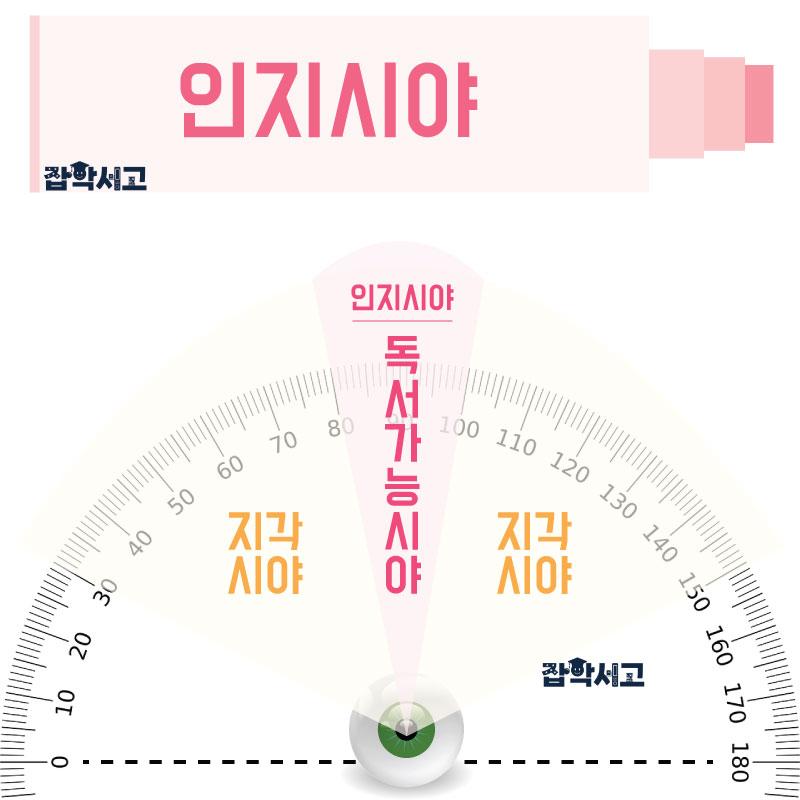 Recognition Field and Perceptual Field
When the eyes perceive an object, the area of about 6 cm within which it can be recognized clearly is called the recognition field, while the surrounding area of about 120 degrees in which objects are recognized only roughly is called the perceptual field.
Because people can perceive only the characters that fall within their recognition field, training to expand that field can be considered the most important aspect of speed reading.
Attention
 The determination to read a book well!
Attention is an ability people can control according to their own will, and taking greater care while reading a book allows them to recognize the characters within their recognition field accurately.
However, the less attention a person pays, the more regressions occur. This refers to situations in which a person is looking at a book but their mind is elsewhere, and their eyes are simply staring blankly at it. This is what people commonly describe as 'zoning out.'
Ultimately, attention can be controlled through one's own determination, so dedicated training is needed to sustain it for long periods.
Concentration
 Concentration that keeps your attention on the book alone!
People can usually concentrate most effectively for about 3 minutes. During this time, they can focus all their mental energy to improve comprehension and memory.
If training expands your recognition field so that you can recognize many characters per 1 fixations, you will be able to improve your speed-reading ability.
We have now explored eye movements, which refer to the path the eyes follow during reading, and speed reading that uses these movements. Improving speed-reading ability requires consistent practice through various training methods, including training to improve attention and concentration, expand the recognition field, develop visual perception skills, improve comprehension, and training using machines.
I hope you gain an understanding of the basic concepts of reading and speed reading and find reading habits that suit you.