Monetary policy is one of the key tools central banks use to promote economic stability and growth. This material examines in depth the basic concepts and historical background of monetary policy, its main tools and how they work, its various effects on the economy, and an analysis of its effectiveness through real-world examples. Through this examination, readers will gain a clear understanding of how important a role monetary policy plays in the economy.
The Basic Concepts and Historical Background of Monetary Policy
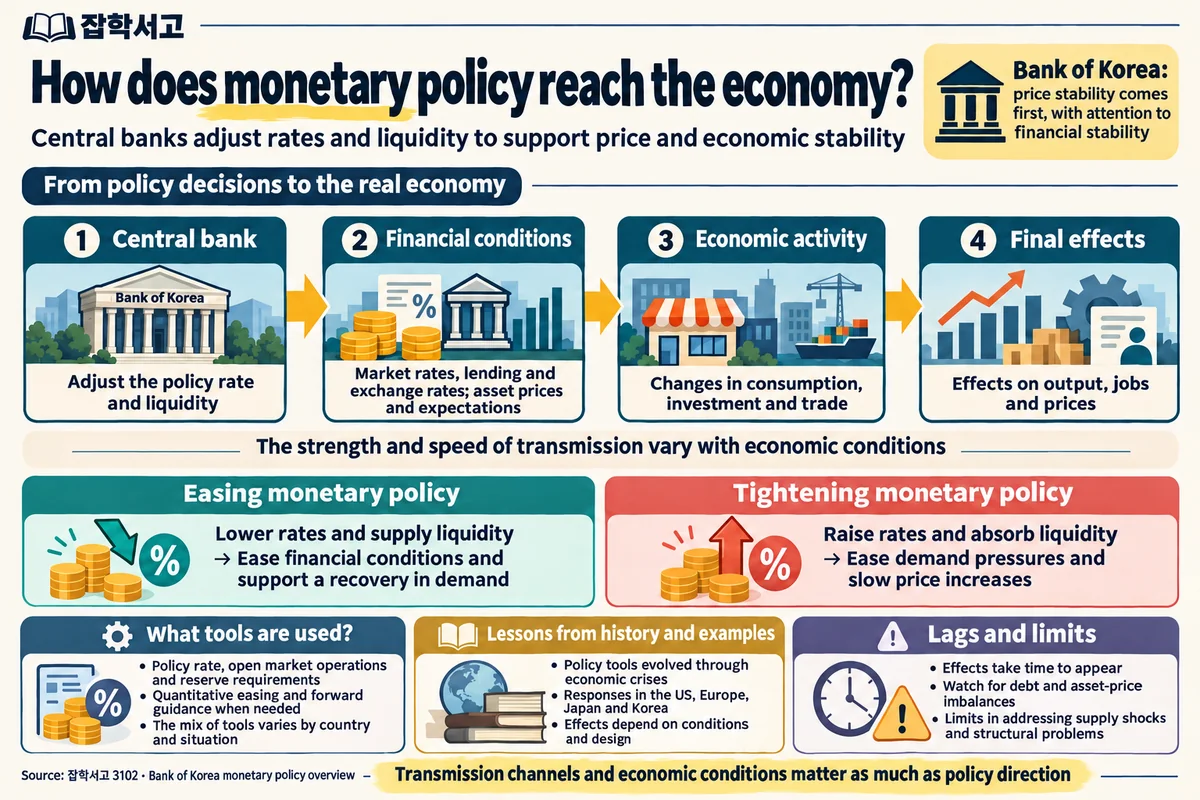

The Basic Concepts of Monetary Policy
Monetary policy (Monetary Policy) refers to policies through which a central bank or monetary authority adjusts the money supply, interest rates, and other factors to achieve economic objectives. The main objectives of these policies include price stability, economic growth, increased employment, and financial market stability, through which they seek to guide the overall course of the economy.
The Historical Background of Monetary Policy
Monetary policy has a long history. In ancient times, money was managed through metallic currency, but monetary policy in its modern sense began to develop in earnest in the 20th century. Following the Great Depression of the 1930s, the importance of monetary policy as a tool for economic stabilization gained considerable attention, and during the stagflation of the 1970s, it became a central means of economic adjustment.
A Major Example: The U.S. Federal Reserve
The U.S. Federal Reserve (Fed) is an important example representing the development of monetary policy. Established in 1913, this institution laid the foundation for modern monetary policy by abolishing the gold standard and being granted the authority to adjust the money supply freely. Since then, the Federal Reserve has sought economic stability through active monetary policy during various economic crises.
The Development of Monetary Policy in Europe and Japan
The European Central Bank (ECB) and the Bank of Japan (BOJ) have also played important roles in the historical development of monetary policy. The European Central Bank implements various monetary policies aimed at stabilizing the economies of eurozone countries, while the Bank of Japan contributes to the development of monetary policy in major economies by introducing various monetary easing policies to escape prolonged deflation.
The Connection Between Economic Theory and Monetary Policy
The development of monetary policy is also closely linked to the development of economic theory. The emergence of the Keynesian school (Keynesianism) and monetarism (Monetarism) played an important role in establishing the theoretical foundations of monetary policy, and these theories made it possible to analyze the effects of monetary policy on the economy more systematically.
The Modern Evolution of Monetary Policy
Today, monetary policy is evolving in various forms in response to changes in the global economic environment. Its role and methods of application continue to change in new economic environments shaped by developments such as the introduction of digital currencies and blockchain technology, and these changes represent new challenges facing central banks and monetary authorities. Monetary policy adapts to these changes while continually seeking to promote economic stability and growth.
The Main Tools of Monetary Policy and How They Work

The Main Tools of Monetary Policy
The main tools of monetary policy consist of various methods designed to enable central banks to manage the economy effectively according to economic conditions. Three representative tools are open market operations (Open Market Operations), policy interest rate adjustments (Interest Rate Policy), and reserve requirements (Reserve Requirements).
Open Market Operations
Open market operations are a method by which a central bank adjusts the money supply by buying and selling government bonds or other securities. When the central bank purchases securities, money flows into the market and the money supply increases; conversely, when it sells securities, the money supply decreases. This method is mainly used to adjust short-term liquidity and plays an important role in managing the flow of funds in financial markets.
Policy Interest Rate Adjustments
Policy interest rate adjustments are a method by which a central bank adjusts its benchmark interest rate to change the interest rate structure throughout the economy. When the policy rate is lowered, lending rates fall, encouraging consumption and investment by businesses and households; when the rate is raised, the opposite effect occurs. This tool plays a key role in preventing economic overheating or recession and is regarded as one of the most powerful instruments of monetary policy.
Reserve Requirements
Reserve requirements specify the minimum reserves that banks must deposit with the central bank. When the reserve requirement ratio rises, the funds banks can lend decrease, reducing the money supply; conversely, when the ratio falls, the funds available for lending increase, expanding the money supply. This tool plays an important role in maintaining financial market stability and ensuring the soundness of the banking system.
Unconventional Monetary Policy Tools
In addition to traditional tools, central banks sometimes use unconventional monetary policy tools such as quantitative easing (QE, Quantitative Easing) and forward guidance (Forward Guidance). Quantitative easing is a method by which a central bank purchases securities on a large scale to lower long-term interest rates and expand the money supply, and it is mainly used when conventional monetary policy tools reach their limits. It plays a very important role in stabilizing the economy during financial crises.
Forward guidance is a method by which a central bank announces the future direction of monetary policy in advance to shape market expectations. This can encourage economic participants to anticipate future economic conditions and act accordingly. For example, if a central bank announces that it will keep interest rates low for a certain period ahead, economic participants can develop long-term investment and consumption plans with greater stability.
The Appropriate Combination and Use of Tools
These tools are used in appropriate combinations suited to particular economic conditions. During recessions, policies that lower the policy interest rate and expand the money supply through quantitative easing are mainly used, while in an overheated economy, tightening policies such as interest rate increases are implemented. Through combinations of these various monetary policy tools, central banks seek economic stability and pursue sustainable growth.
The Various Effects of Monetary Policy on the Economy

The Economic Effects of Monetary Policy
Monetary policy has various effects throughout the economy, extending broadly to interest rates, prices, exchange rates, asset prices, employment, and financial market stability. These effects serve as important factors determining the overall course of economic activity.
Interest Rate Changes and Economic Activity
The most direct effect of monetary policy on the economy is a change in interest rates. When a central bank lowers the policy interest rate, borrowing costs for businesses and households decrease, encouraging consumption and investment. This plays an important role in stimulating economic activity and promoting economic recovery. Conversely, when interest rates rise, borrowing costs increase, weakening consumption and investment, which can slow economic growth. This process serves as an important factor influencing growth and contraction across the economy.
Price Stability and the Money Supply
Monetary policy also has a substantial effect on prices. When a central bank increases the money supply, the amount of money circulating in the market grows, potentially causing inflation, a rise in prices. Conversely, a decrease in the money supply can cause deflation, or falling prices. Price stability is one of the central bank's main objectives, and monetary policy is used as a key tool to achieve it. Since price instability increases uncertainty throughout the economy, central banks seek to manage it rigorously.
Effects on Exchange Rates
Monetary policy also directly affects exchange rates. For example, when a central bank lowers the policy interest rate, foreign investors find that country's financial assets less attractive, which can cause the value of its currency to fall. This can benefit exporting businesses, but it can also raise import prices and affect consumer prices. Conversely, raising interest rates increases the value of the currency and lowers the prices of imported goods, but it can negatively affect exports.
Asset Prices and the Wealth Effect
When interest rates fall, investment demand in stock and real estate markets increases, potentially raising asset prices. Such increases in asset prices can have the positive effect of encouraging consumption through the wealth effect. However, excessive increases in asset prices pose a risk of bubble formation, which can deliver a severe shock to the economy if the bubble bursts. Central banks therefore monitor asset price trends carefully and make adjustments through policy when necessary.
Employment and Economic Growth
Monetary policy also has an important effect on the labor market. When monetary policy promotes economic growth, businesses increase production and investment, leading to more employment opportunities. This lowers the unemployment rate and helps stimulate the labor market. Conversely, monetary tightening can slow economic activity and negatively affect the labor market. Central banks adjust monetary policy in consideration of these changes in the labor market.
Ensuring Financial Market Stability
Central banks' monetary policy also plays an important role in financial market stability. By supplying sufficient liquidity, central banks can maintain the stability of the financial system and prevent its collapse during financial crises. This is particularly important when economic uncertainty is high, as the entire financial system can become unstable if appropriate monetary policy is not implemented. Central banks therefore pursue prudent and strategic monetary policy to maintain financial market stability.
In this way, monetary policy profoundly affects many aspects of the economy, and central banks must carefully design and implement policy with these complex interactions in mind.
Analyzing the Effectiveness of Monetary Policy Through Real-World Examples

Examining real-world examples to analyze the effectiveness of monetary policy is an important way to understand its influence clearly. Examples from major economies allow us to analyze how monetary policy has contributed to economic recovery and stabilization, as well as its limitations.
The Global Financial Crisis of 2008 and U.S. Monetary Policy
The monetary policy of the U.S. Federal Reserve (Fed) following the global financial crisis of 2008 is a representative example demonstrating the effectiveness of monetary policy. At the time, the Fed lowered the policy interest rate to nearly 0% and supplied liquidity to financial markets through a large-scale quantitative easing (QE) program. This active monetary policy played an important role in preventing the collapse of the financial system and promoting economic recovery. Stock and real estate markets stabilized quickly, and the real economy also showed signs of recovery. This example shows how important a swift, large-scale response by a central bank is in overcoming a financial crisis.
The European Central Bank's Quantitative Easing and the Eurozone Economy
The European Central Bank (ECB) also introduced large-scale quantitative easing policies after the financial crisis of 2008 to prevent a recession in the eurozone economy. The ECB purchased government bonds and other assets on a large scale to supply liquidity to eurozone countries, thereby promoting economic growth. This policy contributed to lower unemployment and economic growth, but some countries also experienced side effects such as excessive increases in asset prices. These side effects illustrate not only the positive effects of monetary policy on the economy but also the risks that can arise when it is not managed carefully.
Japan's Attempt to Escape Deflation: Abenomics and Monetary Policy
The Bank of Japan (BOJ) implemented various monetary easing policies to address prolonged deflation and low growth. In particular, as part of Abenomics, the economic policy of former Prime Minister Shinzo Abe, the Bank of Japan sought to stimulate the economy through large-scale quantitative easing and policy interest rate cuts. These policies helped improve Japan's inflation rate to some extent and restore economic activity. However, structural problems in Japan's economy prevented a full recovery. This example suggests that although monetary policy is a powerful tool, it may have limitations when used alone without addressing structural economic problems.
South Korea's Monetary Policy in Response to Crises
The Bank of Korea played an important role in stabilizing the economy through swift and active monetary policy during the Asian financial crisis of 1997 and the global financial crisis of 2008.
During the Asian financial crisis of 1997, South Korea faced a severe economic crisis due to a shortage of foreign exchange and instability in its financial system. In response, the Bank of Korea sharply raised the policy interest rate to prevent rapid capital outflows, but later lowered rates again to respond to rapidly deteriorating economic conditions and actively intervened in the foreign exchange market to secure stability. It also received emergency funding through cooperation with the International Monetary Fund (IMF) and pursued financial restructuring to promote the stability of the banking system. In this process, the Bank of Korea's monetary policy provided an important foundation for overcoming the crisis and contributed to the economy's rapid recovery afterward.
The Bank of Korea also responded swiftly during the global financial crisis of 2008. As global financial markets collapsed and the real economy contracted sharply, the Bank of Korea rapidly lowered the policy interest rate and greatly expanded the supply of liquidity. In particular, the Bank of Korea entered into a currency swap agreement with the U.S. Federal Reserve to promote stability in the foreign exchange market, thereby curbing sharp fluctuations in the won exchange rate. These measures played an important role in restoring confidence in financial markets and promoting a rapid economic recovery.
These responses by the Bank of Korea clearly demonstrate how important swift and appropriate monetary policy by a central bank is during an economic crisis. South Korea's experience also suggests that the role of a central bank with strengthened crisis response capabilities is essential to economic stabilization and sustainable growth.
A Case of Monetary Policy Failure in Türkiye (Turkey)
By contrast, the case of Türkiye illustrates the negative consequences that can arise when monetary policy is implemented incorrectly. In recent years, Türkiye attempted to curb inflation through excessive monetary easing, but instead caused problems of high prices and exchange rate instability. This warns that monetary policy can have severe negative effects on the economy if it is not implemented appropriately.
Lessons from the Analysis of Monetary Policy Cases
As the analysis of these various cases shows, the effectiveness of monetary policy can vary greatly depending on economic conditions and the appropriateness of the policy. When designing and implementing monetary policy, central banks must consider the various elements of the economy comprehensively, and swift and appropriate responses are required. These lessons will serve as important guidance for central banks in stabilizing the economy and promoting growth through monetary policy.
Monetary policy is a key tool for promoting economic stability and growth. By analyzing its historical background, main tools, and various effects on the economy, we can clearly understand its importance.
In addition, analyzing the effectiveness of monetary policy through real-world examples makes it even clearer that central banks need to implement appropriate policies suited to economic conditions. Through this analysis, we can gain a deeper understanding of the complex and multidimensional effects of monetary policy on the economy.