
Someone who bombs a test yet says, "The questions were easy, I was just unlucky," or someone trying something for the first time who insists, "This will be a breeze." Most of us have come across people like this at some point. Meanwhile, high performers can also rate their standing relative to peers lower than it really is. The concept that explains this "mismatch between ability and self-assessment" is the Dunning-Kruger effect.
The Dunning-Kruger effect refers to the tendency of groups who performed poorly on a particular task to rate their performance higher than it actually was. The original study also found that high-performing groups underestimated their relative standing compared with peers. It is a concept frequently cited in social and cognitive psychology to explain biases in self-perception.
This article explains, in easy-to-understand terms, what the Dunning-Kruger effect means and the research it grew out of, why people with low ability overestimate themselves, the opposite pattern seen in highly able people, and the misconceptions and practical uses surrounding the concept.
The Psychology of the Dunning-Kruger Effect
What Is the Dunning-Kruger Effect?
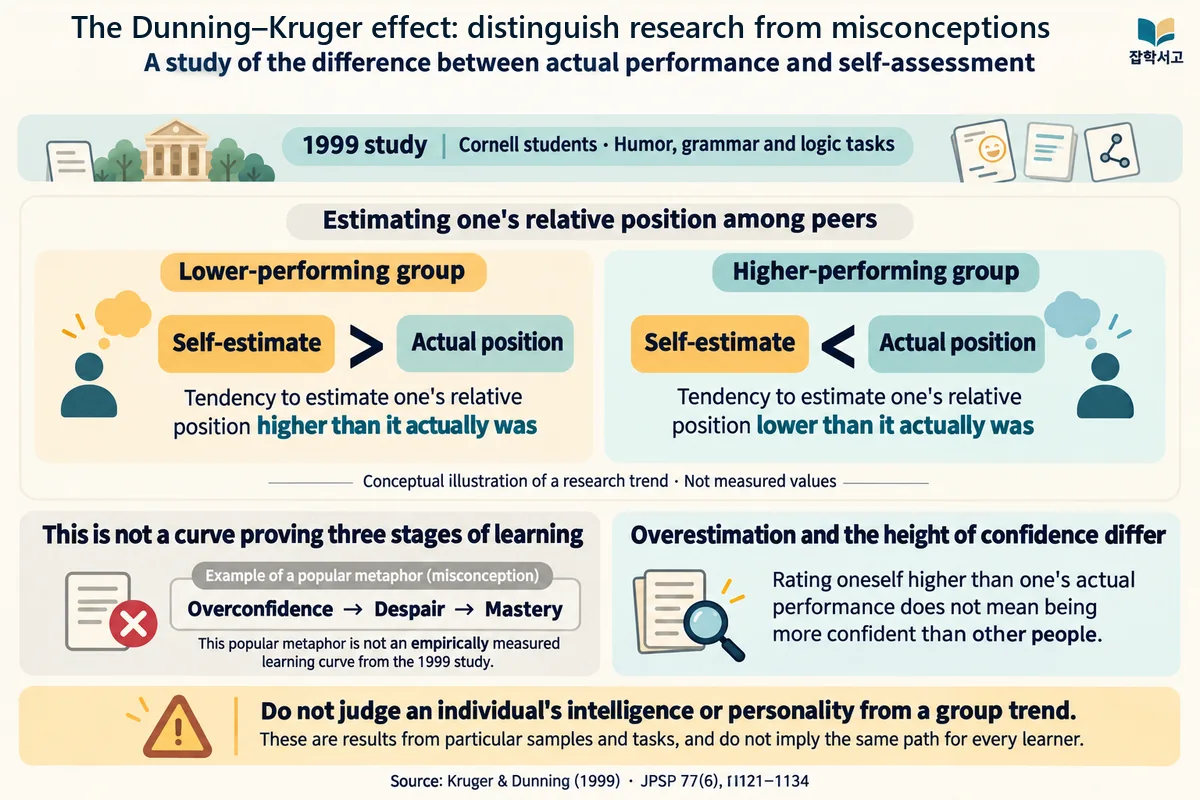

In a study published in 1999, the American social psychologists David Dunning and Justin Kruger reported intriguing experimental results from Cornell University students. After giving the students tasks in humor, logical reasoning and grammar, they asked them to estimate which percentile their ability or test score fell into compared with their peers. In the logic and grammar studies, participants were also asked to estimate how many questions they had answered correctly.
Those in the bottom 25% of actual performance greatly overestimated their relative standing, while those in the top 25% underestimated theirs. However, the top group did not consistently underestimate the number of questions they got right. The two researchers published these findings in a paper titled "Unskilled and Unaware of It," and the phenomenon later became widely known as the Dunning-Kruger effect.
- Overestimation: seeing your performance or relative standing on a particular task as higher than it really is. In the original study, the gap was large among the low-performing groups.
- Relative Underestimation: placing your standing relative to peers lower than it really is. It was observed among the high-performing groups in the original study, and it does not mean that their confidence itself is low.
The important point is that this is not "something only foolish people do." Anyone can fall into the same trap in an unfamiliar area. It can be a useful reference when reflecting on how we rate ourselves at everyday tasks such as driving, investing, writing or cooking, but we cannot conclude that the same pattern appears in every domain.
Why low performers may overestimate themselves

Dunning and Kruger proposed that the knowledge needed to perform a task and the knowledge needed to evaluate that performance can overlap. What they called the "dual burden" means that, on top of struggling to perform the task well, people also struggle to recognize their own mistakes.
(1) A lack of metacognition
Metacognition is the ability to step back and examine your own thinking and abilities. If your sense of how to solve a problem is itself fuzzy, it is hard even to notice that you got it wrong. So people can give a wrong answer and still believe, “That went pretty well.”
(2) Scarce feedback
In everyday life, the signals that correct our mistakes are often weak or delayed. When the people around us only say what we want to hear, or when outcomes depend on chance, misplaced confidence can last a long time.
(3) The illusion of small successes
When beginners get lucky and succeed once or twice, they easily take that experience as proof of skill. Because they have not yet experienced enough failure, they underestimate how hard the task really is.
The limits of metacognition are an explanation the original study examined. The points about feedback and small successes are everyday possibilities worth considering, not a three-factor model proven by the original study. Also, a large degree of overestimation does not mean the absolute level of confidence is the highest.
Why high performers underestimated their relative standing

In the original study, the high-performing groups underestimated their standing relative to peers. These results alone do not show that experts always lack confidence or underrate even their own scores.
(1) The false consensus effect
The false consensus effect is the bias of assuming that your own thoughts or abilities are common among others as well. The researchers interpreted the high-performing groups as having assumed that "others probably did as well as I did." In the grammar study, after seeing other participants' answers, this group assessed its relative standing more accurately.
(2) The height of the comparison group
In everyday life, people may also rate themselves lower as their comparison group shifts to more skilled people. However, a change in comparison group is not an explanation the 1999 study tested directly.
(3) The limits of knowledge come into view
As people learn, they may discover more of "what they don't know yet," and their confidence may shift. This, too, is a possible everyday explanation; the 1999 study did not demonstrate a universal drop in confidence with learning.
The curve of "early overconfidence → drop in confidence → realistic self-assessment" is a popular learning metaphor. The main graphs in the 1999 paper compare actual results and self-assessments of groups by performance level; they are not longitudinal findings showing that an individual passes through those three stages while learning.
Misconceptions and Everyday Uses

The Dunning-Kruger effect is often cited in the popular media, but misconceptions have spread along with it.
(1) It is not “a label for stupid people”
The effect is not a term for disparaging a particular kind of person; it refers to a cognitive bias that anyone can experience in an unfamiliar area. Someone who is an expert in one field may show a beginner's overconfidence in another.
(2) Criticism of the measurement method
When comparing groups by performance level, statistical factors such as regression to the mean must also be considered, and the original paper examined this issue as well. In the logic training experiment of the 1999 study, the self-assessment accuracy of the low-performing group improved. This limited result alone cannot be generalized to claim that all education or feedback always reduces overconfidence.
(3) How to use it in everyday life
When checking yourself, it is better to ask “Is there objective evidence and outside feedback to back up my confidence?” rather than “How sure am I?” When learning a new skill, it helps to be wary of early confidence and to make a habit of frequent small tests to check your actual level.
In teams and organizations, giving specific feedback on the process, not just the results, and making the standards visible so that beginners can see their own blind spots are practical ways to reduce overconfidence.
The Dunning-Kruger effect shows how dangerous it is to ‘not know what you don't know.’ Confidence drives us to take on challenges, but unfounded confidence shuts the door to learning.
The habit of checking your convictions against evidence and feedback: that is the first step toward real growth.