This time, I would like to prepare material on the information retrieval methods commonly used when searching through internet portals or looking for specialized resources. The operation known as Boolean search discussed here can generally be found in advanced search features.
Boolean search is currently the most widely used search technique in online search systems. It uses Boolean logic to express information needs precisely through logical relationships between search terms, and its main operators include AND, OR, NOT, and XOR.
These operators are also sometimes represented by symbols, as shown below.
- AND : &, *
- OR : +, |
- NOT : -, !
The Concept of Boolean Search
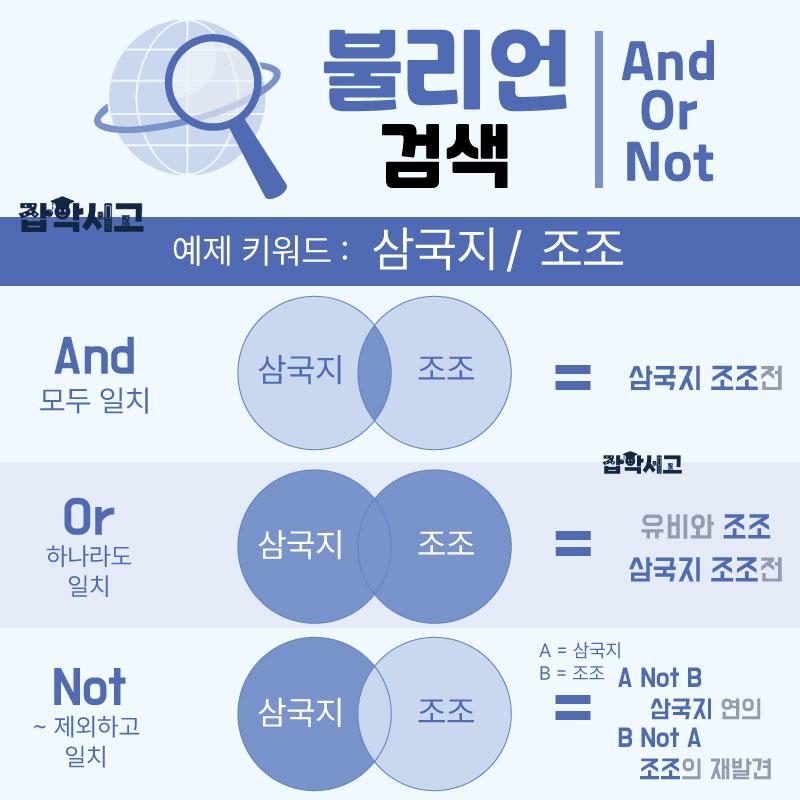 Diagram of the Concept of Boolean Search
The Boolean model is a concept based on Boolean logic (true and false / 0 and 1) and traditional set theory (intersection, union, etc.), and performs searches by treating both the documents to be searched and user queries as sets of words.
The example above applies the concept of Boolean search using the keywords 'Three Kingdoms' and 'Cao Cao'.
An AND search retrieves documents containing both keywords, 'Three Kingdoms' and 'Cao Cao', while an OR search includes documents containing at least one of the keywords, 'Three Kingdoms' or 'Cao Cao'.
Finally, a NOT search retrieves documents that contain the keyword before NOT and do not contain any of the keywords after NOT.
What Actual Searches Look Like
Let us briefly examine the concepts explained so far through actual searches.
 RISS Advanced Search
To show what this looks like in practice, we will examine searches using the advanced search feature of RISS, where academic information can be viewed in one place.
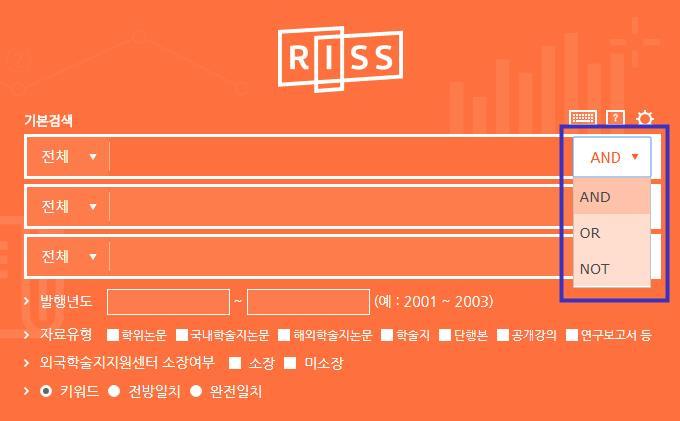 Boolean Operations (AND, OR, NOT) in Advanced Search
When you click the Advanced Search button above the search box, you can see a search interface that applies AND, OR, and NOT, as shown above.
AND Search
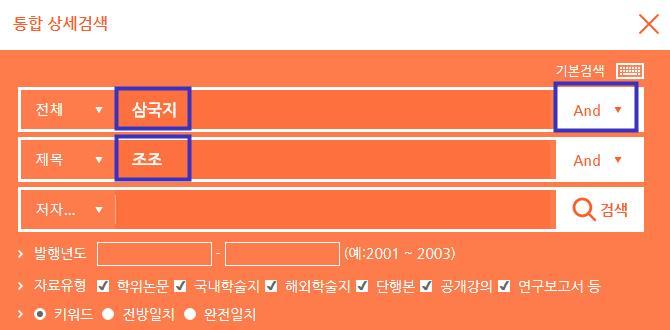 Three Kingdoms AND Cao Cao
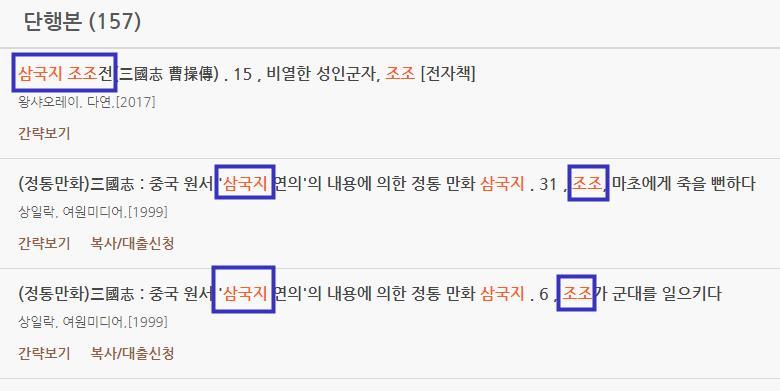 Search Results Using the AND Operator
The first method used was a search with the basic AND operator. This search method, which can also be written as 'Three Kingdoms AND Cao Cao' or 'Three Kingdoms & Cao Cao', finds documents that contain both of the two words entered, 'Three Kingdoms' and 'Cao Cao', in the same document.
OR Search
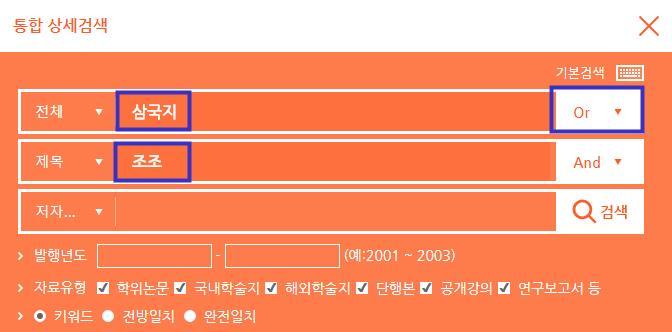 Three Kingdoms OR Cao Cao
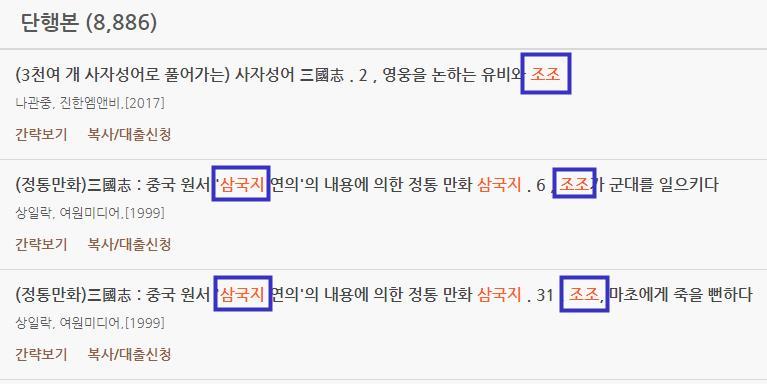 Search Results Using the OR Operator
The second method used, OR search, is based on the concept of a union, which displays documents in the search results even if they contain only one of the search terms, 'Three Kingdoms' and 'Cao Cao'.
This is the most comprehensive search method, encompassing documents retrieved with the AND operator, and it retrieves many documents. While the earlier monograph search using the AND operator returned 157 results, the monograph search using the OR operator returned 8,886 results.
NOT Search
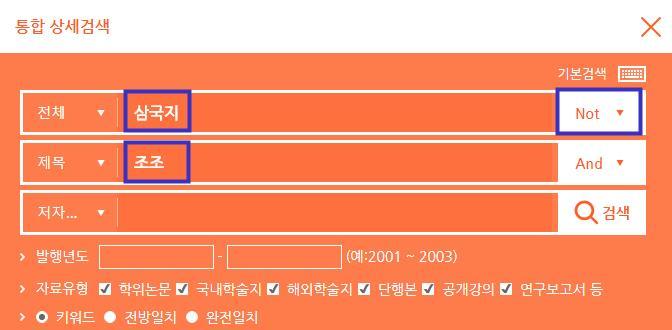 Three Kingdoms NOT Cao Cao
![Search Results for [Three Kingdoms NOT Cao Cao]](https://www.gklibrarykor.com/wp-content/uploads/2023/09/5_2-not-%EC%97%B0%EC%82%B02.jpeg) Search Results for [Three Kingdoms NOT Cao Cao]NOT search is an operation that excludes unwanted search terms, and because the results can differ greatly even with the same search terms, two separate searches were conducted.
Search Results for [Three Kingdoms NOT Cao Cao]NOT search is an operation that excludes unwanted search terms, and because the results can differ greatly even with the same search terms, two separate searches were conducted.
First, the search [Three Kingdoms NOT Cao Cao], spelled out, means to search for 'Three Kingdoms' while excluding documents containing 'Cao Cao'.
As shown above, the results include only documents whose titles contain 'Three Kingdoms' and do not contain the keyword 'Cao Cao'.
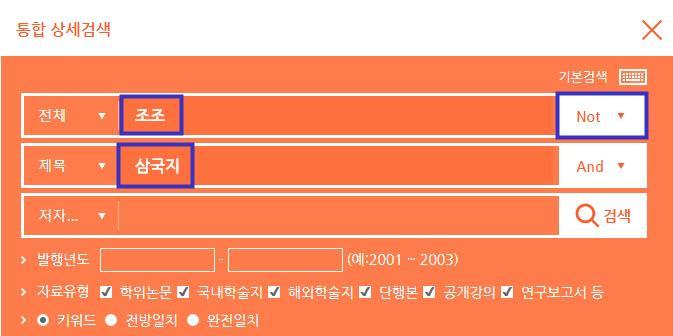 Cao Cao NOT Three Kingdoms
![Search Results for [Cao Cao NOT Three Kingdoms]](https://www.gklibrarykor.com/wp-content/uploads/2023/09/5_4-not-%EC%97%B0%EC%82%B04.jpeg) Search Results for [Cao Cao NOT Three Kingdoms] This time, the order was reversed: the keyword 'Cao Cao' was placed first and the keyword 'Three Kingdoms' was placed after NOT. This search command means to search for the keyword 'Cao Cao' and exclude documents containing 'Three Kingdoms'.
Search Results for [Cao Cao NOT Three Kingdoms] This time, the order was reversed: the keyword 'Cao Cao' was placed first and the keyword 'Three Kingdoms' was placed after NOT. This search command means to search for the keyword 'Cao Cao' and exclude documents containing 'Three Kingdoms'.
As shown above, the search results show documents with only the word 'Cao Cao' in their titles and with the keyword 'Three Kingdoms' completely excluded.
We have now examined Boolean search, which is commonly used on internet portals and specialized academic information websites. This model has the advantages of making searches simple and fast and being easy to implement.
However, when searches are based on exact matches, the number of resulting documents can be too small or too large, and although retrieved documents differ in importance, the model cannot rank the results. Another drawback is that queries are difficult to convert into expressions.
I hope the concepts and features introduced in this material help you understand Boolean operations and find the information you need.