Books are considered one of the most important tools for spreading and advancing human knowledge. The history of books also provides vivid evidence of how humanity's wisdom and experience have been recorded, preserved, and passed on.
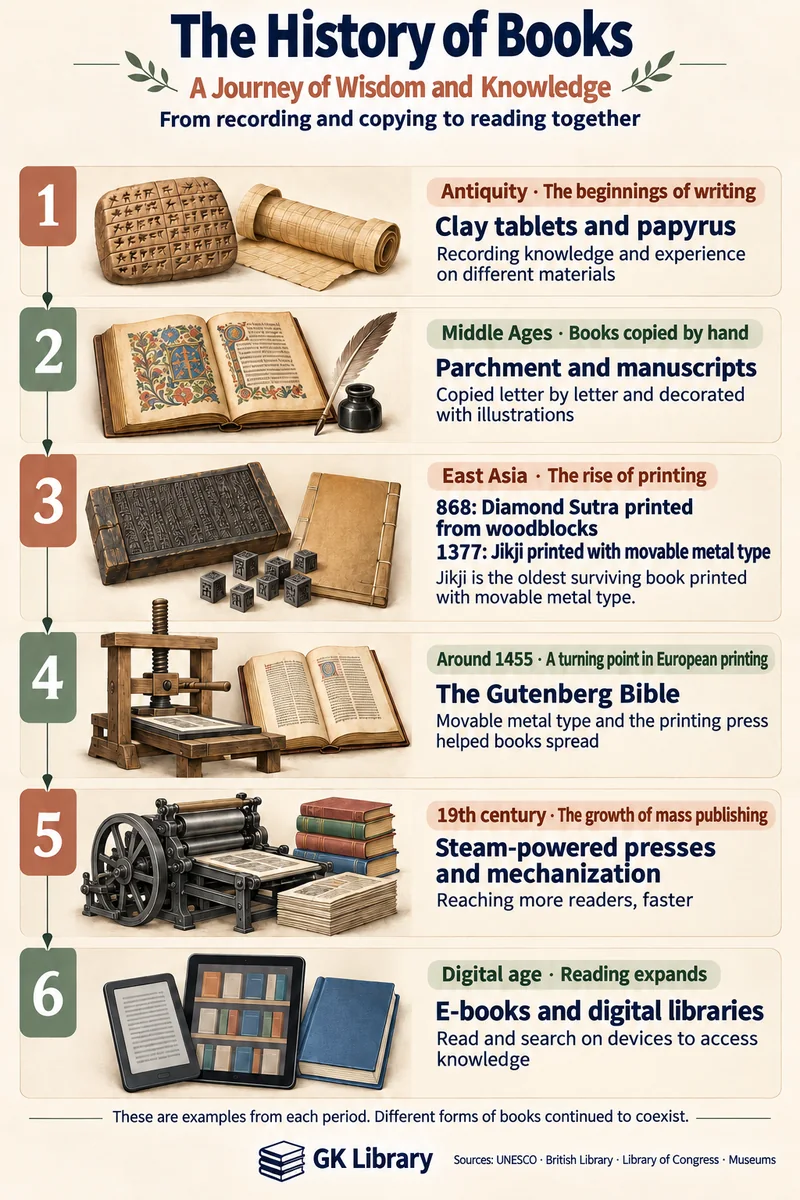
This article will examine the evolution of books through five major periods, from ancient civilizations through medieval manuscripts, the printing revolution, and modern publishing to the digital age.
The Wisdom of Ancient Civilizations: The First Books and the Beginnings of Written Records
 Papyrus as a Writing Medium in Ancient Egypt
Clay Tablets and Cuneiform: Mesopotamian Civilization
Ancient civilizations used various materials to record and preserve wisdom and knowledge. Clay tablets and papyrus were prominent early writing media. The Sumerians of Mesopotamian civilization recorded information by inscribing cuneiform on clay tablets around 3000 BCE. These were used mainly for administrative and commercial purposes, but literary works and scientific knowledge were also recorded.
Papyrus and Egyptian Civilization
In ancient Egypt, papyrus was used as the main writing medium. Papyrus was made by cutting the papyrus plant, a type of reed, into thin strips, and its form resembled today's paper. Documents written on papyrus mainly contained religious and political material and, together with the murals inside pyramids, provide important clues for understanding various aspects of ancient Egyptian civilization.
Bamboo and Silk: Writing Media in China
In China, bamboo and silk were used as early writing media. During the Spring and Autumn and Warring States periods, people used books made by inscribing characters on bamboo strips and binding them together, while writing on silk was also common during the Han dynasty. These writing media played an important role in preserving the philosophy, science, and culture of the time.
Scrolls: Ancient Greece and Rome
In ancient Greece and Rome, scrolls were used as the main writing medium. Scrolls were made from papyrus or parchment and were widely used to preserve legal documents and historical records, particularly in the Roman Empire. Works of ancient classical literature were also passed down in scroll form.
Palm Leaves: Written Records in Ancient India
In ancient India, palm leaves were used to record religious scriptures. Buddhist and Hindu scriptures in particular were recorded in this form and passed down over the centuries. These records are important sources for understanding the philosophy and religious thought of the Indian subcontinent.
Overall, books and written records in ancient civilizations played an important role in preserving each civilization's wisdom and knowledge and passing them on to future generations. Recorded using various materials and methods, these sources provide essential information for people today to understand ancient civilizations.
Medieval Manuscripts: Preserving and Spreading Knowledge
 A Medieval Manuscript
Manuscript Production Centered on Monasteries and Churches
During the Middle Ages, books were produced and preserved mainly in monasteries and churches. Monks devoted considerable time to producing manuscripts, which played an important role in preserving and spreading knowledge at the time. Manuscripts were usually written on parchment or calfskin and were produced with great precision.
Elaborate Decoration and Illustrations
One of the most distinctive features of medieval manuscripts is their elaborate decoration and illustrations. While copying religious documents such as the Bible or the lives of saints, monks often added beautiful decorations in the margins. These decorations reflected the artistic sensibilities of the time while also helping readers concentrate and understand the text.
The Role of the Scriptorium
In medieval Europe, producing manuscripts was considered a very important task. Monasteries had a separate space called a scriptorium for producing manuscripts, where monks devoted themselves to copying texts throughout the day. Thanks to these efforts, many classical documents and religious texts could be passed down to future generations.
Manuscript Production in the Islamic World
Manuscripts were also actively produced and preserved in the Islamic world. Baghdad's "House of Wisdom" in particular was a center for collecting and translating various documents from around the world, and Islamic scholars of the time translated ancient Greek and Roman scientific, philosophical, and medical documents into Arabic and studied them. This translation work later had a major influence during the European Renaissance.
Difficulties in Preserving Manuscripts
Preserving medieval manuscripts was difficult because of the technological limitations of the time. Parchment could deteriorate over time, and if monasteries that housed manuscripts were destroyed by war or fire, many documents risked being lost. Nevertheless, many manuscripts have survived to the present day and serve as important sources for understanding medieval knowledge and culture.
Preserving Knowledge Across Various Fields
The importance of medieval manuscripts also lies in the fact that they were not limited to religious documents. Monks also contributed to recording and preserving knowledge in various fields, including science, medicine, philosophy, and history. These manuscripts served as an important bridge through which medieval knowledge reached the modern world.
Medieval manuscripts played an important role in preserving and spreading knowledge. Thanks to the monks' tireless efforts and care, we can gain a deep understanding of medieval knowledge and culture today, and these manuscripts remain an important legacy in human history.
The Printing Revolution: Gutenberg and the Dawn of Popularization
 The Printing Revolution Begun by Gutenberg
Gutenberg and the Invention of Printing with Movable Metal Type
The printing revolution began in the mid-15th century with Johannes Gutenberg of Germany. Gutenberg developed a printing technique using movable metal type, which made the mass production of books possible. Gutenberg's printing technique was far more efficient than existing methods of producing manuscripts and allowed more books to be produced in a short time.
Making Knowledge Widely Available and Lowering Prices
Gutenberg's printing technique contributed greatly to making knowledge widely available. Until then, books had been extremely rare and expensive objects that ordinary people found difficult to own. However, advances in printing lowered book prices and enabled more people to access books. The mass printing of the Bible in particular also had a major influence on historical events such as the Reformation.
The Development of Language and Literature
Advances in printing also contributed to the development of language and literature. Previously, many documents had been written only in particular languages such as Latin, but advances in printing led to the production of more books in the languages of individual countries. This helped enrich the culture and literature of each region.
The Spread of Printing Across Europe
Gutenberg's printing technique spread rapidly across Europe. Printing houses were established in various countries, including Italy, France, and England, and books on a wide range of subjects were printed. These books spread new ideas and knowledge in various fields, including scientific discoveries, philosophical thought, and artistic expression.
Advances in Scholarship and Science
The printing revolution also had a major influence on the advancement of scholarship. Universities and scholarly institutions gained access to more books, which greatly benefited research and education. During the Scientific Revolution, scientists shared their research findings with one another through books, allowing them to accelerate the accumulation and advancement of knowledge.
Laying the Foundations of the Modern Publishing Industry
Overall, the printing revolution was an important turning point in making books widely available and spreading knowledge. During this period, books became established as a source of information accessible to everyone, rather than something that only a privileged few could own. Gutenberg's printing technique was a revolutionary invention that laid the foundations for the modern publishing industry and the dissemination of knowledge.
Advances in Modern Printing Technology
 The Mass Production of Books Made Possible by More Advanced Printing Techniques
The Introduction of Steam-Powered Printing Presses and Mass Publishing
One of the most important innovations in the development of modern printing technology was the introduction of the steam-powered printing press. In the early 19th century, the steam-powered printing press developed by Germany's Friedrich Gottrop Köhler and Britain's William Nicholson made high-volume printing possible much faster and more efficiently than existing manual presses. This technology dramatically increased printing speeds, and as mass publishing became possible, printed materials such as books, newspapers, and magazines increased rapidly. This contributed greatly to the dissemination of information and public education.
The Emergence of Publishing Houses and Public Education
Publishing houses emerged alongside the introduction of steam-powered printing presses. In the 19th century, as publishers began specializing in planning, producing, and distributing books, the publishing industry became more organized and expanded. Public education expanded during this period, and more people became able to read and write. Publishers produced large quantities of books in various fields, including textbooks, literary works, and scientific books, playing an important role in spreading knowledge.
Changes in the Relationship Between Modern Authors and Readers
Advances in modern printing technology also changed the relationship between authors and readers. As mass publishing became possible, authors could reach more readers and earn a living through book sales. This led to the professionalization of authorship and improvements in the quality of literary works. In addition, as the public gained easy access to books on various subjects and in various styles, a culture of reading spread. Authors and readers developed closer relationships, which encouraged the development of literature and publishing.
The Introduction of New Printing Technologies
New printing technologies were introduced in the late 19th and early 20th centuries. Offset printing and rotogravure printing in particular represented important advances. Offset printing is a method of printing images and text by chemically processing them on a flat plate, which enabled higher-quality printed materials to be produced quickly. Rotogravure printing made high-volume printing possible by using images engraved on cylinders and was widely used, particularly for printing magazines and posters.
Advances in modern printing technology contributed greatly to making information and knowledge widely available. The introduction of steam-powered printing presses and new printing technologies transformed the publishing industry, encouraged the development of public education and literature, and changed the relationship between authors and readers. These technological advances laid the foundations for the modern publishing industry and played an important role in dramatically expanding access to and the dissemination of knowledge.
The Digital Age: Electronic Books and the Unlimited Expansion of Knowledge
 Books Advancing Again in the Digital Age
The Emergence of Electronic Books and the Changes They Brought
The arrival of the digital age completely changed the concept of books and the ways they are used. With the emergence of electronic books (e-book), books were no longer limited to a physical form. Electronic books are stored as digital files and can be read on various electronic devices, which has greatly helped overcome constraints of space and time.
Innovations in Portability and Accessibility
One of the greatest advantages of electronic books is their portability and accessibility. Thousands of books can be stored on a single electronic device, allowing people to read a variety of books anytime and anywhere. This is particularly useful for students and researchers and offers the convenience of carrying a large number of books even while traveling.
The Ease of Self-Publishing
The development of digital publishing has also made publishing at one's own expense (self-publishing) easier. In the traditional publishing process, publishers made all the decisions, but digital platforms have enabled anyone to publish their own books directly. This has led to the publication of more books on various subjects and in various styles.
Changes in Libraries and Bookstores
Libraries and bookstores are also changing with the emergence of electronic books. Many libraries offer electronic book lending services to make books more accessible to their users, while bookstores operate in a hybrid format, selling both printed and electronic books. This gives readers a wider range of choices and encourages diversification in the book industry.
Increased Knowledge Sharing and Collaboration
Advances in digital technology have made knowledge sharing and collaboration easier. Through the internet, people around the world can read and discuss the same book at the same time, which contributes greatly to the formation of a global knowledge network. Materials such as academic papers and research reports are also being shared in digital form, accelerating scholarly progress.
The Educational Impact of Electronic Books
Electronic books in the digital age have also had a major impact on education. Electronic textbooks and online learning materials are more affordable and easier for students to access, contributing to greater equality in education. Educational institutions are introducing various teaching methods that use electronic books to improve learning outcomes.
Overall, books in the digital age are moving beyond their traditional form and enabling new dimensions of knowledge dissemination and sharing. Electronic books overcome physical constraints, improve access to knowledge, encourage changes in the publishing industry, and play an important role in forming a global knowledge network.
The history of books extends beyond changes in recorded knowledge and has played an important role in shaping and spreading human civilization and culture. The history of written records, which began in ancient civilizations, has developed continuously through medieval manuscripts to the printing revolution and the digital age.
Through this process, we come to realize that books are more than a means of storing information: they are an important cultural legacy containing humanity's wisdom and experience. Books will continue to contribute to humanity's advancement by spreading and sharing knowledge.