When we buy expensive shoes and then find the same product cheaper online, we often comfort ourselves by saying, “Still, it was worth trying them on in the store.” The same goes for someone who smokes while saying “stress is more harmful,” or someone who chooses gaming over studying for an exam and then justifies it with “I needed a rest today.” This process, in which the mind rewrites the story on its own to ease the discomfort when beliefs and actions clash, is ‘Cognitive Dissonance.’
Put simply, cognitive dissonance refers to ‘the psychological discomfort that arises when contradictory beliefs, attitudes, and behaviors exist at the same time, and the automatic adjustment process that tries to reduce that discomfort.’ Since the American psychologist Leon Festinger formulated it as a theory in 1957, it has become a key concept for explaining persuasion, attitude change, and consumer behavior.
In this article, we lay out the definition of cognitive dissonance and its classic experiment, the four paths for resolving it, its implications in everyday life and marketing, and a healthy attitude for dealing with it, all in a way that is easy to understand.
The mechanism of cognitive dissonance and everyday solutions
What Is Cognitive Dissonance?
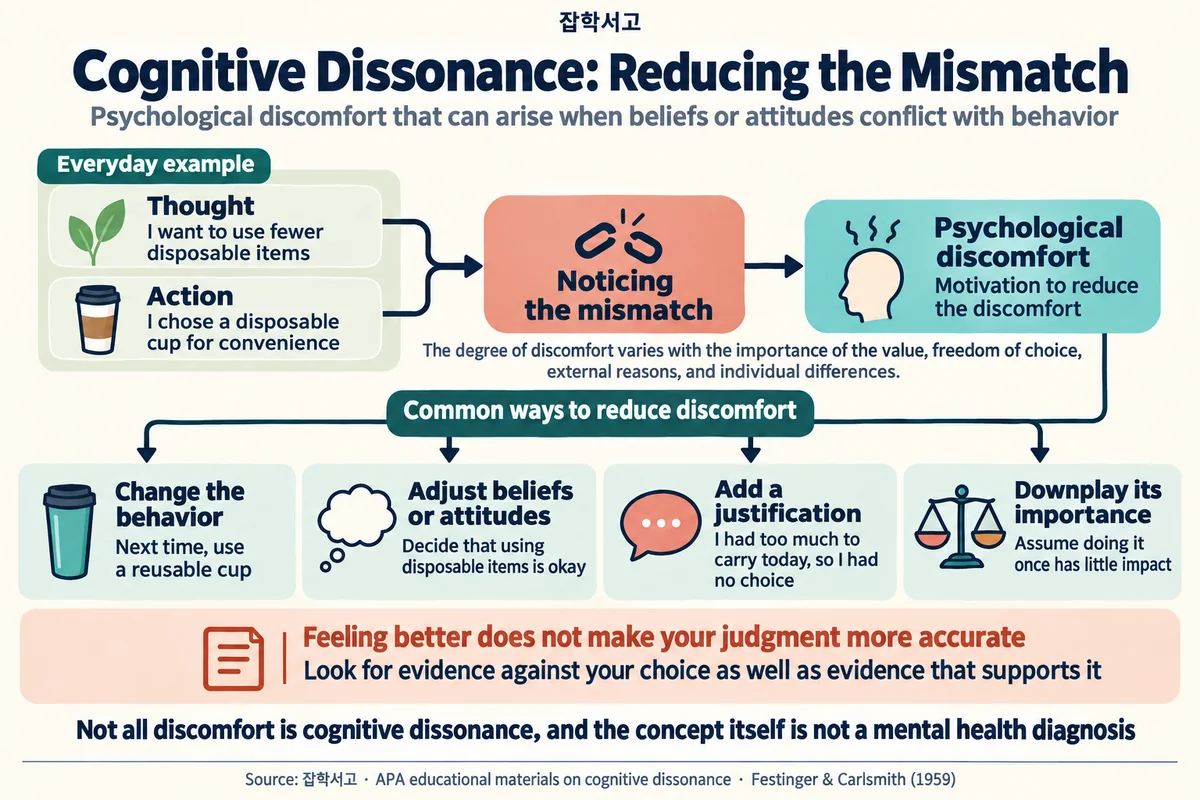

Festinger saw people as ‘beings who want to be consistent.’ When what I believe and what I do collide, tension arises, and to reduce that tension we change our beliefs, our actions, or the interpretation that connects the two. The discomfort itself is less a pathology than a signal that the mind is trying to regain its balance.
To understand this concept, it helps to distinguish three elements.
- Cognition: A unit of information that comes to mind, such as a belief, an attitude, a piece of knowledge, or an evaluation of oneself.
- Dissonance: The state of tension that arises when two cognitions do not fit together logically or psychologically.
- Drive for Consistency: The motivation to adjust cognitions or behaviors in order to reduce the tension.
The important point is that the discomfort comes not from ‘the facts being wrong’ but from ‘things not fitting together.’ Even for the same action, the strength of the dissonance varies depending on how much that action conflicts with your own values.
The Paradox of Forced Compliance Shown by a Classic Experiment

One of the studies that made cognitive dissonance famous is the 1959 ‘Forced Compliance’ experiment by Festinger and J. Merrill Carlsmith. After doing a boring task, participants were asked to tell the next participant that it had been “fun.”
(1) The $1 condition
People who received a small reward were more likely to change their own attitude, saying “It really was a little fun.” Since they had no sufficient reason to lie, they had to revise their attitude to reduce the discomfort.
(2) The $20 condition
People who received a generous reward largely kept their original attitude that the task was ‘boring.’ They had a sufficient external reason (“I said it for the money”), so they had less need to change their attitude.
(3) Applied to everyday life
When we come to take a position without much reward, we often end up believing that position more sincerely. This also connects to persuasion techniques in which a small commitment leads to a large change in attitude.
Post-purchase rationalization and smokers’ self-persuasion show the same principle. Once a choice has already been made, the mind often reinterprets that choice as ‘the right choice.’
Four Paths for Reducing Dissonance

When the discomfort grows, people usually use one of the following paths, or several at once.
- Change Behavior: Actually cut down or quit smoking to match the belief that smoking is harmful.
- Change Belief: Loosen your own standard, as in “This time was an exception.”
- Add or Avoid Information: Read only the reviews that support your choice, and deliberately avoid information that contradicts it.
- Trivialize: Make the conflict feel lighter by saying, “That much isn’t a big problem.”
[A simple scene]
Someone who paid for a gym membership but does not go either lowers its importance by saying “I can start next week,” or changes the interpretation by adding information, as in “Signing up itself was the start of taking care of my health.” The paths themselves are neutral, but depending on which path you use often, it can become growth or self-deception.
How It Plays Out in Everyday Life, Persuasion, and Marketing

Cognitive dissonance works constantly outside the classroom and the laboratory, too. Advertisements try to reduce post-purchase dissonance by sending the message “You made the right choice” right after a purchase, and campaigns sometimes start by getting a small public commitment to guide people into bringing their attitudes in line with their actions.
To handle it in a healthy way, what you need is not speed in getting rid of the discomfort but an attitude of reading the direction the discomfort points to.
(1) See the discomfort as a signal
Before guilt or excuses come to mind, try writing down in one sentence, “Which belief and which action are clashing right now?”
(2) Choose the side you can change
If your actions conflict with your values, adjust your habits; if your values are far removed from reality, review your standards. If both are possible, starting with a small change in behavior tends to last longer.
(3) Don’t collect only confirmation
If you gather only information that supports your choice, the dissonance disappears for a while, but errors in judgment can grow. The habit of deliberately reading at least one counterargument helps.
(4) Separate your self-worth from your choices
When you do not lump a wrong choice together with being ‘a wrong person,’ correcting your attitude becomes much easier.
Cognitive dissonance is a device by which the mind balances itself to protect its consistency. Thanks to this device we quickly regain stability, but sometimes it also covers up uncomfortable truths. If you use the theory only as a tool for pointing out ‘other people’s rationalizations,’ it becomes poison; if you use it as a mirror for looking back on your own choices, it becomes medicine.
The next time an excuse comes to mind first, pause that sentence for a moment and try placing the two clashing pieces side by side. Facing the discomfort instead of turning away from it: that is the first step toward a more honest understanding of yourself.