Some of us have had our hearts pound so hard before a presentation that our minds went blank, and have also had the experience of finally being able to focus only once a deadline was right on top of us. Conversely, when there is no tension at all, work slips out of our grip and drags. Tension seems to be a problem both when there is none and when there is too much, so how much is the right amount?
The explanation that has long been cited in answer to this question is the Yerkes-Dodson Law. It is commonly presented as an inverted-U curve: performance is best when arousal or tension is moderate and falls when it is too low or too high. But the fact that this curve is not as it first appeared is a key to reading the law.
This article goes in order through the original 1908 experiment, how the inverted-U curve became fixed, why the right amount of tension changes with the difficulty of the task, and finally the limits of the law and how to use it in daily life.
How to Read the Relationship Between Tension and Performance
1908: An Experiment That Began with Dancing Mice

The law is named after the American psychologists Robert Yerkes and John Dodson. In 1908 they published a paper titled “The Relation of Strength of Stimulus to Rapidity of Habit-Formation.” The subjects were not people but Japanese dancing mice.
The experiment was simple. In front of a mouse were a white passage and a black passage; the mouse was supposed to go to the white one, and if it entered the black one it received a mild electric shock. The researchers varied the strength of the shock and repeated the same test ten times a day to measure how quickly the mice learned the habit of avoiding the black passage. They also added a condition that made the two passages harder to tell apart by reducing the difference in their brightness.
At first they expected that the stronger the shock, the faster the learning, but the result was not so. In some cases the mice learned fastest at a medium shock strength. To follow up this unexpected result the experiments grew in number, and in the process the researchers came to compare cases where the passages were easy to tell apart with cases where they were hard. That comparison later became the heart of the law.
The Harder the Task, the Lower the Right Level of Tension

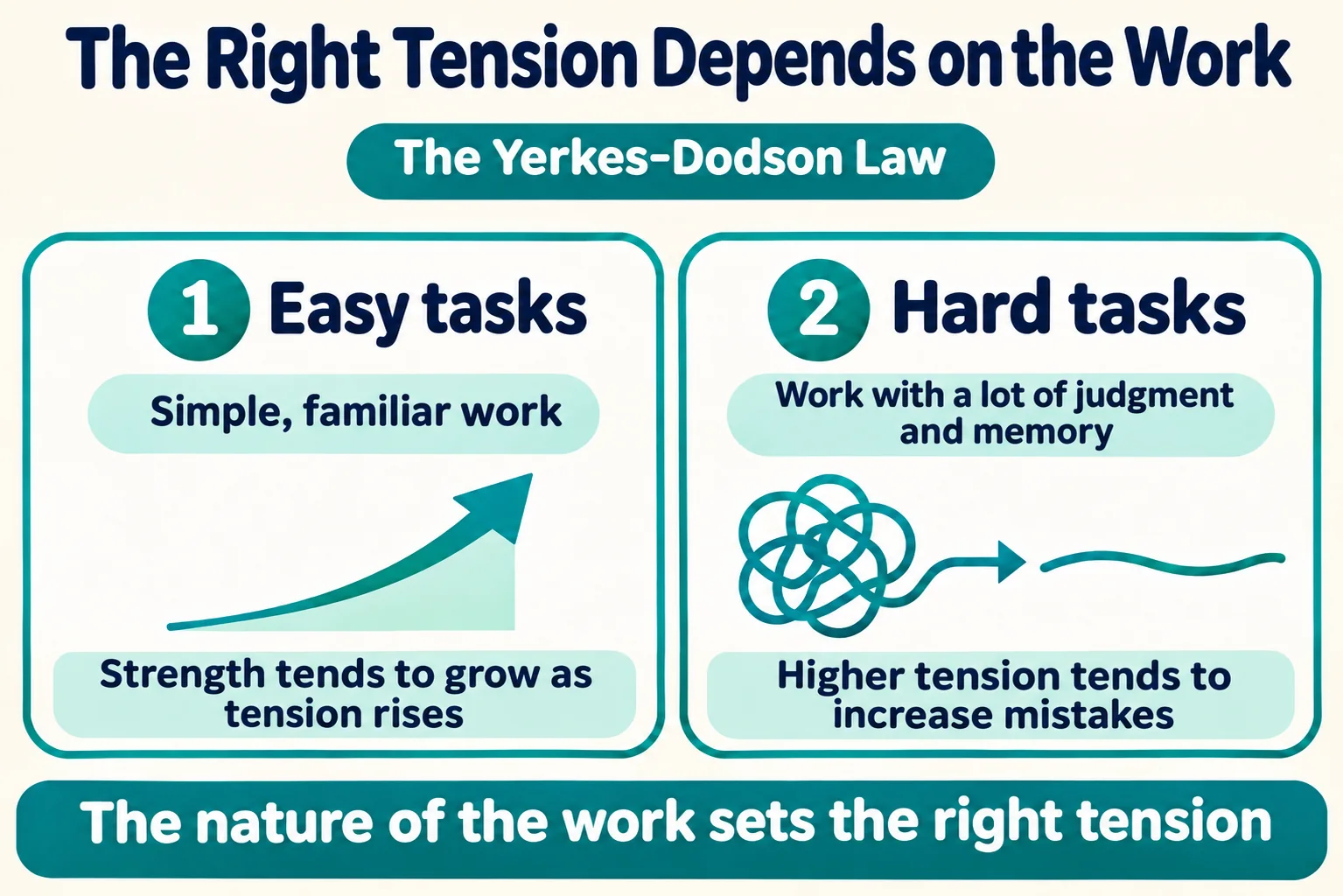
The key conclusion of the original paper was not an inverted-U curve but that the best stimulus strength changes with the difficulty of the task. When the passages were easy to tell apart, a stronger shock sped up learning, and when they were very hard to tell apart, a weak shock close to the threshold worked better.
(1) Easy tasks
With simple, familiar work, performance tends to gain strength as tension rises. Simple repetitive tasks and work that relies on physical effort are close to this.
(2) Hard tasks
With complex work that demands a lot of judgment and memory, higher tension tends to narrow thinking and increase mistakes. This kind of work is solved better in a calm state.
Yerkes and Dodson cautiously wrote of this result that easy habits, which do not demand fine sensory discrimination or complicated connections, can be formed readily even under strong stimulation. In that sense the conclusion was worded from the start as a supposition rather than an assertion.
This is why the same person at the same level of tension can do one kind of work well and ruin another. The right tension is not fixed at a single number but moves with the nature of the work. In terms of exam questions, it means the comfortable level of tension can differ between a simple memorization question and an essay question that takes several steps.
How the Inverted-U Curve Took Hold

The curve we see in textbooks today was made much later. From around the 1950s, researchers focused on the U-shaped curve in the graph of the original paper and began to reinterpret it as the relationship between arousal and performance. A major turning point is said to be the 1955 paper in which the Canadian psychologist Donald Hebb explained the inverted-U relationship between arousal and performance in terms of the nervous system.
- The original law (Original Finding): the content that the best stimulus strength changes with the difficulty of the task.
- The later interpretation (Inverted-U Curve): the curve saying that performance is highest when arousal is moderate, which spread widely mixed together with Hebb’s theory.
So some point out that it is historically more accurate to call this curve Hebb’s curve. The name of the law stayed the same, but what it holds has changed over time. It is also worth remembering that the original experiment was a small one with a few mice and did not measure arousal or performance directly, because the learning speed of mice cannot be carried over straight to human exam scores or work performance.
Knowing the Limits and Using It in Daily Life

This law is a picture that shows a rough tendency, not a formula that fits every person. The right level of tension varies with a person’s temperament and experience and with how familiar the task is, and it is also hard to measure tension precisely as a single number. The curve is only a drawing made to be easy to think with, so laying it directly over real human performance easily leads to misunderstanding.
(1) Look at the nature of the work first
For hard work you are learning for the first time, calming yourself may help, and for simple work you know well, raising the goal to raise your tension may help.
(2) Keep ways to lower or raise your tension
When you are too tense, you can slow your breathing or break the work into small pieces, and when you are too relaxed, you can adjust by setting a short deadline.
(3) Don’t use the curve as a reference chart
Rather than trying to pinpoint exactly where your tension sits on the curve right now, keeping a record of your body and mind when work goes well and when it stalls will help more in finding your own right level of tension.
Tension is not an enemy to be eliminated but a material to be shaped to the nature of the work. Noticing how much tension your work calls for, and raising or lowering it to match, is the first step of the Yerkes-Dodson Law.