Show someone the word “blue” written in red ink and ask, “Say the color of the letters,” and most people hesitate for a moment. The correct answer is “red,” but “blue” keeps trying to come out first. This phenomenon, in which the simple task of naming a single color suddenly feels difficult, is the “Stroop Effect.”
Put simply, the Stroop Effect means “the phenomenon in which responses to name a color slow down and mistakes increase when the meaning of a word and the color of its letters conflict.” It happens because our brains are so good at reading words, and it is a classic experiment showing how we divide our attention and suppress distracting information.
In this article, we will look in turn at the experiments that first made the Stroop Effect known, the theories and brain processes that explain it, and its uses in psychological testing and everyday life.
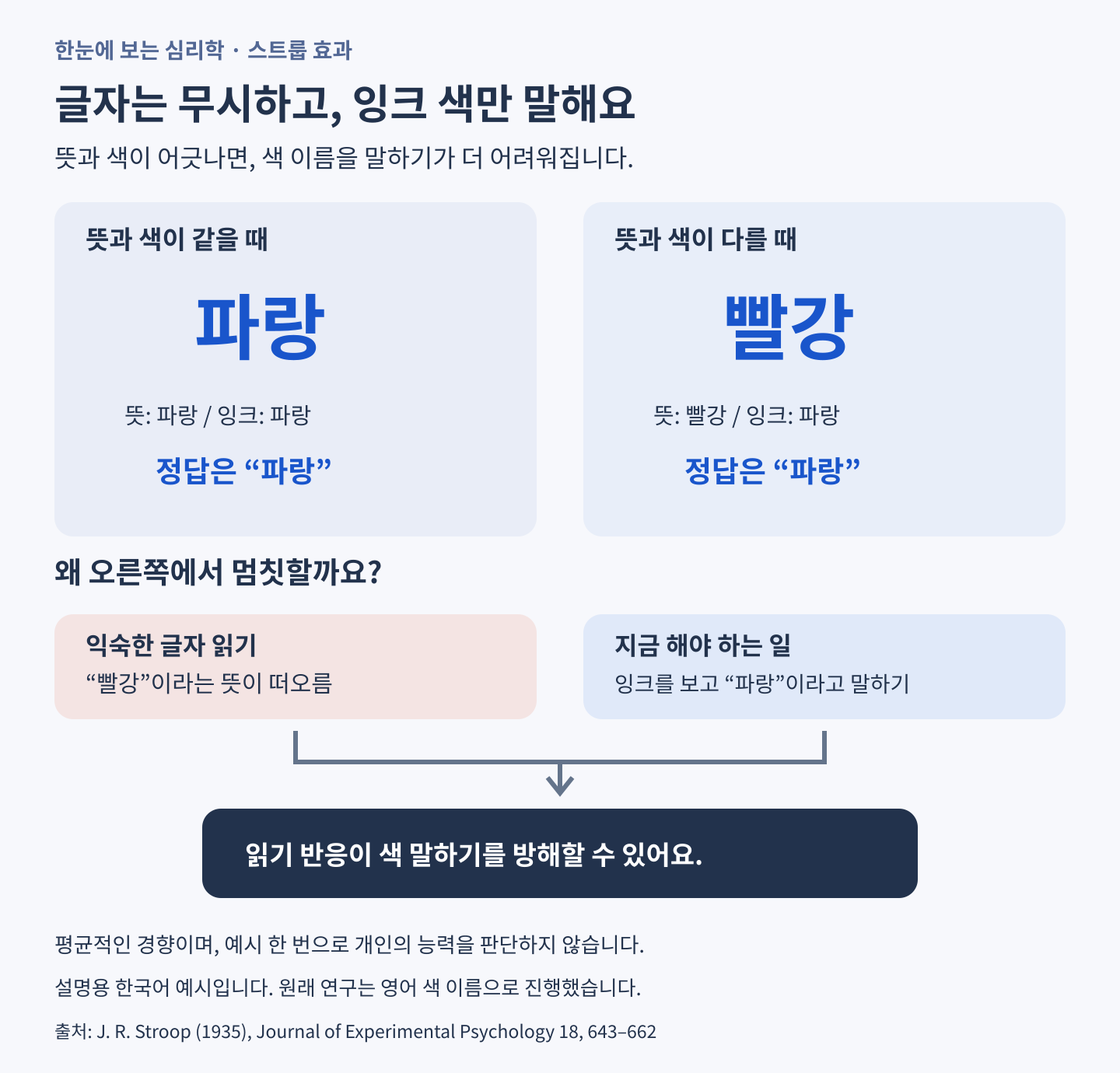
The Brain's Tug-of-War Between Reading and Seeing
Experiments That Began with Color Name Cards in 1935
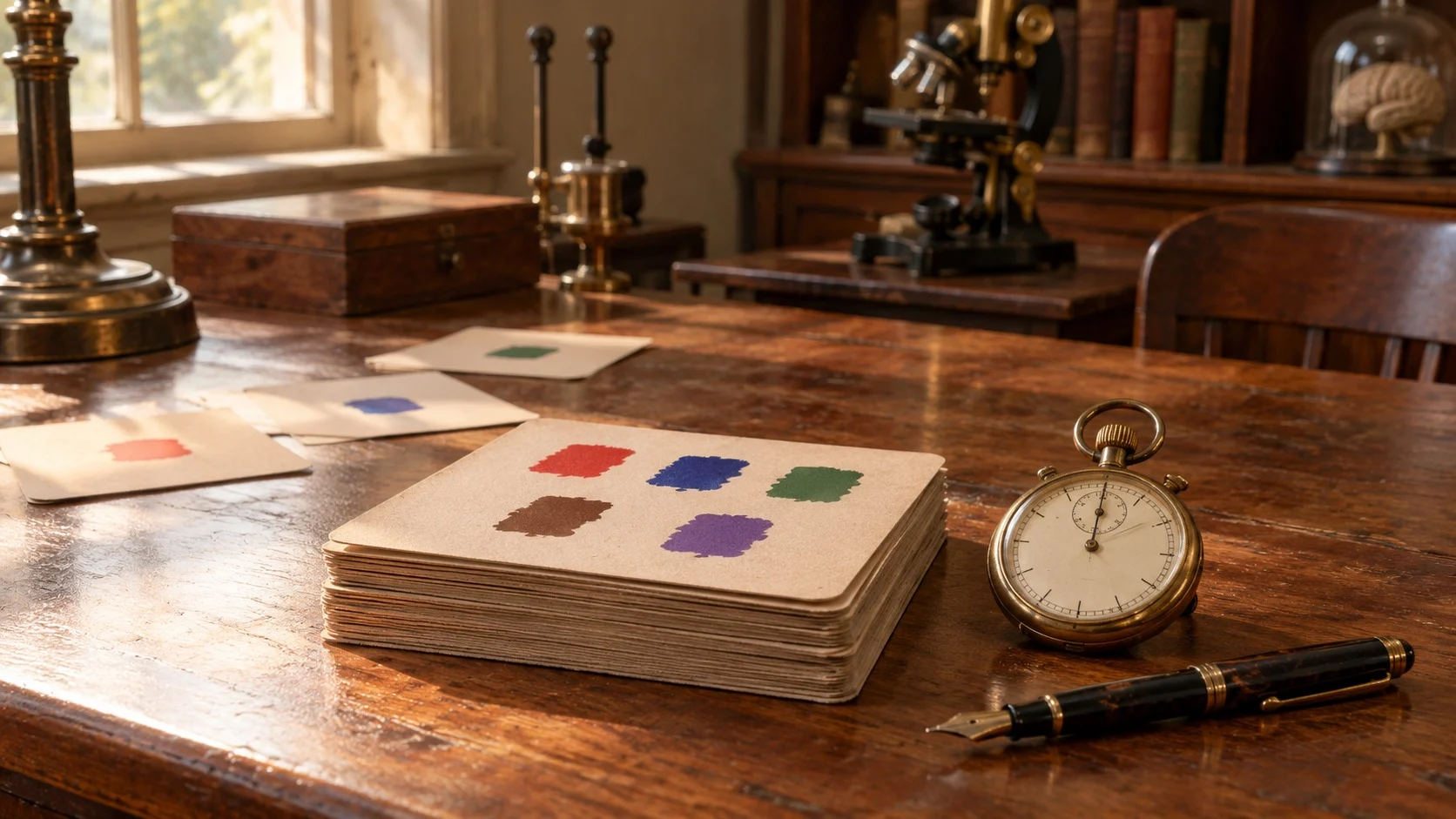
The Stroop Effect is named after the American psychologist John Ridley Stroop. In 1935, he published a paper titled “Studies of Interference in Serial Verbal Reactions” in the Journal of Experimental Psychology. However, a similar phenomenon had been reported earlier, in 1929, by Erich Rudolf Jaensch in Germany, and 19th-century research by James McKeen Cattell had also shown that people read words faster than they name colors.
(1) The First Experiment
Participants read aloud color names printed in black and color names printed in a different color of ink. Even when the ink color did not match, their reading speed barely changed.
(2) The Second Experiment
This time, participants were asked to ignore the words and name the ink color. Naming the colors of 100 color squares took an average of 63.3 seconds, but naming the ink colors of 100 mismatched color names took 110.3 seconds, an increase of about 74 percent.
(3) The Third Experiment
Stroop also examined how the interference changed with repeated practice. Practice made participants faster, but the interference did not disappear completely.
Why Does Naming Colors Slow Down?

The common idea behind several theories is that two pieces of information, the word and the color, are processed at the same time and then collide at the stage of choosing a single answer.
- Relative Speed of Processing: Because the brain reads words faster than it recognizes colors, the word information arrives first and blocks the way for the color information.
- Selective Attention: This explains that recognizing colors requires more attention than reading words, so it takes longer.
- Automaticity: The most widely accepted explanation. Because of long reading habits, the meaning of a word comes to mind automatically, but naming a color does not happen automatically, which causes hesitation.
- Parallel Distributed Processing: This focuses on the strength of neural pathways rather than speed. It explains that the frequently used reading pathway is stronger than the color-naming pathway, so when both are activated together, the stronger one interferes with the weaker one.
In brain imaging studies, the Anterior Cingulate Cortex and the Dorsolateral Prefrontal Cortex became active during this task. The anterior cingulate cortex detects conflict and selects the appropriate response, while the prefrontal cortex holds on to the goal of “focus only on the color” and suppresses distracting information.
The Stroop Effect as a Psychological Test
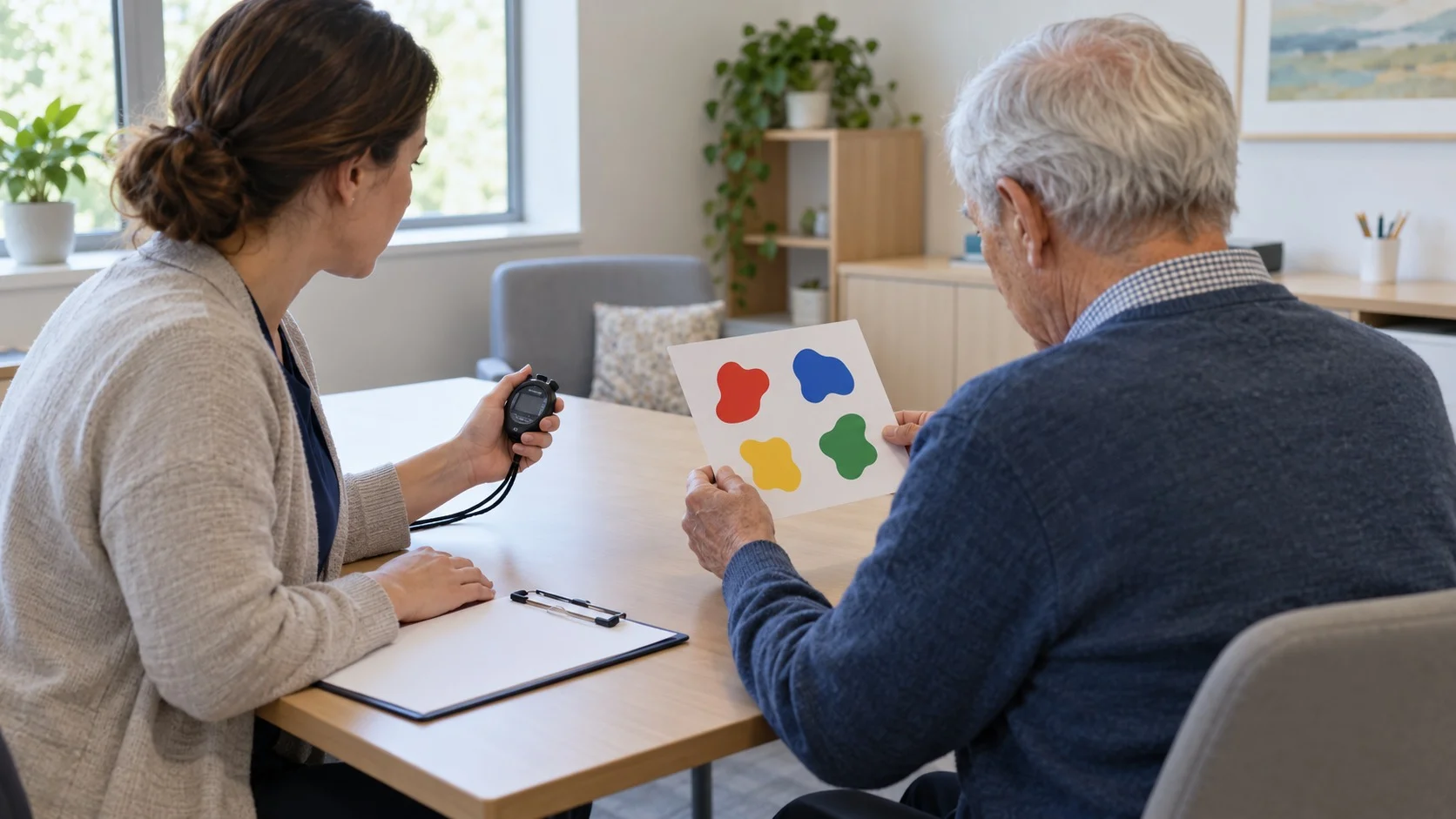
The Stroop Effect has moved beyond the laboratory and become established as a neuropsychological test. The so-called Stroop Test is a tool for measuring selective attention, cognitive flexibility, and processing speed, and it is used alongside other tests to assess executive function, the ability to plan and regulate.
(1) How the Test Works
Detailed rules differ from test to test, but most include both a task of reading mismatched color names and a task of naming their ink colors. Scores are based on how many items are answered correctly within a set time, or how many seconds it takes to finish, along with the number of errors.
(2) Clinical Use
Interference tends to be greater in brain injury, neurodegenerative diseases such as dementia, attention-deficit/hyperactivity disorder (ADHD), schizophrenia, addiction, and depression. That is why the test is used as material to support diagnosis and monitor a person's condition.
(3) Developmental Research
Reaction times on the Stroop task decrease steadily from childhood to early adulthood. This is interpreted as meaning that processing speed increases and the capacity for self-regulation grows with age.
Variations and the Stroop Effect in Everyday Life

The Stroop task has been adapted into many different forms for research.
The Emotional Stroop Task
Participants name the colors of a mix of negative words such as “sadness” and “violence” and neutral words such as “clock” and “door.” Depressed people tend to be slower when naming the colors of negative words, so the task is used to study how emotions capture attention.
Numerical and Spatial Stroop Tasks
These tasks create a mismatch between meaning and position or appearance, for example by writing small numbers in large print and large numbers in small print and asking participants to compare their size, or by showing the word “up” at the bottom of the screen. Even though the forms differ, responses slow down whenever meaning and appearance collide.
Similar things are common in everyday life. When meaning and appearance differ, as with a sign whose arrow direction conflicts with the word “left” or an “OK” button colored red, people pause for a moment. That is why, when designing signs or screens, it is important to make color, text, and position point to the same meaning.
The Stroop Effect shows how deeply ingrained our reading habits are, and how hard the brain works to suppress them. An experiment that began with simple color name cards has now become a leading tool for measuring attention and self-control.
Pausing a familiar response for a moment and looking again at the information in front of you is the first step toward the power to focus.