
Pencil lead and a diamond ring look like completely different things. One wears away easily when you rub it on paper, while the other is counted among the hardest natural substances in the world. Yet, surprisingly, the atoms that make up both are exactly the same: carbon. Chemistry has a single name for this phenomenon, in which the same ingredient produces such different properties. It is called an “allotrope.”
Put simply, an allotrope is “a substance made of only one element whose properties differ because its atoms are bonded and arranged in a different way.” Even when the element is the same, how its atoms are stacked and linked can greatly change its color, hardness, electrical conductivity, and even its reactivity.
This article lays out allotropes in an easy-to-follow way, from their definition and how they arise to the many faces of carbon, examples from oxygen, phosphorus, and tin, and perspectives for understanding allotropes.
How Allotropes Work and Key Examples
What Is an Allotrope?
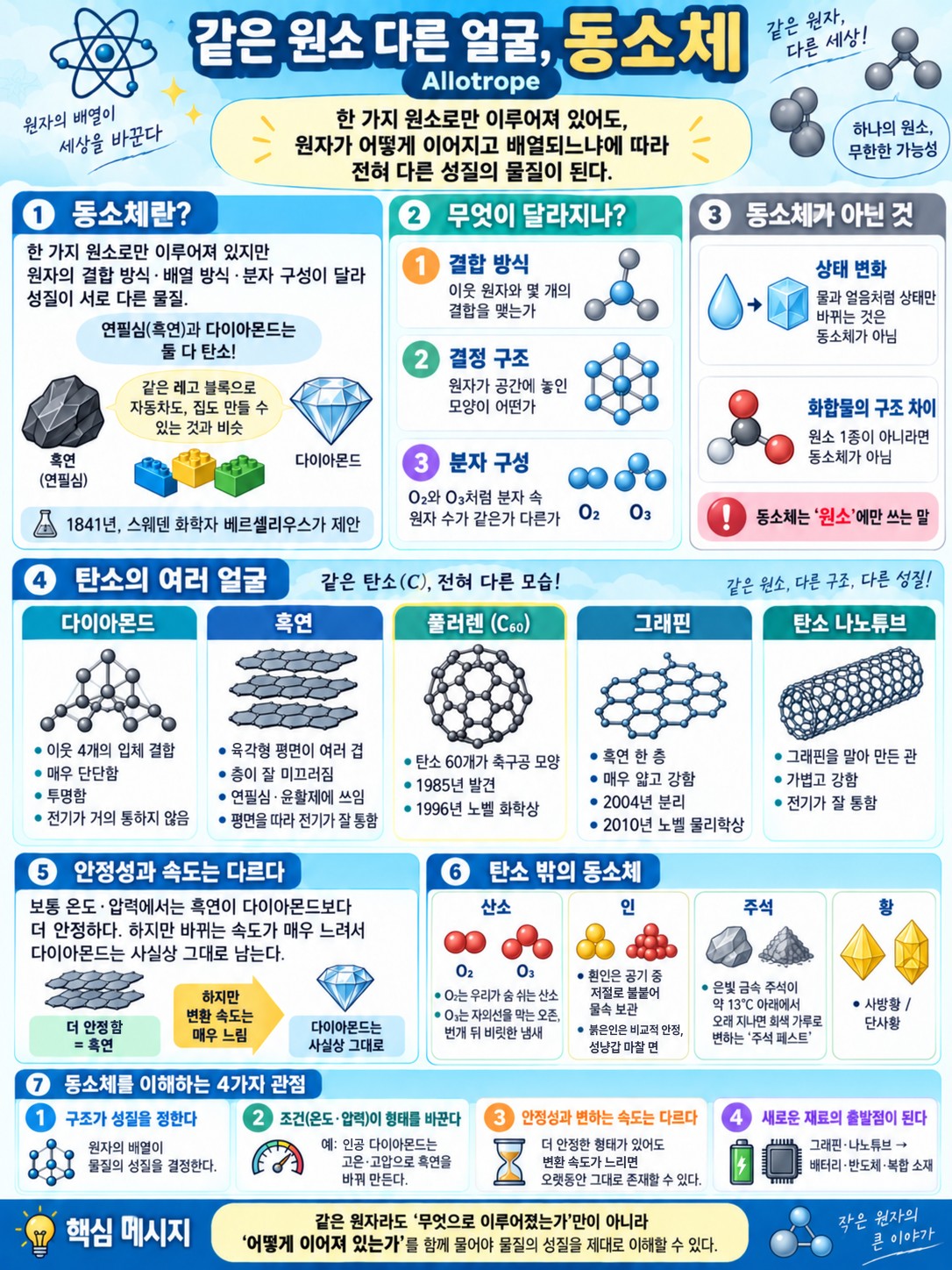
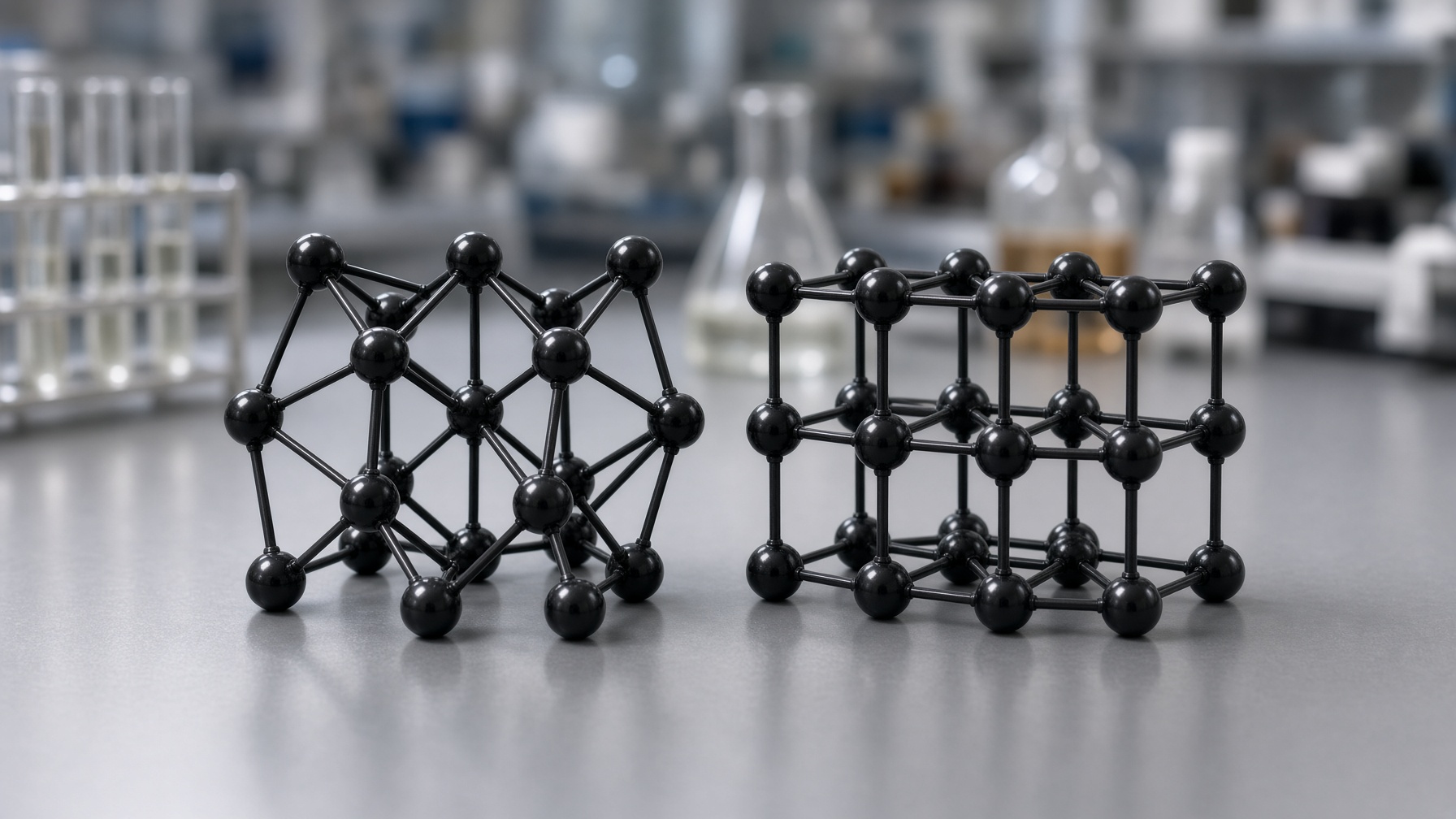
Allotropes appear when a single element can exist in two or more structures. When there are differences in how many neighbors each atom bonds with, whether the bonds spread out in a plane or connect in three dimensions, or how many atoms go into a single molecule, the element can behave like an entirely different substance.
- Bonding: how many bonds a single atom forms with neighboring atoms.
- Crystal structure: the shape in which atoms are regularly arranged in space.
- Molecular form: the number of atoms in a molecule, as in the oxygen molecule O₂ and ozone O₃.
As an analogy, it is like being able to build either a car or a house from the same LEGO bricks. The bricks themselves are the same, but what they can be used for changes completely depending on how they are put together.
The concept of the “allotrope” is known to have been first proposed in 1841 by the Swedish chemist Jöns Jacob Berzelius. He coined the name to explain substances that have different properties even though they are made of the same element.
One point to note here is that the term allotrope applies only to “elements.” Cases where the same substance simply changes state, such as water and ice, or structural differences among compounds made of several elements, are not called allotropes.
The Same Carbon, Different Faces

The first element that comes up when explaining allotropes is carbon. Carbon atoms can bond in many different ways, so they form several substances with diametrically opposite properties.
(1) Diamond
In this structure, each carbon atom is firmly bonded in three dimensions to four neighboring atoms. That is why diamond is extremely hard and transparent, and conducts almost no electricity.
(2) Graphite
In this structure, carbon atoms form flat sheets in a hexagonal mesh pattern, and these sheets are stacked in many layers. Because the forces between the layers are weak, they slide easily, so graphite is used for pencil lead and as a lubricant, and it conducts electricity well along the sheets.
(3) Fullerenes and graphene
Fullerene, in which 60 carbon atoms gather in the shape of a soccer ball, was discovered in 1985 and led to the 1996 Nobel Prize in Chemistry. Graphene, a single layer peeled away from graphite, was isolated in 2004 and earned the 2010 Nobel Prize in Physics.
A carbon nanotube is tube-shaped carbon that looks as if a single sheet of graphene has been rolled up. It is light yet extremely strong and conducts electricity well, so it is drawing great attention in research on new materials.
Interestingly, at ordinary temperatures and pressures, graphite is a more stable form than diamond. However, diamond turns into graphite so unimaginably slowly that the diamond in a ring effectively stays as it is forever.
Allotropes Beyond Carbon

Allotropes are not just a carbon story. The oxygen we breathe is O₂, made of two atoms, but when three atoms come together it becomes ozone (O₃). Ozone has a strong smell and is highly reactive, so it can be harmful up close, but in the ozone layer high in the sky it absorbs the Sun’s ultraviolet rays and protects life on Earth.
Ozone forms when a large amount of energy, such as lightning or strong ultraviolet light, acts on oxygen. The sharp, metallic smell in the air after a lightning strike is also often caused by ozone.
Phosphorus (P) is another classic example. White phosphorus is so reactive that it can catch fire on its own in air, and it is highly toxic, so it is stored under water. Red phosphorus, by contrast, is much more stable and is used on the striking surface on the side of a matchbox.
Tin (Sn) changes its form depending on temperature. The silvery metallic tin we know can, if kept below about 13℃ for a long time, slowly turn into a brittle gray powder. This phenomenon is called “tin pest.”
Sulfur (S) also has allotropes with different crystal shapes, such as rhombic sulfur, which is stable at room temperature, and monoclinic sulfur, which forms at high temperatures.
[Key Points from the Examples]
- Oxygen: the O₂ we breathe and the O₃ that blocks ultraviolet rays
- Phosphorus: dangerous white phosphorus and red phosphorus used in matches
- Tin: silvery metal and gray tin that crumbles in the cold
- Sulfur: rhombic and monoclinic sulfur with different crystal shapes
Four Perspectives for Understanding Allotropes

Studying allotropes teaches us that the properties of a substance are not determined solely by “what it is made of.” Even with the same atoms, how they are arranged governs the properties.
(1) Structure determines properties
Hardness, color, and electrical conductivity depend far more on how atoms are bonded and arranged than on the type of atom.
(2) Conditions change the form
When temperature and pressure change, which allotrope is more stable changes too. Synthetic diamonds are made by transforming graphite under high pressure and temperature.
(3) Stability and speed are different things
Even if a more stable form exists, the original form persists for a long time if the change happens slowly.
(4) They are starting points for new materials
Newly discovered allotropes such as graphene and carbon nanotubes become materials for research on batteries, semiconductors, and composite materials.
Just as you can build both a hut and a tower from the same bricks, atoms create entirely different worlds depending on the shape in which they are stacked. That is why, when chemists talk about the properties of an element, they always also specify “which structure of that element” they mean.
Asking “how are they connected?” even for the same atoms is the first step toward a deep understanding of the properties of matter.