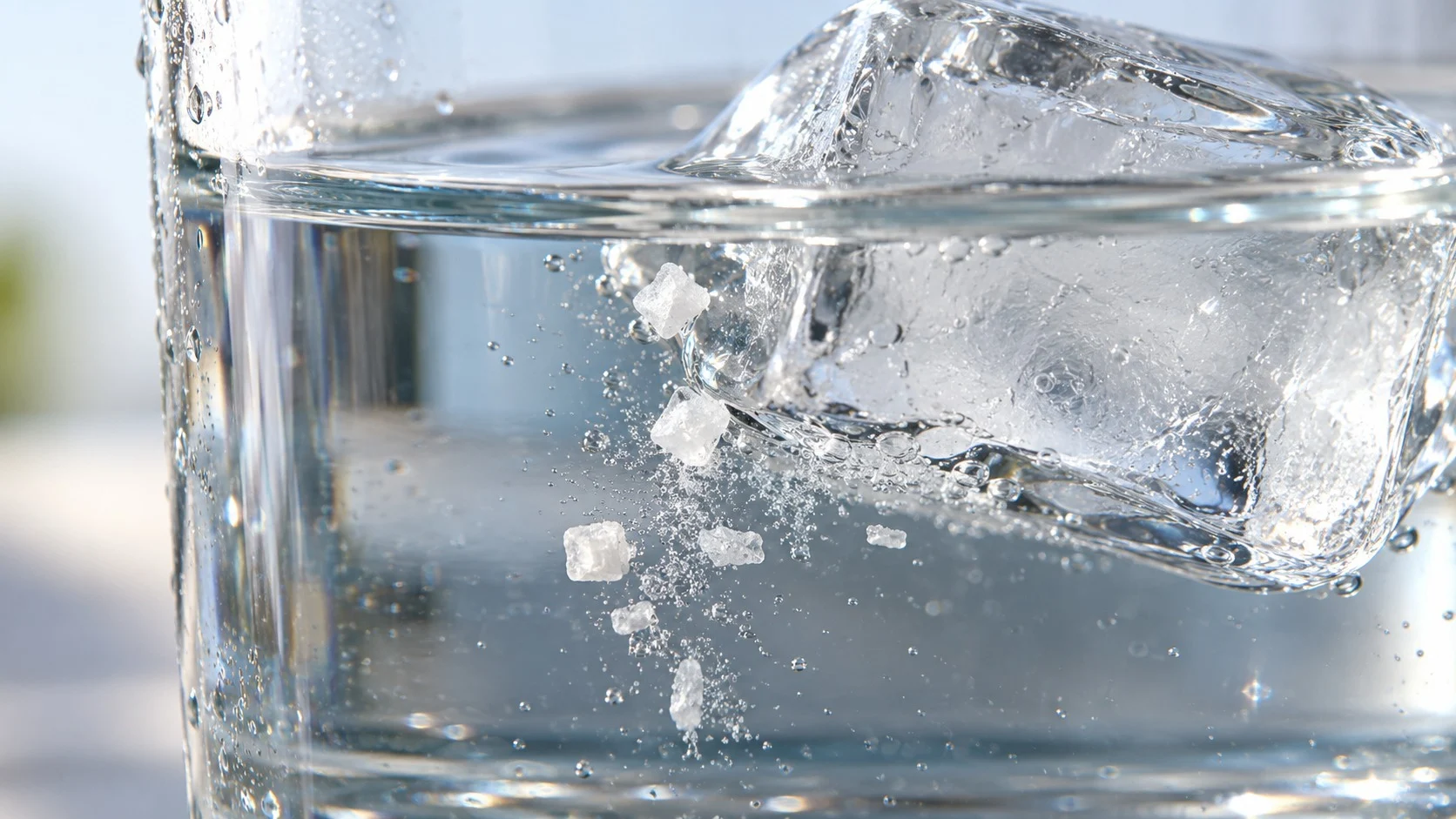
On a snowy winter morning, once a snowplow scatters white granules across the road, the frozen surface soon turns to slush. Even at the same subzero temperatures, seawater does not freeze easily, and ice cream left in the freezer for a long time never becomes rock-hard. The common principle hidden behind all of these scenes is freezing point depression.
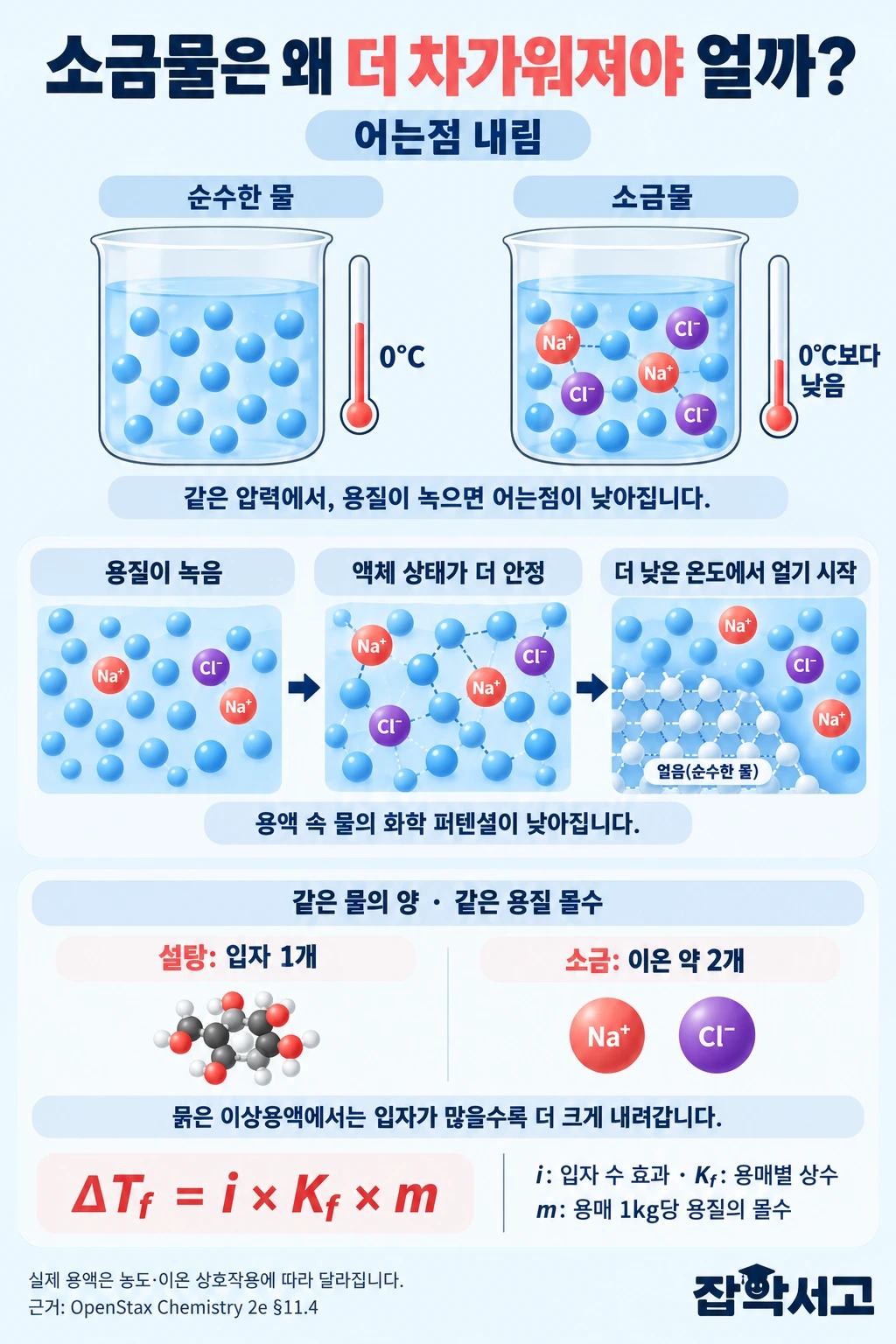
Put simply, freezing point depression means ‘the phenomenon in which a pure liquid freezes at a lower temperature when another substance is dissolved in it’. Pure water freezes at 0 degrees, but water with salt or sugar dissolved in it has to get colder still before it finally turns to ice. In chemistry it is treated as a classic property whose size depends on the number of dissolved particles rather than on what kind of substance they are.
In this article, we will look in turn at the principle behind the lowered freezing point, how to estimate its size, how it is used on roads, in cars and in the kitchen, and its applications ranging from cold-hardy organisms to quality testing.
How Dissolved Particles Delay Ice
Why do dissolved substances get in the way of freezing?
When water freezes, water molecules line up in a regular pattern, as if holding hands, to form ice crystals. Where ice and water meet, molecules attach to the ice and break away from it at the same time, and the temperature at which these two rates are equal is the freezing point.
(1) Fewer molecules are available to join the ice
When salt dissolves in water, salt particles mix in between the water molecules. Fewer water molecules reach the ice surface as a result, so the ice grows more slowly.
(2) The melting side stays the same
The ice, on the other hand, is made only of pure water molecules, so the rate at which molecules break away from it hardly changes. In the end, the temperature has to drop further before the freezing and melting rates can balance again.
(3) The mixed state is more stable
A solution in which several substances are evenly mixed is more disordered than pure water, so it has a stronger tendency to stay that way. That is why a lower temperature is needed for it to turn into orderly ice.
The number of particles sets the size
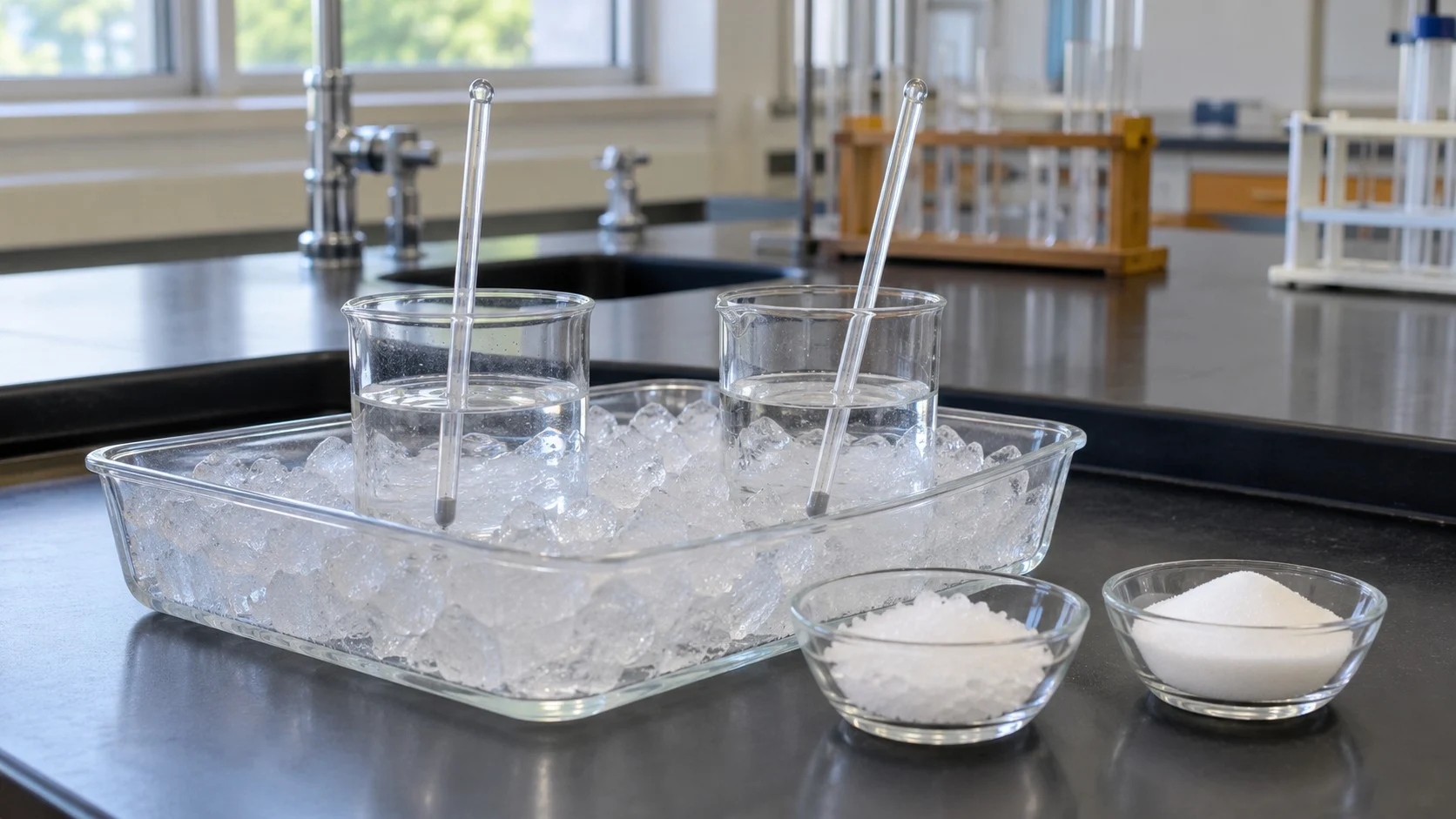
How far the freezing point drops depends less on what substance is dissolved than on how many particles are scattered through the water. Properties like this are called colligative properties, and boiling point elevation and osmotic pressure belong to the same group.
- The rule for dilute solutions (Blagden’s Law): In the 18th century, the British scientist Charles Blagden showed that the drop in freezing point is proportional to the amount of dissolved substance. In a dilute solution, doubling the amount dissolved lowers the freezing point by almost twice as much.
- The reference value for water (Cryoscopic Constant): When 1 mole of particles is dissolved in 1 kilogram of water, the freezing point drops by about 1.86 degrees. This value differs from solvent to solvent, reaching about 5.12 degrees for benzene and as much as about 39.7 degrees for camphor.
- The effect of substances that split apart (Van ‘t Hoff Factor): When sugar dissolves in water, each molecule remains a single particle, but salt splits into two, a sodium ion and a chloride ion. So for the same number of moles, salt lowers the freezing point about twice as much as sugar.
On roads, in cars and in the kitchen

Freezing point depression is used throughout the ways we get through winter. Rather than saying salt melts ice directly, it is more accurate to say it dissolves in the thin film of water on the ice surface and keeps that water from freezing again.
The temperature limit of de-icers
Sodium chloride, commonly spread on roads, can lower the freezing point of water to around minus 21 degrees at most. In colder places it becomes less effective, so other salts such as calcium chloride or magnesium chloride are used. However, these salts easily corrode metal, so places with a lot of metal equipment, such as airports, use de-icers like potassium formate or potassium acetate instead.
Antifreeze and ice cream
Car coolant contains antifreeze, a mixture of water and ethylene glycol, so the radiator does not freeze and burst even in the dead of winter. Ice cream stays soft enough to scoop with a spoon below freezing because the dissolved sugar lowers the freezing point, leaving part of it unfrozen.
Cold-hardy organisms and quality testing
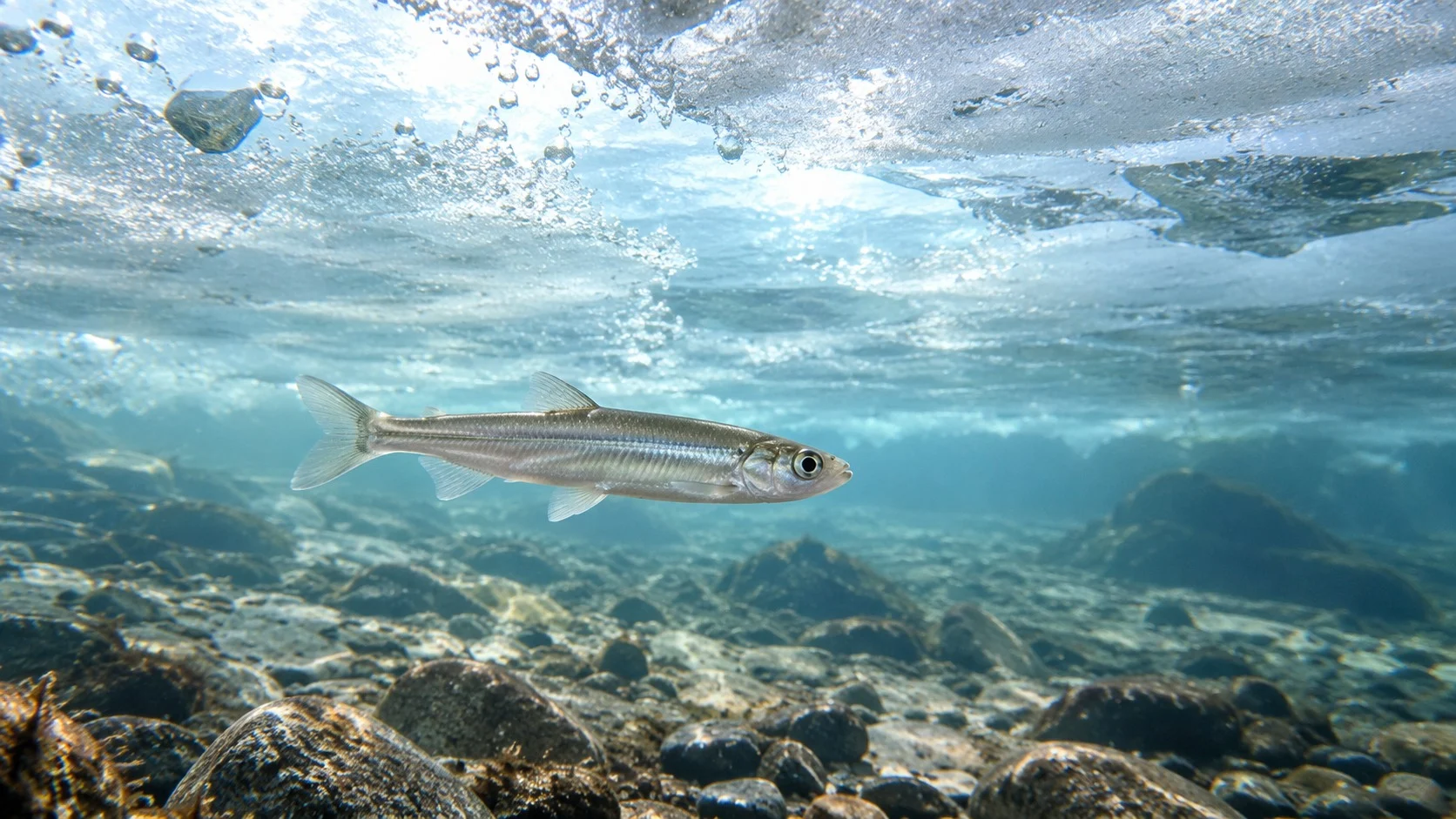
Freezing point depression is also the secret that lets living things survive harsh cold, and in laboratories and factories it serves as a precise measuring tool.
(1) Organisms that make their own antifreeze
In winter, the rainbow smelt of North America builds up glycerol in its body and survives even in frozen estuaries. When the cold sets in, some frogs break down glycogen stored in the liver and release large amounts of glucose into their blood. Tree sap, too, resists freezing in winter thanks to the substances dissolved in it.
(2) Detecting water added to milk
Milk has a consistently lower freezing point than water because of the lactose and minerals dissolved in it. Adding water raises the freezing point toward 0 degrees, so the dairy industry measures the freezing point to check whether water has been mixed in.
(3) Measuring purity and molecular weight
When impurities get into a pure solid, its melting point drops and its melting range widens. That is why organic chemistry labs measure melting points to gauge a substance’s purity, and sometimes calculate the molecular weight of an unknown substance from how far the freezing point has dropped.
Freezing point depression shows that a handful of invisible tiny particles can delay the moment water turns into ice. Road de-icers in winter, car antifreeze, fish that do not freeze and milk testing all start from the same principle.
Reading the power of dissolved particles in familiar winter scenes is the first step in chemistry toward understanding the properties of solutions.