The reason we get a flu shot before flu season is simple. If the body first meets a weakened pathogen and learns how to fight it, it will not easily give way even when the real virus gets in. But what if this principle worked not only for the body but also for the mind? A vaccine for the mind that prepares us in advance for plausible lies and clever persuasion is what we call ‘Inoculation Theory.’
Put simply, inoculation theory is ‘the theory that people who are exposed to weak counterarguments in advance and practice refuting them on their own are less likely to change their minds later, even when they face stronger persuasion.’ It was put forward in 1961 by the American social psychologist William J. McGuire, and today it draws particular attention in communication studies as a way to fight fake news and disinformation.
In this piece we will look in turn at the background from which inoculation theory was born, the four elements that make it work, examples of prebunking that stops fake news in advance, and how to use it in everyday life.
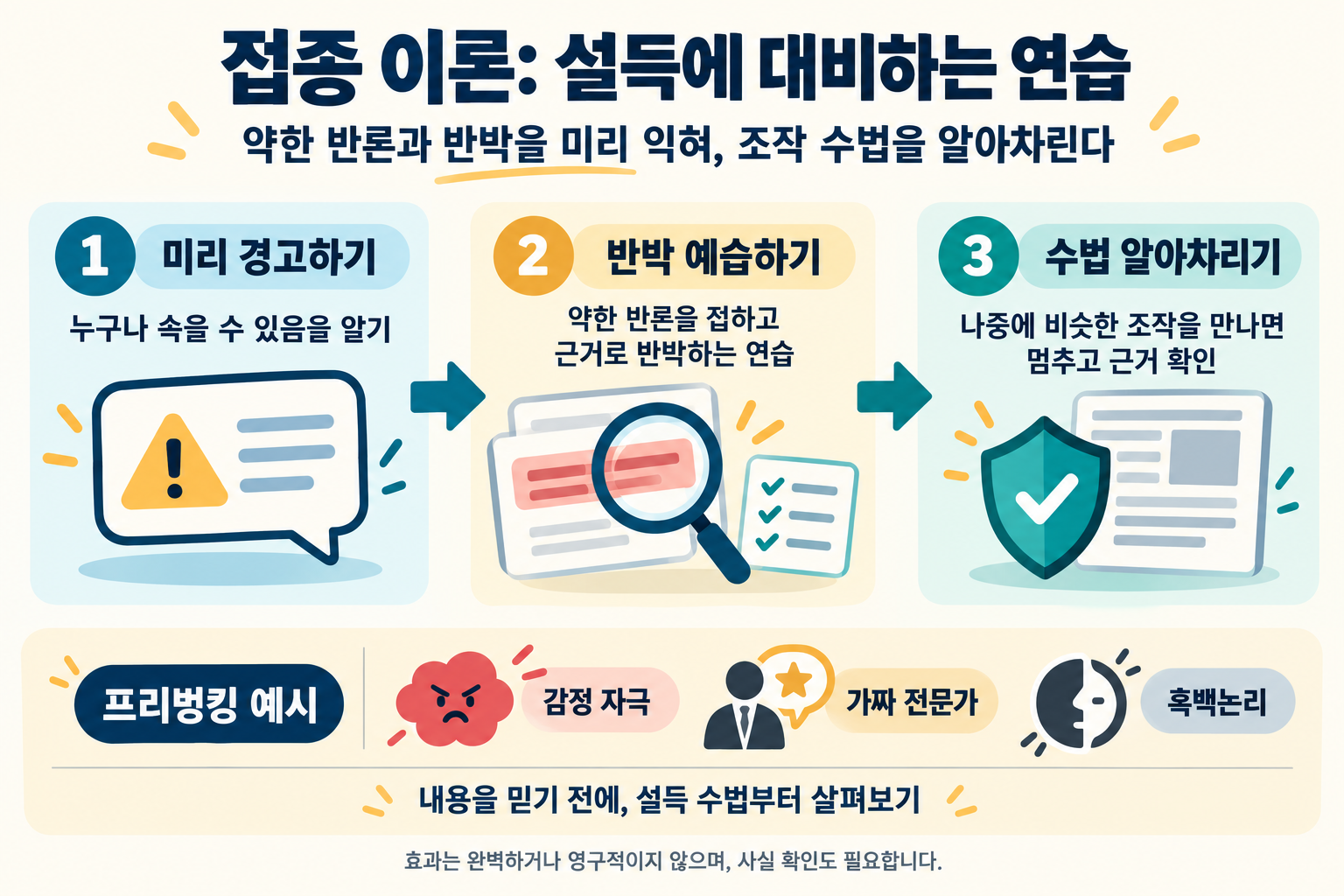
The Principle of Building a Mind That Does Not Waver Under Persuasion
How Was Inoculation Theory Born?

After the Korean War came to a halt with the 1953 armistice, the fact that some American prisoners of war chose to stay with the other side rather than return home deeply shocked American society. Many people believed they had been brainwashed, and McGuire became interested not in how to persuade people but in how to build their ability to resist persuasion.
(1) Beliefs That Had Never Been Questioned
McGuire used as his experimental material common-sense truths that no one had ever argued against, such as ‘It is good to brush your teeth every day.’ He focused on the fact that because such beliefs had never been attacked, they could collapse easily the first time people heard a plausible counterargument. It is just like a body that has never encountered germs being vulnerable to even a minor infection.
(2) Refutation Is Stronger Than Support
The experiments showed that people who heard a weak counterargument together with an explanation that knocked it down held up better against later strong attacks than people who heard only plenty of evidence supporting their original belief. Experiencing opposing arguments in advance turned out to be a sturdier shield than repeating what is right.
Four Elements That Build Immunity in the Mind

As many scholars continued the research, it became clear that several conditions must be in place together for the inoculation effect to work properly.
- Threat: People must feel a sense of danger that their own views could change before they want to defend them. Studies show that simply warning in advance that counterarguments are coming raises resistance.
- Refutational Preemption: This is the stage of hearing weak counterarguments firsthand and practicing the logic that knocks them down, corresponding to the weakened pathogen in a vaccine.
- Delay: After inoculation, the defensive reasoning needs time to settle in, but if too much time passes, the effect gradually weakens.
- Involvement: The more important an issue is to us, the greater the threat we feel and the more actively we defend.
Interestingly, the inoculation effect does not stay limited to the counterarguments covered in advance. People also gain some ability to hold up against other counterarguments they never practiced, and as inoculated people talk about the topic with those around them, the effect can spread and grow stronger.
Prebunking: Stopping Fake News Before It Spreads

Once false information has spread, it is hard to correct even after fact-checking articles come out. So instead of debunking, which corrects falsehoods after they have spread, prebunking, which prepares people before they encounter falsehoods, emerged from inoculation theory.
A Game Where You Make Fake News Yourself
In 2018, researchers at the University of Cambridge in the UK released the online game ‘Bad News’ together with DROG, a Dutch organization that counters disinformation. Players become fake news producers who must gather followers while keeping their credibility, and along the way they learn techniques one by one, such as impersonation, emotional provocation, polarization, conspiracy theories, discrediting opponents, and trolling. An analysis of about 15,000 people found that their ability to spot fake news improved after finishing the game.
A Vaccine Delivered in Short Videos
In 2022, the researchers worked with Google to create and test five short videos explaining manipulation techniques. In experiments involving about 29,000 people, those who watched the videos were better at identifying posts containing manipulation, and a similar effect was confirmed in a test run in the format of YouTube ads.
How to Use Inoculation Theory in Everyday Life

Inoculation theory is widely used outside the laboratory as well. Smoking prevention education that helps teenagers avoid starting to smoke at a friend’s urging, election campaigns that prepare for an opposing candidate’s attack ads, and marketing that counters a competitor’s comparative advertising all make use of this principle.
(1) Teach the Techniques First
Rather than refuting each piece of fake news one by one, it is more efficient to reveal the techniques hidden behind them. If you know commonly used patterns such as fear-inducing headlines, fake experts, and wording that forces you to choose only one of two options, you can be prepared even for falsehoods you have never seen before.
(2) Get a Booster Just When You Might Forget
Studies show that the inoculation effect gradually weakens after a few weeks. So, like a booster shot of a vaccine, scholars recommend steadily repeating education that goes over the same techniques again.
However, this principle can also be used in reverse. If opposing arguments are deliberately presented as weak and ridiculous, they can harden even beliefs that lack sufficient evidence.
Inoculation theory is not a way to avoid persuasion at all costs but a way to build our ability to think by meeting opposing arguments in advance. The point that the less a belief has ever been questioned, the more easily it can collapse in the face of a plausible attack is all the more worth keeping in mind today, when information is overflowing.
When you see sensational news, it helps to make a habit of asking yourself once, ‘What technique might have been used here?’ before you believe or share it right away. That small question becomes a vaccine that protects you from the more cunning lies to come.
Getting to know the face of a lie before you meet it is the first step toward an information life that does not waver.