Life is a series of choices. From the smallest questions when we open our eyes in the morning, such as "Should I sleep for 5 more minutes, or get up now?", to major decisions that shape the course of our lives, such as "Which major should I choose?", "Which company should I join?", and "Should I invest in this stock or that stock?", we go through life choosing something at every moment.
But there is a fact we often overlook. Choosing something also means giving something else up. Economics places great importance on the value we give up. This is precisely the topic we will explore in depth today: opportunity cost (Opportunity Cost).
What Is Opportunity Cost?

The definition of opportunity cost is simple: "The value of the most valuable alternative among those that must be given up when making a choice." The key phrase is "the most valuable alternative." It is not simply the sum of everything you give up.
Our resources, including time, money, and effort, are limited. To use these limited resources as efficiently as possible, we need to understand opportunity cost accurately and be able to calculate it.
Example: A Choice on a Weekend Afternoon
You have 3 hours of free time this Saturday afternoon. You are considering how to spend that time.
- Alternative A: Watch a movie with friends. (Movie cost: 15,000 won; an enjoyable time with friends)
- Alternative B: Catch up on your economics studies at home. (Cost: 0 won; gaining knowledge and expecting better grades)
- Alternative C: Work a part-time job. (Hourly wage: 10,000 won; earnings of 30,000 won for 3 hours)
If you choose alternative B (studying economics), what is your opportunity cost?
- What you have given up is the enjoyment of watching a movie and 30,000 won in part-time earnings.
- The most valuable of these is your opportunity cost. If you urgently need money and consider the part-time job the most important option, your opportunity cost is 30,000 won. On the other hand, if you place greater importance on making memories with friends, your opportunity cost is the net value of watching a movie with friends, after subtracting the movie cost of 15,000 won. This value is subjective and varies from person to person.
Hold on a moment! There is something many people get wrong: the distinction between explicit cost (Explicit Cost) and implicit cost (Implicit Cost).
The Components of Opportunity Cost: What You Can and Cannot See
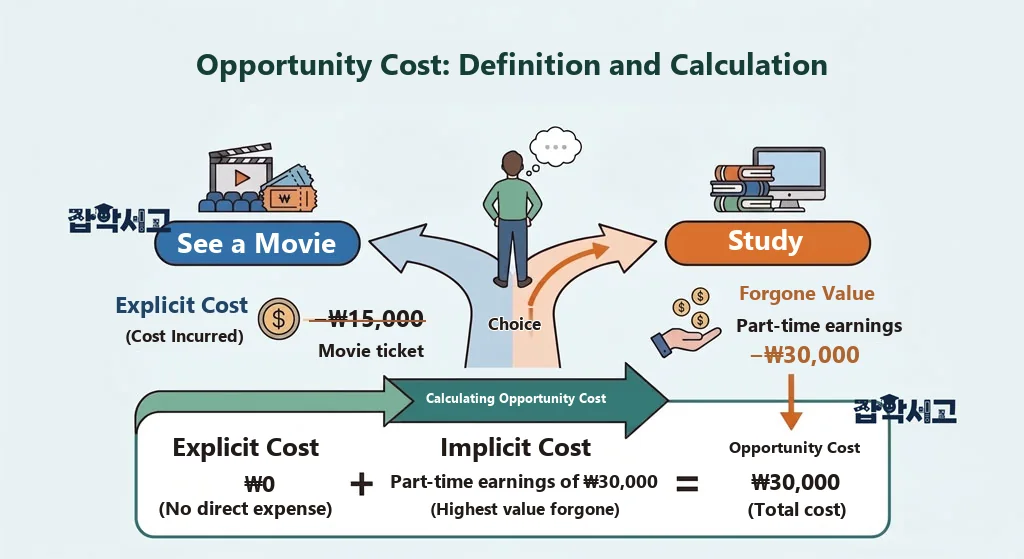
Opportunity cost does not simply mean the money that leaves your wallet (explicit cost). To calculate the true opportunity cost, you must also include opportunities you cannot see (implicit cost).
- Explicit Cost: Cash that is actually spent. In the example above, the movie cost of 15,000 won when you choose alternative A falls into this category. It is a cost that can be recorded in accounting books.
- Implicit Cost: Potential income you had to give up because of your choice, even though no money actually leaves your hands. In the example above, the 30,000 won in part-time earnings you give up when choosing alternative B falls into this category. Another typical example of implicit cost is the employment income you must give up over 4 years when choosing to attend university.
Therefore, true opportunity cost is defined as follows.
Opportunity cost = Explicit cost (actual expenditure) + Implicit cost (the highest of the potential values forgone)
This concept becomes even more important in business management. Accounting profit, calculated by accountants, considers only explicit costs, while economic profit, calculated by economists, considers the entire opportunity cost (explicit + implicit costs). To determine whether a business is truly making a profit, you need to examine its economic profit.
Why Should We Consider Opportunity Cost?

Choices that do not account for opportunity cost often lead to irrational outcomes. We tend to focus unconsciously only on the costs we currently incur (explicit costs). But thinking in terms of opportunity cost makes our judgment broader and more rational.
An Example of an Irrational Choice: The Sunk Cost Trap
The most typical trap we are likely to fall into when we fail to consider opportunity cost is sunk cost (Sunk Cost). A sunk cost is a cost that has already been incurred and cannot be recovered. To make rational decisions, we must completely disregard sunk costs. Yet many people remain tied to sunk costs because they want to "get their money's worth," repeatedly making poor choices.
Example: You spend a lot of money ordering food that tastes bad. After a bite, you find that you simply cannot eat it. But you force yourself to finish it because "it would be a waste of money."
The money already paid for the food is a sunk cost. What would be the rational choice? It would be to avoid ruining your mood and harming your health by eating bad food (new costs), and instead go without food or eat something else that tastes good. But because of the sunk cost, you bring an even greater loss upon yourself.
From an opportunity cost perspective, you are giving up the "better mood" or the "value of other productive activities" you could have gained during the time you spend forcing yourself to eat.
Opportunity Cost in Investing
Opportunity cost is essential in stock investing as well. Suppose you invest 1,000 units of ten thousand won in stock A and earn a return of 5% (50 units of ten thousand won) over 1 year. On the surface, this is a profit. But what if investing in stock B over the same period could have earned you a return of 20% (200 units of ten thousand won)?
- Accounting profit: +50 units of ten thousand won
- Opportunity cost (the value forgone by giving up alternative B): 200 units of ten thousand won
- Economic profit: 50 units of ten thousand won (return) - 200 units of ten thousand won (opportunity cost) = -150 units of ten thousand won (loss)
Investing in stock A is a loss in economic terms because you gave up a better investment opportunity. Considering opportunity cost in this way allows us to assess our investment performance more objectively.
The Limitations of Opportunity Cost and Points to Keep in Mind
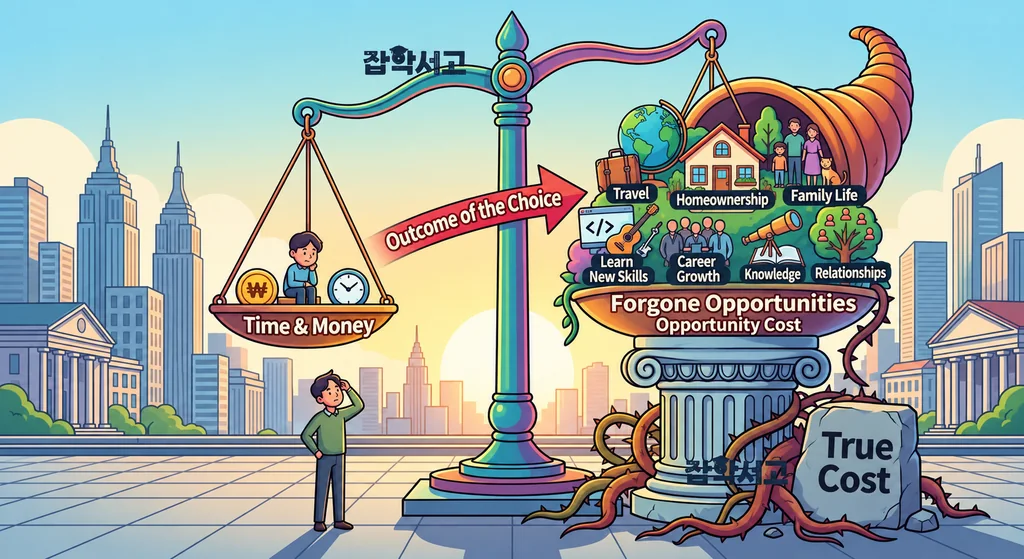
Opportunity cost is a powerful tool, but it has several limitations.
- Value is difficult to measure: It is difficult to express the value of a forgone alternative accurately in monetary terms, especially nonmonetary values such as "enjoyment," "honor," and "health." Such assessments are inevitably subjective.
- We cannot know every alternative: When making a choice, it is impossible to know every possible alternative in the world perfectly. Because of information asymmetry, we calculate opportunity cost only among a limited set of alternatives.
- It can favor a short-term perspective: It is difficult to predict the value we are giving up over the long term. By focusing only on immediate gains, we may miss greater opportunities in the long run.
Opportunity Cost: A Compass for a Rational Life
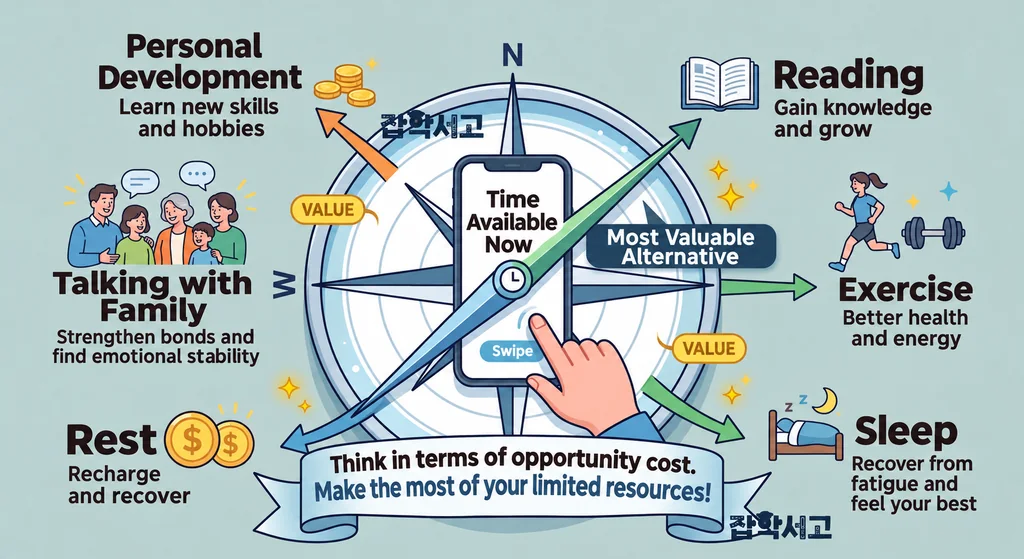
Opportunity cost is not a concept that exists only in economics textbooks. It is like a secret code hidden in every moment of our daily lives. Simply understanding this concept and applying it to our decision-making process can help us make far fewer irrational choices.
The next time you make a choice, pause for a moment and ask yourself:
"What is the most valuable thing I must give up to make this choice?"
If the value your choice will bring is greater than the value you give up (opportunity cost), it is a rational choice. Conversely, if the opportunity cost is greater, you need to reconsider.
Thinking in terms of opportunity cost is not simply a way to save money. It is a way to focus our limited time and resources on "what is most valuable." With this compass, may you navigate the long voyage of your life more wisely and without regret.