A monopoly market is a structure in which a particular company dominates the market and can control prices and production. It has various effects on the economy as a whole and has become a major subject of economic analysis and discussion. The formation of monopoly markets is determined by a complex combination of factors, and elements such as barriers to entry, economies of scale, and technological advantages help explain how a company gains a dominant position in a market.
This material systematically examines the definition and main characteristics of monopoly markets and seeks to analyze in depth how they form and the economic effects they produce. It will also compare monopoly markets as described by theoretical models with the differences observed in real-world cases, discussing the implications of monopoly structures for companies, consumers, and the market as a whole.
Definition and Characteristics of Monopoly Markets

The Concept of Monopoly Markets and the Background to Their Formation
A monopoly market is a structure in which a particular company monopolizes the supply of a product or service and dominates the market without competitors. In this structure, the monopolist is the sole or nearly sole supplier, so consumers have almost no options for purchasing the product elsewhere.
Several factors contribute to the formation of monopoly markets. High barriers to entry, meaning a structure that makes it difficult for new companies to enter the market, are a major factor strengthening monopoly markets. Monopolists can reduce production costs through technological advantages or economies of scale to secure price competitiveness, making it difficult for new companies to respond. In addition, because substitutes are scarce or virtually nonexistent in monopoly markets, consumers have no choice but to depend on a particular company's products, further strengthening the monopolist's market power.
Monopolists' Pricing Power and Market Dominance
One of the main characteristics of a monopoly market is the monopolist's pricing power, which allows it to set prices freely. In an environment without competitors, the monopolist can set its desired price while adjusting output to market demand. Because consumers have limited options, they have no choice but to accept the price offered by the monopolist.
Pricing power is essential for a monopolist to maximize its profits. As the sole supplier in the market, the monopolist can anticipate consumer behavior and set a price that maximizes revenue. In particular, a monopolist can directly influence demand and prices by reducing or increasing the supply of a particular product, a characteristic rarely seen in ordinary competitive markets. Such monopoly pricing is likely to cause prices to rise across society, increasing the burden on consumers.
Monopolists' Output Adjustments and Profit Maximization
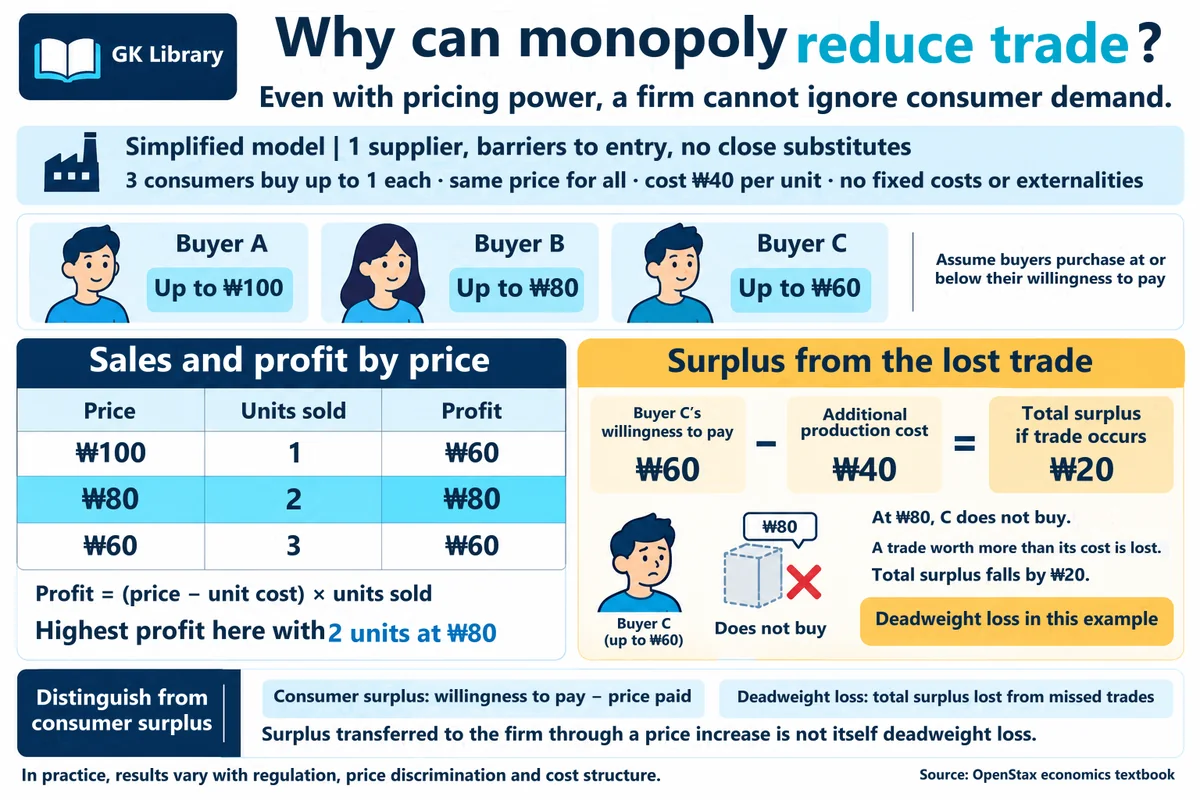
Monopolists seek maximum profits by adjusting output, closely analyzing marginal cost and marginal revenue in the process. Marginal cost refers to the cost incurred through additional production, while marginal revenue refers to the revenue earned through additional production. A monopolist determines output at the point where these two factors are balanced, adjusting it so that no additional costs arise.
Profit maximization through output adjustments can lead to an inefficient allocation of resources from the perspective of society as a whole. Because monopolists can set high prices in the market, consumer demand is suppressed, increasing the likelihood of social welfare loss. Social welfare loss refers to the difference between the amount consumers are willing to pay and the amount they actually pay, and in monopoly markets, welfare loss occurs as consumer choice is restricted.
Restrictions on Consumer Choice and a Lack of Product Differentiation
Because there is almost no competition in monopoly markets, monopolists face little pressure to improve quality or develop new products. As a result, there is little product differentiation, and the range of products available to consumers is limited. Consumers have no choice but to depend on the limited products or services provided by the monopolist, which can negatively affect consumer satisfaction.
In addition, because monopolists face little pressure to innovate, their motivation to develop new technologies or improve services also declines. For example, monopolists can generate stable revenue without incurring additional development costs, creating an environment in which consumers can hardly expect better quality. Consequently, consumers in monopoly markets are more likely to pay higher prices for lower-quality products. This situation reduces market vitality and can hinder technological and industrial development in the long term.
Economic Imbalances and the Concentration of Wealth
If a monopoly market persists over the long term, economic imbalances and the concentration of wealth can worsen. When a small number of monopolists monopolize the enormous returns generated in the market, economic resources become excessively concentrated in a few companies, deepening wealth inequality. This inequality causes wealth to become excessively concentrated in particular companies or social groups, producing various adverse effects on the economy and society as a whole.
The concentration of wealth aggravates social unrest and can hinder stable growth across the economy. When the distribution of income and resources becomes imbalanced, the purchasing power of consumers and workers weakens, potentially reducing the economy's growth potential. These imbalances are an important consideration in formulating economic policy and are a particular reason for emphasizing policies related to fair competition.
Main Factors and Processes Behind the Formation of Market Monopolies

The process by which monopoly markets form plays an important role in understanding the background and mechanisms that allow a single company to dominate a market without competitors. Monopoly markets are fostered by a combination of factors, and monopolies become stronger when an industry's particular characteristics and conditions are met. These factors raise barriers to market entry, restrict competition, and enable a particular company to dominate the market over the long term. The main factors include natural monopolies, legal barriers, technological advantages, exclusive ownership of resources, and mergers and acquisitions, each of which contributes to the formation of monopoly markets in a different way.
Natural Monopoly: Strengthening a Monopoly Position Through Economies of Scale
A natural monopoly occurs in an industry with very high fixed costs, when a particular company secures a monopoly position by achieving economies of scale through large-scale production. Natural monopolies frequently arise in public services such as electricity supply, water supply, and railways, where having a single company operate the entire market may actually be more efficient. In this structure, provision by a single company is more likely to offer consumers lower prices than competition among multiple companies.
For example, in industries with high fixed costs, such as electricity supply, competition among multiple companies duplicates infrastructure costs and reduces cost efficiency. A single company providing the service exclusively can therefore benefit from cost reductions, strengthening its price competitiveness. However, in such natural monopoly situations, consumer choice is limited, and thorough government oversight and regulation are essential to protect the public interest. If a monopolist independently sets prices or manages quality, there is a risk of declining service quality or rising prices.
Legal Barriers: Granting Monopoly Rights and Regulatory Protection
Legal barriers arise when the government grants exclusive rights to a particular company, usually to encourage technological innovation or promote national economic development. These rights are protected through patents or exclusive contracts, allowing companies to maintain a monopoly position under legal protection for a certain period. For example, a pharmaceutical company that develops a new drug can sell it exclusively for a certain period through a patent, which plays an important role in recovering the capital invested in research and development.
Monopolies created through legal barriers can promote innovation, but they may also have the adverse effect of restricting market competition over the long term. Governments monitor monopolists to prevent them from limiting consumer choice or setting excessive prices, seeking to maintain fairness in the market. In some industries, however, legal barriers become excessively strong, allowing monopoly positions to persist for too long and severely restricting competition. Legal monopoly rights should therefore be granted only for an appropriate period, establishing a balance between technological development and consumer protection.
Technological Advantages: Securing Market Power Through Innovation
A company can secure a monopoly position through technological advantages when it possesses superior technology or innovative products compared with its competitors. This is possible when a particular company provides distinctive value in the market based on unique technology or products. For example, companies that achieve technological innovation in semiconductors, computer software, aerospace, and other fields strengthen their monopoly positions by creating technological barriers that are difficult for competitors to overcome.
Technological advantages not only allow companies to maintain a high market share but also provide opportunities to retain a monopoly position over the long term. In particular, technological advantages do more than improve product competitiveness: they increase production efficiency and enable cost reductions, helping companies secure an even stronger market position. However, such technological monopolies also risk hindering market vitality and innovation by making it difficult for competitors to enter the market. If a monopoly position lasts too long, pressure to innovate weakens, and market competitiveness declines.
Exclusive Ownership of Resources: Controlling a Market Through Essential Resources
Exclusive ownership of resources occurs when a particular company owns resources or infrastructure essential to an industry, and it is especially prominent in industries that use limited natural resources. For example, a company that exclusively owns resources such as oil or natural gas gains a monopoly position in the market because access to those resources is restricted. In this situation, the resource-owning company is in a position to influence market prices, while competing companies cannot easily enter the market.
Exclusive ownership of particular resources can give a company excessive dominance and lead to unfair pricing rather than an effective allocation of resources in the market. This not only harms consumers but is also likely to cause an inefficient allocation of resources throughout the economy. In addition, companies that exclusively own resources may face less pressure to protect the environment or manage resources sustainably, creating a substantial long-term risk of resource depletion and environmental problems.
Mergers and Acquisitions: Expanding Market Share and Strengthening Monopolies
Mergers and acquisitions are one way to strengthen a monopoly position in the market, as companies increase their market share and restrict competition through mergers. When competing companies merge, a single company gains a larger market share and strengthens its monopoly position. Through mergers and acquisitions, companies can expect synergies such as cost reductions and improved production efficiency, which can ultimately lead to the company dominating the market.
Monopolies resulting from mergers and acquisitions are often subject to monitoring and sanctions by regulatory authorities. Many countries implement regulations that restrict or monitor corporate mergers when they are considered likely to harm consumers. However, the complexity of markets and companies' diverse interests make it difficult for regulation to control every merger effectively. Companies seeking to strengthen their monopoly positions by exploiting regulatory gaps use various strategies to maintain market dominance, potentially limiting consumer choice and reducing market vitality.
The Positive and Negative Effects of Monopolies on the Economy

Positive Effects of Monopolies: Economies of Scale and Lower Production Costs
Because a monopolist is the sole supplier in the market, it is more likely to achieve economies of scale through large-scale production. Economies of scale refer to the decline in production costs per unit as output increases, allowing monopolists to maintain relatively low production costs through mass production.
These cost reductions give monopolists an opportunity to offer consumers lower prices, which can benefit consumers. For example, in industries with high fixed costs, such as electricity supply and railways, monopolists can maximize efficiency through large-scale production.
However, government regulation and monitoring are essential for these cost reductions to translate into actual benefits for consumers, and monopolists' independent pricing needs to be strictly supervised.
Technological Innovation Through the Concentration of Resources and Investment in Research and Development
Monopolists are in a position to invest substantial resources in research and development (R&D) using the enormous profits they earn in the market. This investment capacity can lead to the development of new technologies and the launch of innovative products, with considerable potential to promote the development of entire industries and the national economy over the long term.
Examples include monopolists developing new treatments by investing in new drug development, or leading research and development in advanced technology fields to drive industrial progress. Continued investment in research and development ultimately has positive effects not only on the growth of monopolists but also on the economy as a whole.
However, for monopolists to maintain their motivation to invest in research and development, they need an environment that does not entirely eliminate competitive pressure, supported by government policies that encourage technological innovation.
Negative Effects of Monopolies: A Greater Burden on Consumers Through Price Control
Because monopolists have no competitors in the market, they can set prices freely, and consumers have no choice but to accept the prices they set. Such pricing imposes a direct economic burden on consumers, with an especially significant impact on essential goods and services such as daily necessities and medical care.
Monopolists can generate high profits through the high prices they set, but this reduces consumer welfare and risks deepening social inequality. For example, when drug prices are set excessively high, certain social groups may have difficulty purchasing essential medicines, adversely affecting the health and welfare of society as a whole.
It is therefore important for the government to supervise pricing thoroughly rather than leaving monopolists to set prices independently.
Declining Efficiency and the Inefficient Distribution of Resources
Because there is little or no competition in monopoly markets, monopolists face less pressure to maintain operational efficiency. In competitive markets, various innovations are introduced to reduce costs and improve efficiency, but monopolists feel less need to do so.
As a result, monopolists may be more likely to use resources inefficiently or incur unnecessary costs. The inefficient distribution of resources can reduce productivity across the market, ultimately leading consumers to bear higher prices.
If monopolists continue to operate inefficiently, resources within the market are used inefficiently, which can cause social welfare loss.
Differences Between Theory and Reality: An Analysis of Real-World Monopoly Markets

Theoretically, a monopoly market assumes a situation in which a particular company dominates the entire market and can control prices and output, but monopolies in the real world are more complex. Various examples of monopolies allow a detailed examination of the differences between theory and reality. Real-world examples include Google's search engine monopoly, Microsoft's dominance of the operating system market, and Daimler AG's entry into the electric vehicle battery market.
Each example clearly shows how various factors influence the formation and persistence of monopolies, while the resulting government regulation and consumer responses reveal how theoretical monopoly models are modified and applied in practice.
Google's Search Engine Monopoly and Regulation
Google holds an overwhelming share of the global search engine market and occupies a monopoly position in many countries. Google has improved search accuracy through vast amounts of data and sophisticated search algorithms, establishing itself as an irreplaceable service. These technological advantages and brand recognition reinforce its monopoly position and create substantial barriers to market entry for competitors.
However, Google's monopoly position is subject to regulation by governments in various countries. The European Union (EU) fined Google for abusing its monopoly position by giving its own services preferential placement in search results and introduced various regulations. Thus, although Google dominates the market through its monopoly position, government regulation and consumer protection legislation limit its influence.
Microsoft's Dominance of the Operating System Market and Legal Disputes
Microsoft has held a monopoly position in the PC operating system market through its Windows operating system. By optimizing software distribution and encouraging computer manufacturers to install its operating system through close partnerships, Microsoft made it difficult for competitors to enter the operating system market.
However, Microsoft's monopoly position also triggered legal disputes in various countries. In the late 1990s and early 2000s, the U.S. Department of Justice filed lawsuits after determining that Microsoft had abused its monopoly position to obstruct competitors' entry into the market. Microsoft ultimately became subject to regulations such as orders prohibiting interference with competition, which subsequently brought some changes to the competitive landscape of the operating system market. This case shows that even monopolistic companies can have their market dominance limited through government legal action.
Daimler AG's Entry into the Electric Vehicle Battery Market and Its Weakening Monopoly Position
Daimler AG exercises substantial influence in the electric vehicle battery sector and is working to secure a monopoly position, particularly in the luxury electric vehicle market. By building its own battery production facilities and securing technological advantages, Daimler established barriers to entry that competitors could not easily overcome. This is because battery production requires enormous initial capital, and other competitors find it difficult to replicate Daimler's supply chain and technical expertise.
However, despite this monopoly position, Daimler's position is gradually weakening as global companies such as Tesla and LG Chem enter the electric vehicle battery market. In particular, the rapid growth of the electric vehicle industry is generating various technological innovations and price competition, increasing the pressure on Daimler to maintain its monopoly position. This case shows that technological advantages alone cannot easily sustain a monopoly indefinitely and that market changes and the emergence of competitors can break a monopoly.
Apple's App Store Monopoly and Conflicts with Developers
Apple holds a monopoly position in the App Store by requiring all apps on its iOS operating system to be distributed through the App Store. Apple charges a 30% commission on apps sold through its platform, which has drawn dissatisfaction from developers and consumers. In particular, because Apple blocks app downloads through channels other than the App Store, developers are compelled to follow Apple's rules.
As a result, Apple has been involved in legal conflicts with several developers. Most notably, Epic Games filed a lawsuit arguing that Apple's commission policy constituted an abuse of its monopoly position, and this issue became a major point of contention in court. Some countries have also drawn up legislation requiring Apple to allow payments outside the App Store. This case shows that monopolistic companies can cause conflicts between consumers and developers and suggests the importance of regulatory authorities' role.
Amazon's Monopoly in the Retail Market and Consumer Protection Issues
Through its monopoly position in the online retail market, Amazon connects countless consumers and sellers worldwide and has secured exceptional distribution capabilities through logistics infrastructure and data analysis. Amazon expanded its influence over consumers and sellers by launching its own brands and giving them preferential placement on its platform.
However, Amazon's monopoly position has sparked various controversies. In some countries, Amazon has been investigated for giving its own products more favorable placement than competitors' products, raising concerns about the resulting distortion of market competition. In addition, Amazon's dominant position adversely affects the self-employed and small sellers, prompting discussion of regulatory measures to ensure fair competition. This case illustrates the fair competition problems that can arise when monopolists hold strong market power and suggests the need for government consumer protection policies.
Monopoly markets have complex and wide-ranging effects on the economy, and their fundamental characteristics differ between theory and reality. Theoretical models help explain the basic principles of monopoly, but in real-world cases, interacting economic and social factors can alter the nature of a monopoly. A balanced analysis of the positive and negative effects of monopoly, along with a clear understanding of the differences between theory and reality, provides important insights for economic policymaking and corporate strategy decisions.