You walk into a clothing store and find a sweater you love, only to discover that the one color you want has sold out. Meanwhile, in a corner of the warehouse, sweaters in a color nobody wants may be piled up like a mountain. This happens because it is hard to predict exactly what will sell.
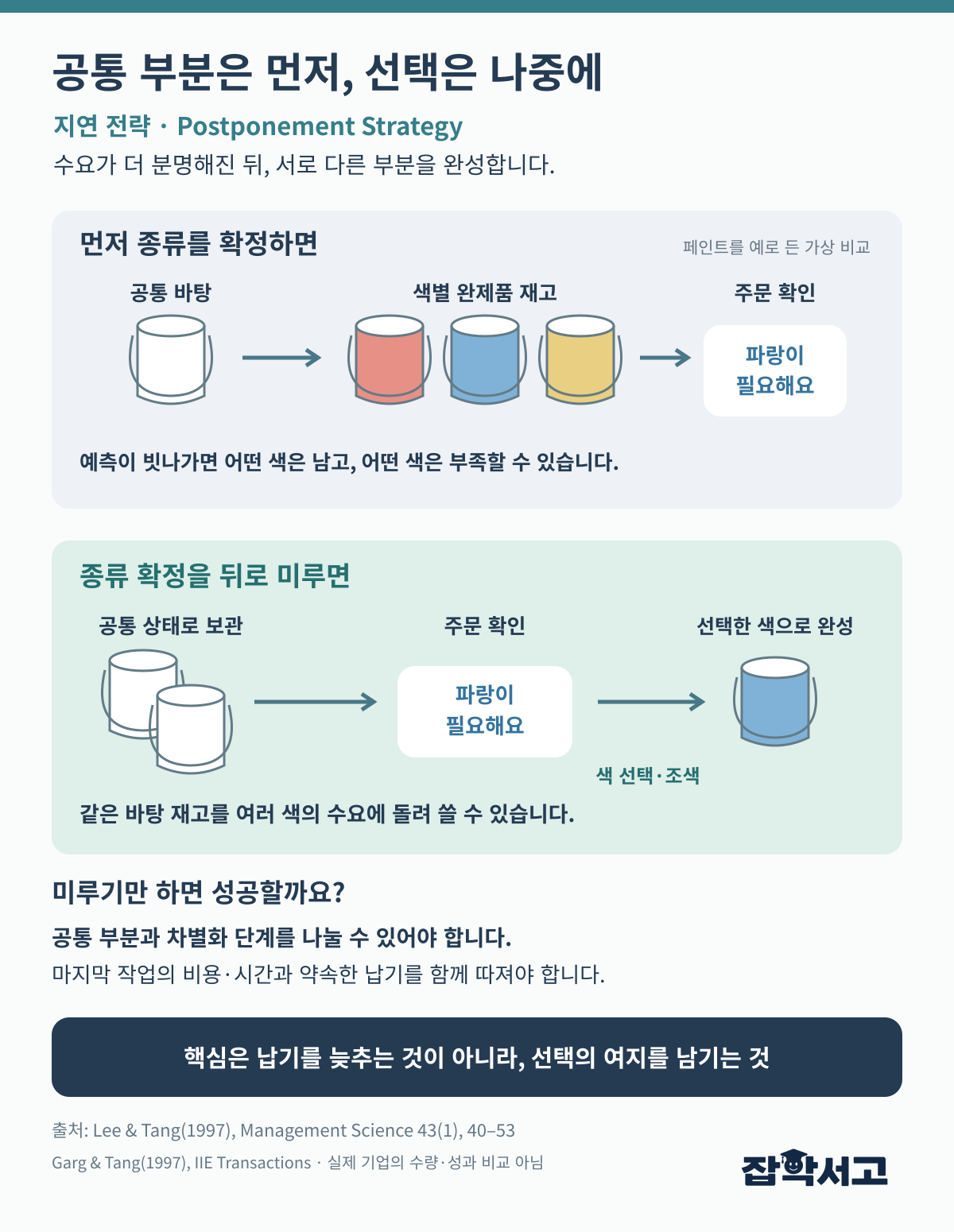
One piece of logistics wisdom that tackles this problem is “Postponement Strategy.” Instead of making finished products and stockpiling them, it delays the final steps that make products different from one another, such as color, packaging, and language, for as long as possible, until customer orders or demand become clear.
This article looks in turn at what postponement strategy means and where it came from, its types based on what is delayed, real company examples, and what to weigh when adopting it.
The Later You Decide, the Lighter Your Inventory: How Postponement Strategy Works and How It Is Used
What Is Postponement Strategy?

Postponement strategy delays the stage at which products are differentiated in the supply chain, moving it as close to the customer, and as close to the point of sale, as possible. It is also called “Late Customization” or “Delayed Product Differentiation.”
(1) Where the idea began
This idea was first named in 1950 by the American marketing scholar Wroe Alderson. He argued that letting products take on their distinct forms closer to the moment of purchase reduces distribution costs, and he called this the “Principle of Postponement.”
(2) Compared with speculation
In 1965, Louis Bucklin also described “Speculation” as the opposite of postponement. Speculation means forecasting demand, making finished products in advance, and stockpiling them close to customers. Speculation favors economies of scale and fast supply, while postponement favors lower inventory risk.
(3) The core principle
The common parts shared by many products are made in bulk in advance, and only the parts that differ are added later. Because a single common stock can meet demand for many products, the burden of forecasting errors is smaller than when separate inventory is built up for each product.
What Gets Delayed: Five Types of Postponement Strategy

In 1988, Walter Zinn and Donald J. Bowersox divided postponement strategy into five types according to which task is delayed.
- Labeling Postponement: Brands or labels for the same product are attached only after an order comes in.
- Packaging Postponement: Products are stored in large units and later packed in the size and form that fit each order.
- Assembly Postponement: Products are kept as parts, and final assembly takes place close to the customer.
- Manufacturing Postponement: Part of the manufacturing process itself is moved closer to the market and carried out later.
- Time Postponement: Finished products are held in a central warehouse and shipped to each region only after orders are confirmed.
The first four are “form postponement,” which settles the product's form late, while the last is “place and time postponement,” which delays when and where goods are shipped.
Gray Sweaters and Printers: Classic Examples of Postponement Strategy

Postponement strategy became widely known thanks to a few companies that actually made it work.
(1) Benetton's late dyeing
Starting in the 1970s, the Italian clothing company Benetton changed the practice of dyeing yarn first. It knitted and assembled sweaters in an undyed gray state, then dyed the finished garments after seeing which colors were popular that season. Processing costs rose a little, but inventory of unsold colors dropped sharply and popular colors could be restocked quickly.
(2) HP's postponed localization
The American company Hewlett-Packard used to finish its DeskJet printers at the factory, complete with country-specific power supplies and manuals, before shipping them abroad. It then switched to making only a common printer at the factory and having distribution centers in Europe and Asia add the power supplies and manuals suited to each region. According to a study published in 1993, this approach cut inventory while also responding better to regional demand.
(3) Everyday examples
The color-mixing service at a paint store, where a white base paint is mixed with the tint a customer chooses, works on the same principle. Instead of stocking hundreds of colors separately, the store only needs a few base paints.
What to Weigh When Adopting Postponement Strategy

Postponement strategy is not a one-size-fits-all solution, and its effects vary with the nature of the product and the market.
(1) When it works well
It is most effective when there are many product variants and demand for each is hard to predict, when products have short life cycles so inventory quickly becomes outdated, and when common parts and differing parts can be easily separated.
(2) The costs to accept
When the final steps are split across many locations, the advantages of mass production shrink and unit costs can rise. And because work must be finished after an order is received, customers may have to wait longer.
(3) Thinking about it from the design stage
Postponement strategy is hard to make succeed by changing logistics alone. As the HP case shows, products need to be designed from the start with common parts and differentiating parts separated, so that there is room to delay the final stage.
Postponement strategy is the wisdom of leaving decisions open until things become certain, rather than struggling to predict the future precisely. The greater the uncertainty in a market, the more the choice to delay that last step protects both inventory and opportunity.
Waiting for the right moment to finish rather than rushing to complete: that is the first step toward running a supply chain without waste.