Nonparametric statistical methods are among the important methodologies that play a powerful role in data analysis. They can be useful when it is difficult to make assumptions about the distribution of data in advance, and they enable practical approaches in a variety of settings.
This material explores in depth the basic concepts of nonparametric statistical methods, their various applications, analytical procedures, and the considerations and limitations involved in their use. Understanding and applying these methods will provide a foundation for improving data analysis skills and, further, increasing confidence in the interpretation of results.
Exploring the Basic Concepts and Advantages of Nonparametric Statistics

Basic Concepts and Characteristics of Nonparametric Statistics
Nonparametric statistics is a flexible approach that does not require assumptions about a specific distribution in data analysis. It is particularly useful when much of the data does not follow a normal distribution or when the distribution of the data is difficult to determine precisely. In general, parametric statistics analyzes data under the assumption that it follows a normal distribution, but in reality, much data readily deviates from a normal distribution. To address this problem, nonparametric statistics can handle diverse data characteristics without distributional assumptions, making it applicable even to complex data structures. This allows more accurate analysis while preserving the essential nature of the data.
Flexibility and Advantages in Data Analysis
Because nonparametric statistical methods do not assume a particular shape for the data distribution, they have the advantage of providing stable results even when sample sizes are small or distributions are irregular. Conventional statistical methods allow the most accurate analysis when data follows a normal distribution, but nonparametric statistics does not require this assumption, allowing highly reliable analysis even with small samples. These methods can therefore be applied flexibly in a wide variety of situations, making it possible to obtain results suited to the characteristics of the data. In addition, nonparametric statistics does not require normality testing, which simplifies the analysis process and makes the results easier to interpret.
Applicability to Various Data Types
Nonparametric statistical methods are effective for analyzing various types of data, including continuous data as well as ranked and categorical data. Ranked and categorical data are difficult to express as quantitative numerical values, but nonparametric statistics can handle these types of data flexibly. For example, nonparametric methods can produce meaningful analytical results from ranked data based on the order of individual observations. This allows analytical methods to vary according to the nature of the data, offering the advantage of applicability to a broader range of research. Thanks to these characteristics, nonparametric statistics is used in a variety of fields, including social sciences, medicine, and education.
Reducing Sensitivity to Outliers
Nonparametric statistics is less sensitive to outliers in the data, giving it the advantage of reducing the influence of extreme values on analytical results. In conventional statistical methods, outliers can distort analytical results and require data cleaning, but nonparametric statistics can minimize these problems. This can be particularly useful for data containing many extreme values and improves the stability of the analysis. As a result, it can reduce errors caused by outliers and better reflect the original characteristics of the data.
Intuitive and Easy Interpretation
Nonparametric statistical methods often derive results through direct comparisons or rankings of data, giving them the advantage of intuitive interpretation. For example, when comparing differences between particular groups, the differences can be assessed using only the ranks or distributions within each group, without complex calculations. This makes statistical results relatively simple to interpret and easy for nonspecialists to understand. This feature is particularly useful in practical settings where statistical results must be communicated quickly and accurately.
Efficiency in Computing Resources
Nonparametric statistical methods are practical analytical approaches that consume relatively few computing resources. When there is a large amount of data, complex analysis must be performed, and quick results are needed, nonparametric statistics can be an efficient choice. This is particularly advantageous in terms of computing resource efficiency when large volumes of data must be analyzed in real time. By shortening data analysis time and enabling efficient resource management, these methods can be used across a variety of industries.
Considerations When Applying Nonparametric Statistical Methods
When using nonparametric statistical methods, it is important to understand the analytical context and data characteristics thoroughly and proceed carefully. Nonparametric statistics is flexible because it does not assume a distribution, but this also calls for care when interpreting results. If nonparametric methods are used indiscriminately without a sufficient understanding of the data characteristics, the analytical results may be distorted. In addition, because an appropriate nonparametric method must be chosen according to the type and characteristics of the data, the characteristics and limitations of each method must be understood accurately before use.
Various Applications of Nonparametric Methods

Nonparametric methods are widely used in many fields because they provide analysis tailored to diverse data characteristics without assuming a specific distribution. They are particularly valuable because they can respond flexibly even when data is nonnormal or complex. Nonparametric methods offer tailored solutions in fields such as medicine, psychology, business, education, environmental studies, and finance, enabling analysis suited to the characteristics of each field.
Applications in Medicine
In medical and clinical research, nonparametric methods are widely used to analyze treatment effects and recovery rates in patients. For example, when analyzing individual patients' recovery times or drug effects in clinical trials, the data often does not follow a normal distribution. In these cases, nonparametric methods analyze the data without assuming normality, allowing more valid and reliable results to be obtained. They are also particularly useful in survival analysis for predicting patients' survival durations or whether recurrence will occur, making important contributions to new drug development and the evaluation of treatment effects. These analytical results can serve as essential information for developing new treatments or creating treatment plans tailored to individual patients.
Psychological Research and Nonparametric Methods
Because psychology deals with human behavior and psychological responses, its data is highly variable and frequently does not follow a normal distribution. When evaluating parameters in experimental results or examining the correlation between two variables, nonparametric methods provide more realistic and reliable results. For example, nonparametric methods are suitable for ranking various psychological responses or analyzing tendencies toward particular responses. They are especially useful in psychological research that must account for the complexity and diversity of human behavior, improving the reliability of experimental results and ensuring predictive accuracy. This enables psychology researchers to develop a more refined understanding of human response patterns in particular situations.
Business and Customer Data Analysis
In business, nonparametric methods are useful in market research and customer satisfaction surveys. Customer data does not follow a normal distribution, and satisfaction levels and purchasing patterns vary widely, making the flexibility of nonparametric methods important. For example, using nonparametric methods to analyze customer satisfaction rankings or product preferences allows accurate analysis of nonnormal or categorical data. This helps identify customer needs and trends, providing a foundation for companies to offer effective marketing strategies and services tailored to customers. Furthermore, these methods play an important role in predicting market responses to new products and analyzing the likelihood of customer churn.
Educational Research and Achievement Assessment
Nonparametric methods are also widely used in education. For example, they are very useful for assessing student achievement or analyzing the effectiveness of educational programs. Educational data often shows substantial differences between individual students and lacks normality, making nonparametric methods that do not assume a normal distribution suitable. These methods can be used to evaluate students' learning achievement and behavioral characteristics and suggest directions for improving educational programs. They also provide reliable information for comparing differences between learner groups or testing the effectiveness of particular teaching methods. Such analytical results can serve as important references for developing educational policies and improving curricula.
Environmental Science and Ecological Research
In environmental science, nonparametric methods are effective tools for analyzing ecosystem changes and climate. For example, when analyzing climate data or biodiversity data from a particular region, nonparametric methods can reflect the complexity of natural phenomena well. Environmental data is generally highly variable and often difficult to predict, so analytical methods that assume a normal distribution are frequently unsuitable. Using nonparametric methods allows various environmental factors to be analyzed together, helping assess the effects of climate change or predict ecosystem changes. Furthermore, the results can serve as essential foundational information for developing environmental conservation and management policies.
Financial Analysis and Forecasting
In finance, nonparametric methods are frequently used to analyze stock markets or forecast economic indicators. Because financial data changes dramatically and is highly irregular, nonparametric methods are more suitable than conventional analytical methods. For example, nonparametric methods enable more reliable analysis when assessing stock price volatility or forecasting returns on particular assets. This provides an important basis for financial institutions when developing investment strategies or assessing risk. These methods are also used as tools for creating more stable financial plans by analyzing relationships between economic indicators and forecasting volatility.
The Continuing Importance of Nonparametric Methods
As described above, nonparametric methods are becoming increasingly important in fields such as medicine, psychology, business, education, environmental studies, and finance. They offer practical approaches because they require no assumptions about data distributions and are flexible enough to analyze various types of data. To use these analytical methods effectively, it is necessary to understand the data characteristics thoroughly and consider the characteristics and limitations of each method. Making good use of the advantages of nonparametric methods allows accurate conclusions to be drawn through more reliable data analysis, contributing greatly to efficient decision-making in each field.
Procedures and Methodology for Nonparametric Statistical Analysis

Overview of the Nonparametric Statistical Analysis Procedure
Nonparametric statistical analysis follows a sequence of steps, each of which is essential to improving the reliability of the data and the accuracy of the analysis. This procedure progresses consistently from identifying data characteristics to selecting methods, preprocessing data, performing the analysis, and interpreting and reporting the results. Each step must be planned systematically and carried out carefully, enabling a deeper understanding of the underlying meaning of the data. Successful nonparametric statistical analysis begins with faithfully following each step.
Identifying Data Characteristics and Assessing Suitability
Before beginning an analysis, it is necessary to understand the data thoroughly and identify its characteristics. This involves determining whether the data follows a normal distribution and examining the presence of outliers and the data type. For example, the nonparametric methods that can be applied vary depending on whether the data is continuous, categorical, or ranked. This initial stage plays a very important role in assessing whether nonparametric methods are suitable for the analysis and ensuring the reliability of subsequent analytical results.
In addition, nonparametric methods are more likely to be suitable when the data distribution is irregular or contains many extreme outliers. Identifying these conditions lays the foundation for choosing the correct analytical method and interpreting the results without distortion.
Selecting Nonparametric Methods Suited to the Analytical Purpose
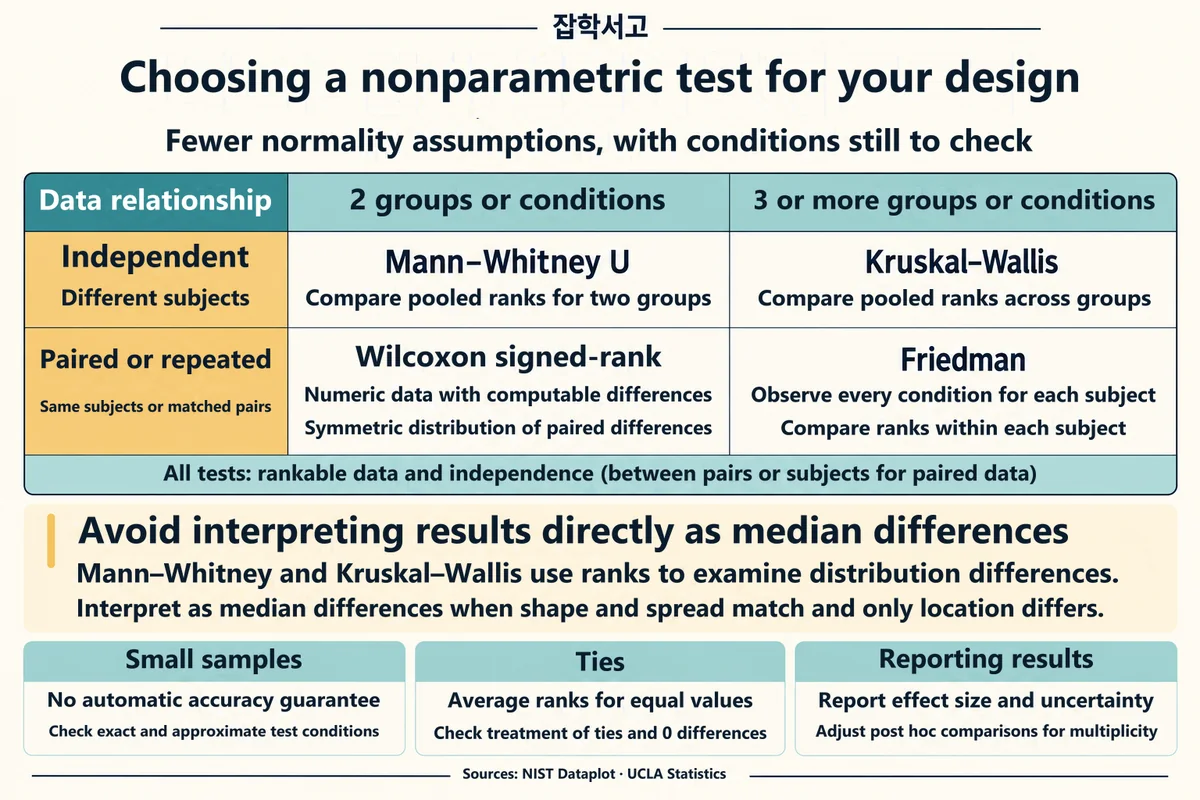
After thoroughly understanding the data characteristics, a nonparametric method suited to the analytical purpose and data characteristics must be selected. For example, the Mann-Whitney U test is suitable for comparing differences between two groups, while the Kruskal-Wallis test is recommended for comparing differences among three or more groups.
Various other nonparametric methods are available, including the Wilcoxon signed-rank test and the Friedman test, and each can be selected according to the research question and data characteristics. It is important to examine whether the selected method aligns with the research question, thereby ensuring that the analytical results can be interpreted in accordance with the characteristics of the data. This method selection process has a substantial effect on the validity and reliability of the analysis and plays a central role in drawing accurate research conclusions.
The Importance of Data Preprocessing
Data preprocessing before analysis is essential to improving the reliability and accuracy of nonparametric analysis. This process includes handling missing values, removing outliers, and adjusting data ranks as needed. Leaving missing values or outliers untreated can distort the analytical results, so they must be handled carefully.
Ranked data is particularly common in nonparametric statistical analysis, so it is necessary to adjust the data ranks with this in mind. This preprocessing prepares the data in a form suitable for analysis, ultimately improving analytical accuracy and ensuring confidence in the final interpretation.
Performing the Analysis and Interpreting the Results
Once the data has been prepared through preprocessing, the next stage is to perform the actual analysis using the selected nonparametric method. At this stage, the method is applied to analyze the data, and the analytical results are interpreted to derive answers to the research question. The analytical results provide important answers to the research question, and it is important to interpret them in a way that properly reflects the data characteristics and research objectives.
An additional statistical review process is also necessary to assess the significance of the results and examine the validity of the analytical findings. This makes it possible to confirm whether the analysis was conducted reliably and provides a clearer understanding of how the data answers the research question.
Drawing Conclusions and Preparing a Report
This is the stage of drawing conclusions about the research question based on the analytical results and considering how the interpretation of the data can contribute to practice. It is necessary to examine whether the conclusions drawn from the analytical results adequately answer the research question and provide practical insights.
During this process, it is important to communicate the results effectively using visual tools such as graphs and tables. This makes complex analytical content easier to communicate and helps share information with various stakeholders.
Preparing and Sharing the Final Report
This process involves bringing together the results of nonparametric statistical analysis, organizing them into a report or presentation, and sharing them with stakeholders. When preparing the report, the analytical objectives and procedures, interpretation of results, and conclusions must be organized systematically, which can improve the transparency and reliability of the research.
The report communicates research findings objectively while also serving as an important record that can be used as reference material for future research or practical applications. Ultimately, this reporting process can maximize the effectiveness of nonparametric statistical analysis and promote the practical use of its results.
Considerations and Limitations When Applying Nonparametric Statistical Methods

Reviewing Data Characteristics Before Applying Nonparametric Methods
Before using nonparametric methods, the characteristics and distribution of the data must be examined thoroughly. Although nonparametric methods have the advantage of being applicable even when data does not follow a normal distribution, they may not be the optimal choice in every situation. For example, when data follows a clearly defined distribution or a large sample can be obtained, parametric methods may offer greater statistical power. In addition, although nonparametric methods do not assume a specific distribution, there is a risk of obtaining inefficient analytical results if the data type and distributional characteristics are not understood. It is therefore essential to choose an appropriate method after developing a deep understanding of the data characteristics.
The Statistical Power of Nonparametric Methods and the Importance of Sample Size
Because nonparametric methods tend to have lower statistical power than parametric methods, a sufficient sample size is needed to improve the reliability of the analysis. When statistical power is low, the data may fail to reflect actual differences adequately, potentially distorting the analytical results. It is therefore necessary at the research design stage to confirm that sufficient data has been collected and secure an appropriate sample size. When the sample size is small, it may be difficult to draw highly reliable conclusions using nonparametric methods alone, making it necessary to use parametric methods as a complement or expand the sample. This can improve analytical accuracy and produce reliable results.
Information Loss from Ranking Data and Limitations in Interpretation
Nonparametric methods often analyze data based on rank information, and information may be lost in this process. Using ranks rather than the original data values reflects only the order rather than the differences between individual values, leaving detailed variation out of the analysis. For example, two values that differ slightly may still be assigned the same rank, causing subtle characteristics of the data to be overlooked. This information loss can make the interpretation of results ambiguous and limit analysis in situations that require detailed comparisons of data. To address this, methods that can use original values rather than ranks may be used alongside these methods when necessary, or additional interpretation may improve the reliability of the results.
Ambiguity in Interpreting Results and the Need for Additional Explanation
Analytical results obtained through nonparametric methods often come from tests based on ranks, so their interpretation may seem ambiguous. Results based on ranks show only the relative order of the data, making it difficult to convey their actual magnitude or meaning precisely. For example, even if differences between groups are found, an explanation is needed of how meaningful those differences are and how they can be applied in practice. To this end, it is advisable to clarify the meaning of the results by comparing them with other information or conducting an additional statistical review alongside the analysis. These supplementary processes can make the results of nonparametric methods easier to understand and communicate reliably.
Technical Proficiency and Software Constraints
Nonparametric methods are supported by a variety of software packages, but advanced methods may require custom coding and therefore technical proficiency. Most statistical software provides basic support for nonparametric methods, but coding skills are needed when detailed adjustments are required for a particular situation. These technical requirements call for a deep understanding of the analysis and knowledge of statistics, and more complex research requires the assistance of experienced specialists. This helps ensure the accuracy and efficiency of the analysis and enables effective use of nonparametric methods.
The Need to Use Nonparametric and Parametric Methods Together
Nonparametric and parametric methods each have advantages and disadvantages, so it may be necessary to use both together depending on the situation. Nonparametric methods have the advantage of making no distributional assumptions, but they may have limitations in statistical power. Parametric methods, by contrast, assume a normal distribution and provide more powerful analysis when the data satisfies that condition. Therefore, combining the two approaches appropriately according to the data characteristics and analytical purpose can produce more accurate analytical results. Considering this combined use at the research design stage allows the optimal analytical method to be selected.
Comprehensive Considerations for Using Nonparametric Methods
Effective use of nonparametric methods requires reviewing data characteristics in advance, securing an appropriate sample size, compensating for information loss, approaching result interpretation carefully, developing proficiency with software, and considering combined use with parametric methods. These comprehensive considerations can address the limitations of nonparametric methods and make the most of their strengths. This enables more reliable data analysis and a flexible response to various data types and research situations.
Nonparametric statistical methods are becoming essential tools for data analysis in an increasing number of fields. Their flexibility in analyzing a wide range of data types without assumptions about distributions enables them to offer practical approaches in diverse situations.
However, applying these methods accurately requires a close understanding of the characteristics of the data and careful interpretation of the analytical results. By using nonparametric statistical methods with a balanced consideration of their advantages and limitations, more accurate and reliable data analysis can be performed.