In this session, I would like to prepare material on how to create a questionnaire and the precautions to take. Generally, a questionnaire is a set of questions that a researcher uses as a research tool to obtain answers to a problem, with respondents completing it themselves to produce results.
 An Example of a Survey: A Satisfaction Survey
The purposes of using such questionnaires can be grouped into establishing facts, gathering information to determine respondents' level of knowledge, asking about respondents' attitudes (dispositions) or opinions (convictions), and helping respondents become aware of (assess) how they view themselves.
When creating a questionnaire, you need to understand the concepts of reliability and validity and work to ensure both. This is necessary for survey results to become information that everyone can accept. The material below will help you understand the concepts of reliability and validity.
 Understanding Reliability and Validity Easily
Categories of Questionnaire Design
 What Are the Types of Questionnaire Design??
The questionnaire method allows for various types of questions, which can broadly be divided into open-ended questions, closed-ended questions, dichotomous questions, multiple-choice questions, ranking questions, and checklist questions. Now, let's explore the types of questionnaire questions!
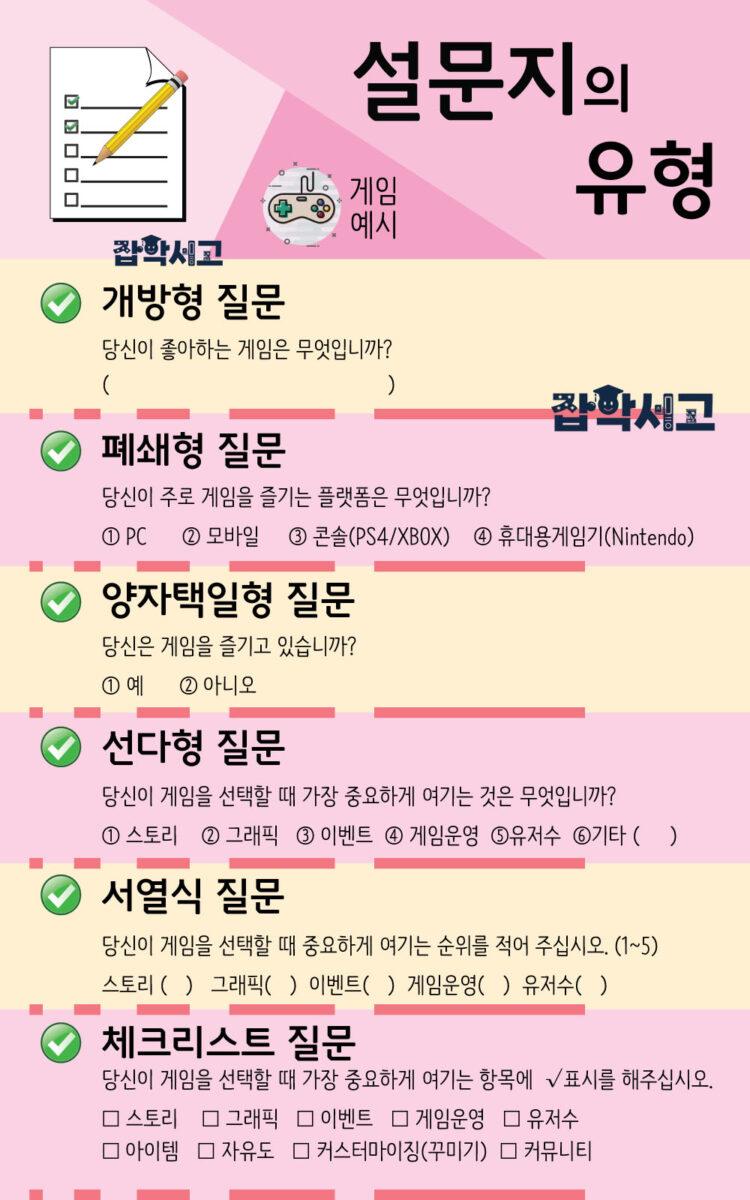 Types of Questionnaire Questions and How to Write Them
The concepts in the image above can be examined individually as follows.
Open-ended questions are free-response questions that allow respondents to answer freely. They are suitable for surveys with a small group of respondents and are used to gain a general understanding when little prior information is available.
Closed-ended questions give respondents several options and require them to choose from those options. They can be useful when you already know something about the respondents and can anticipate their responses to some extent.
Dichotomous questions, as the name suggests, offer only 2 options and ask respondents to choose just one of them. Typical examples include yes/no, do/do not, and agree/disagree. However, for questions that may be somewhat ambiguous, an option such as 'don't know' is sometimes added to give respondents some flexibility.
Multiple-choice questions include several options from which respondents choose, making them similar to closed-ended questions. Generally, about 3–5 options are used, and you should avoid including too many because they can confuse respondents. The points to keep in mind here are to avoid overlapping, similar options and to write them logically using a single criterion.
Ranking questions present several items chosen in advance by the researcher and ask respondents to place them in order of importance. They allow you to determine the relative importance of the items, but too many can be confusing, so the number should not exceed 10. However, because this uses the concept of an ordinal scale, it reveals only the order, not the extent of the differences between ranks.
Checklist questions are similar in concept to multiple-choice questions, but allow respondents to answer more conveniently by simply checking items. They are suitable when the researcher already has a great deal of prior information, and the items primarily consist of individual words.
You should understand the concept of measurement scales, particularly when writing survey questions such as multiple-choice or ranking questions, and the separately prepared material will be useful as a reference.
 The 4 Types of Measurement Scales, Explained Simply
※ Precautions When Creating a Questionnaire
 What Should You Keep in Mind When Creating a Questionnaire?
Arrangement and Order of Questions
Questions that respondents may find sensitive and open-ended questions should be placed toward the end. In contrast, questions that are easy to answer should be placed near the beginning. In other words, put the easy questions first and the difficult questions later.
Questions that require respondents to retain information in their memory while answering should be placed near the beginning, and questions that ask about the reliability of responses should be placed separately. Also, group questions that use the same scale together, and vary the arrangement of questions by type to keep it from becoming monotonous. This variation is necessary because an overly monotonous questionnaire may allow respondents to figure out the survey's intent, which can contaminate the survey.
Terminology and Content of Questions
A neutral questionnaire should be written to avoid ambiguous terms that can be interpreted in multiple ways and to avoid leading questions. Avoid overly sensitive or threatening questions so that respondents do not feel uncomfortable, and do not include two or more issues in a single question. Each question item should ask exactly one question.
Number of Questions
First, keep in mind that too many questions can make respondents feel tired or reluctant to respond. Conversely, too few questions can lead to errors when testing validity, so you should strive to include an appropriate number of questions. Generally, the appropriate number of questions used in public opinion polls is 30.
However, when collecting responses for personal businesses, corporate marketing, and similar purposes, fewer questions are sometimes used, because it is also important to increase the response rate by keeping users from feeling reluctant to respond.
This concludes our look at the methods and precautions you should know when creating a questionnaire. Understanding the types of survey questions and the concept of measurement scales can serve as a stepping stone toward obtaining reliable research results.
I hope this material has been helpful to people studying statistics, public opinion polling, or marketing research, as well as others who need to conduct surveys.