When we meet someone on a street corner asking for help, many of us hesitate for a moment. Thoughts flash through our minds: Are they really in a difficult situation? Will the money I give be put to good use? Some 150 years ago, people in London, England, wrestled with exactly the same worry. There were hundreds of charities, but they had no contact with one another, so some people received help from several places at once while others never received any at all. The organization that stepped forward to clear up this confusion was the “Charity Organization Society.”
Put simply, the Charity Organization Society means “a private organization that brought scattered charities together to coordinate their help so that it was neither duplicated nor missed, and that visited people who asked for help to look into their circumstances in person before connecting them with the right kind of help.” It is commonly shortened to COS and is regarded as the root of casework, the practice in which today’s social workers look into each person’s circumstances one by one.
This article looks in turn at the background from which the Charity Organization Society emerged, the work of its friendly visitors, the path that led to the social work profession, and how the society is judged today.
The Charity Organization Society, Which Brought Scattered Charity Together
Overflowing Charity, Help That Lost Its Way

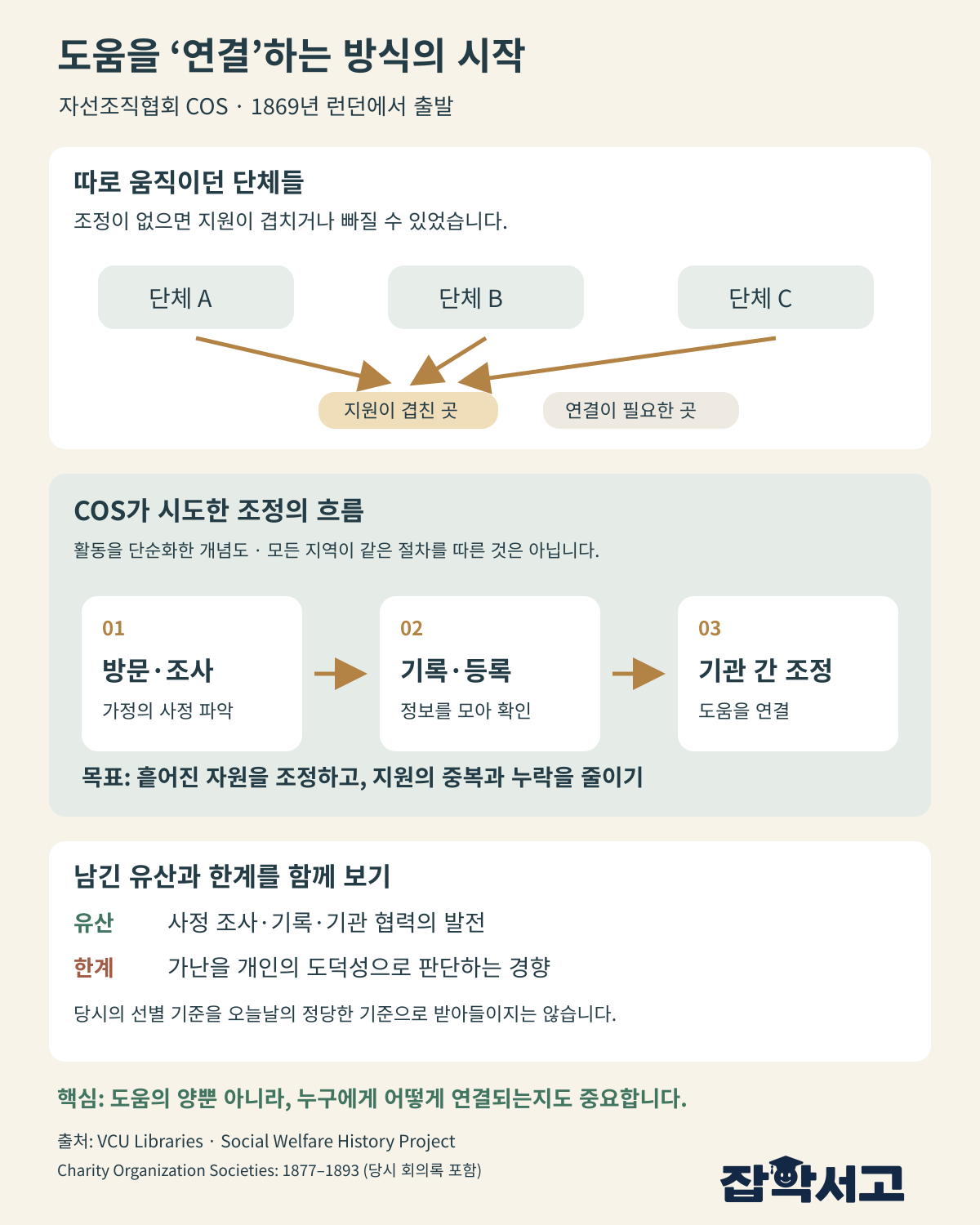
The Charity Organization Society was founded in London, England, in 1869. As industrialization sharply increased the number of poor people in cities, churches and wealthy citizens rushed to set up charities, but because each one acted on its own, a number of problems arose. The people who founded the society saw them as follows.
(1) Duplicated help and missed help
While one person went around several charities receiving the same help again and again, neighbors in truly urgent need were not on anyone’s list.
(2) Money given without knowing the circumstances
They believed that money handed over without looking into the situation of the person asking for help did less to lift people out of poverty than to build a habit of relying on help.
(3) No place to coordinate
There was no channel through which charities could share information, so no one could know who was receiving what kind of help.
So the society set up committees in each district and gathered the records of people who asked for help in one place so that the charities could consult them together. In today’s terms, it was the first shared hub for exchanging information about the people being served. Thanks to these records, charities could cut down on sending money to the same household again and again and redirect the resources they saved to neighbors who had not yet received help.
Friendly Visitors Who Went Door to Door
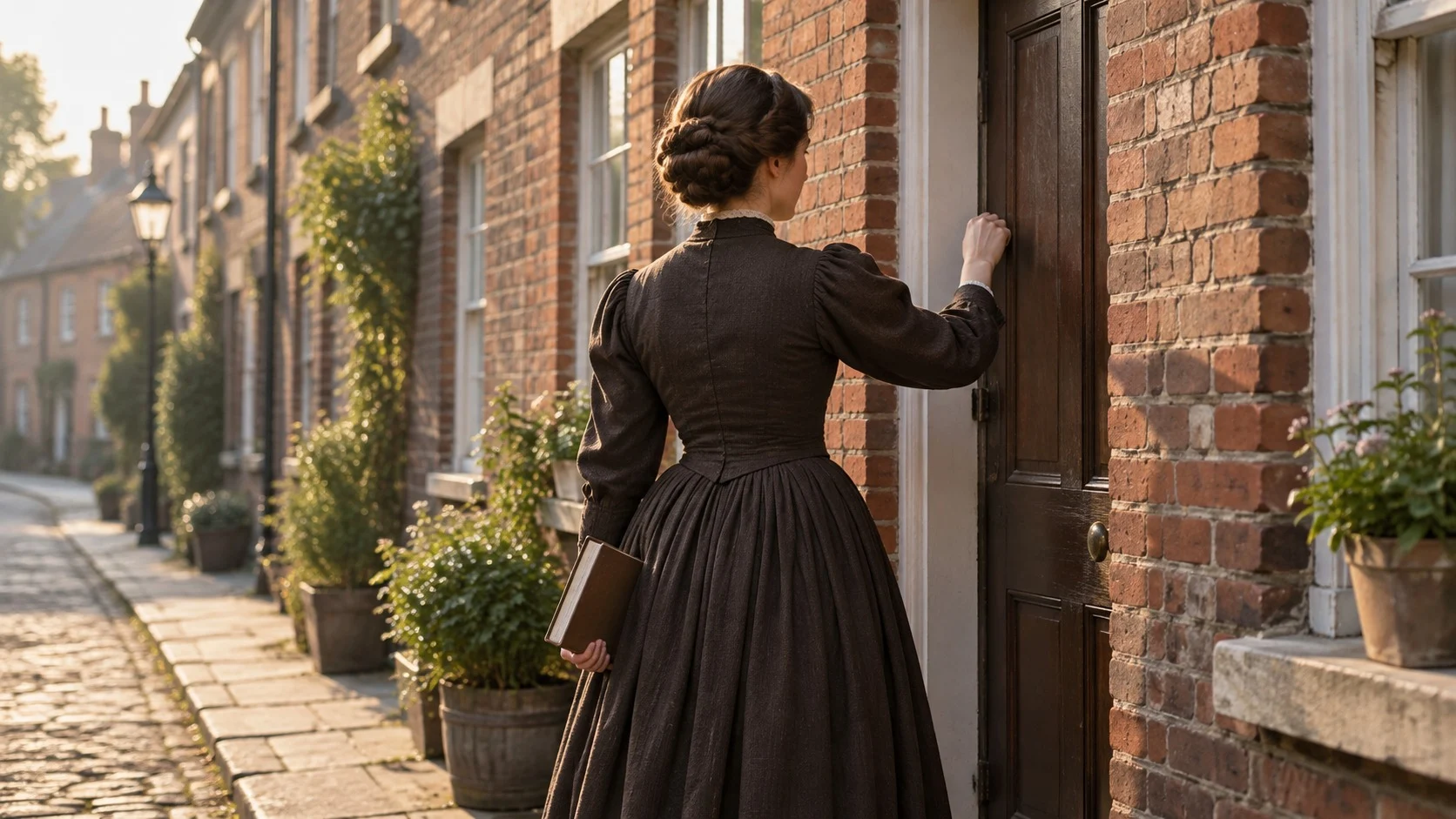
At the heart of the society’s work were the Friendly Visitors. Mostly middle-class women volunteers, they visited poor households in person to look into their living conditions, gave advice on housekeeping and work, and kept up relationships over long periods.
- Investigation: Visitors went to households and carefully checked circumstances such as the number of family members, income, health, and employment.
- Registration: What they found was recorded and shared with other charities so that help would not be duplicated.
- Visiting: Each visitor took charge of two or three households, calling on them once every week or two and keeping an eye on how things changed.
The housing reformer Octavia Hill, who said that what poor neighbors needed was a friend more than money, had a great influence on this kind of visiting. The approach crossed the Atlantic in 1877, when the Reverend Stephen Humphreys Gurteen founded the first society in America in Buffalo, and it then spread quickly to many American cities.
From Volunteering to a Profession: The Footsteps of Mary Richmond

As visiting work built up, more and more voices said that good intentions alone were not enough. At the center of this was Mary Richmond, who worked at the Charity Organization Society of Baltimore in the United States. In 1897 Richmond appealed for a school to train visitors systematically, and the following year a summer course opened in New York, marking the beginning of social work education.
In 1917 Richmond published Social Diagnosis, setting out for the first time the process of investigating and assessing a person’s circumstances, and in 1922 she explained its meaning in What Is Social Case Work? This sequence of gathering a person’s circumstances, assessing their causes, and planning the right help became the foundation of today’s social casework and case management.
Light and Shadow: How the Society Is Judged Today

The Charity Organization Society is highly regarded as the starting point of social work, but its limits were also clear. The society put great effort into separating the poor who deserved help from those who did not, and it often looked for the causes of poverty in personal character, such as laziness or wastefulness. This is also why it is often compared with the settlement house movement of the same period, whose members moved into poor neighborhoods to live alongside residents and called for social reform. It was also criticized because its thorough investigations humiliated the people asking for help and delayed help they urgently needed.
The differences between the two movements can be summarized as follows.
- Perspective: The society looked for the causes of poverty in individuals and families, while the settlement house movement looked for them in the social environment, such as low wages and poor housing.
- Method: The society visited households to investigate their circumstances and give advice, while the settlement house movement lived in the neighborhood and organized education and gatherings.
- Legacy: It is commonly explained that the society led to social casework, while the settlement house movement led to group work and community organization.
A Legacy That Continues Today
Even so, the society’s approach of looking carefully into circumstances, keeping records, and having many agencies join forces lives on in social work practice today. In 1946 the London society changed its name to the Family Welfare Association and carried on its work.
The wish to look into a person’s life before offering help: that was the first step in the history of how helping people was reborn as professional practice.