Texture has become an essential element in contemporary visual design and user experience (UX). Beyond being a visual element, texture brings physical qualities that we can actually touch and feel into digital environments, providing a more intuitive and immersive experience.
This material will examine the concept and basic principles of texture, its effects on user experience, and how it is used across various industries through concrete examples. It will also cover the latest trends and technological developments in texture design in detail, offering an outlook on the future possibilities of texture.
Understanding the Concept and Basic Principles of Texture
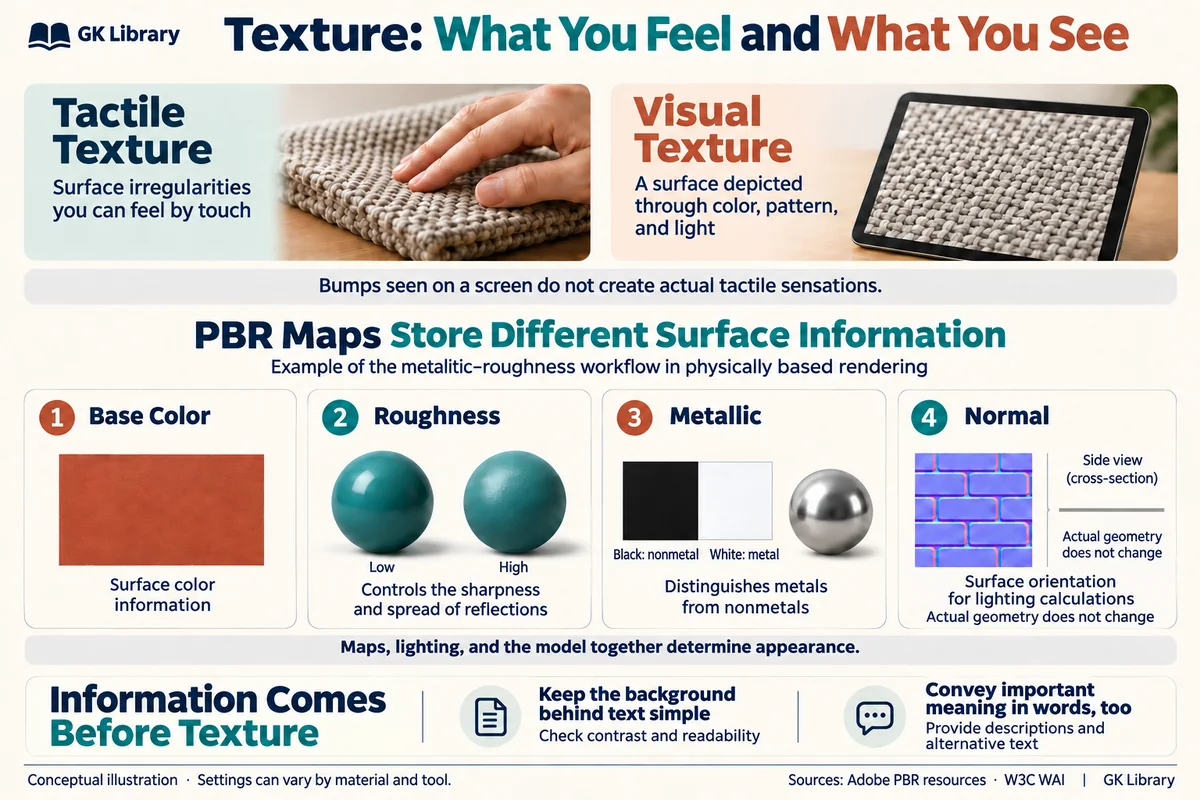

The Concept and Basic Principles of Texture
Texture refers to the visual and tactile characteristics of an object's surface and is an important element that visually represents the sensations we experience when touching an object. For example, the rough surface of wood and the smooth surface of metal have different textures, and these differences determine the sensations associated with an object's material and form.
The basic principle of texture is to visually reproduce the physical characteristics of an object's surface. Optical properties such as reflection, refraction, and absorption are used for this purpose, and these techniques help depict the surface's depth and details more vividly. In 3D modeling in particular, a technique called texture mapping can produce lifelike surface effects.
Texture also plays a very important role in digital environments. Digital texturing is widely used in various fields, including 3D graphics, game design, and web design, allowing users to have more immersive and realistic experiences.
Types of Texture
Texture falls into two broad categories: physical texture and visual texture. Physical texture refers to the surface qualities that can actually be touched, while visual texture is a way of representing those qualities visually. Digital design primarily uses visual texture, but combining it with physical texture allows for more vivid expression. Such visual textures also serve as an important tool for maximizing realism in virtual environments.
Textures That Convey Emotion and Atmosphere
Texture plays an important role in conveying emotion and atmosphere in design. Soft, smooth textures express luxury and comfort, while rough textures can express intensity and naturalness. These characteristics of texture are useful for designers in influencing users' senses and eliciting their emotional responses. For example, textures that feel warm can evoke comfort, while sharp, cold textures can evoke tension.
The Role of Texture in Design
Alongside lighting, color, and form, texture is one of the important elements that determine the overall quality of a design. Texture enriches a design's surface qualities, enabling it to provide users with a richer visual experience. Using texture appropriately improves the quality of a design and strengthens interaction with users. In particular, appropriate use of texture can communicate a product's message clearly and establish a clearer brand image in users' minds.
The Effects of Texture on User Experience

Texture goes beyond being a simple visual element in design and plays an important role in directly affecting user experience. Through this, users elicit specific emotions and reactions, ultimately producing the effect of improving interface usability.
Textures That Elicit Emotions and Reactions
Texture is an important medium for visually conveying various emotions to users. Soft, smooth textures encourage users to feel comfortable and create a sense of luxury. Conversely, rough or irregular textures heighten tension or attention. These emotional responses determine how users respond to and interact with the design element in question. For example, in situations where danger needs to be emphasized, rough textures can intuitively convey a warning message to users.
Textures That Facilitate Intuitive Interaction
In digital product design, texture plays a major role in attracting users' attention. Applying texture to buttons or important information makes it easier for users to recognize them and take action. For example, a design with a texture reminiscent of a real physical button is more effective than a smooth-looking button at intuitively signaling to users that they should press it. In this way, texture can encourage user interaction and provide a more intuitive experience.
Textures That Reduce Visual Fatigue
Flat, monotonous designs can easily tire users' eyes. Appropriate use of texture can reduce this fatigue and create visual interest for users. Variations in surface qualities provide visual stimulation that helps users maintain concentration for extended periods. For example, using varied textures to create visual rhythm on a page greatly improves user experience compared with repeating the same colors and designs.
Textures That Help Strengthen Brand Identity
Texture plays an important role in strengthening brand identity. When a particular texture is used consistently, users can easily recognize the brand through that texture. For example, if the texture of a particular material creates a distinctive brand image, users can naturally recall the brand whenever they use the product. This serves as an important element in maintaining the brand's originality and consistency and can help increase brand loyalty.
Textures That Improve Accessibility
Texture also helps improve accessibility. Users with visual impairments can perceive differences in texture through screen readers or tactile displays and receive information through them. Changes in texture provide these users with important visual cues, helping make digital environments accessible to a diverse range of users. This improvement in accessibility makes digital experiences more inclusive and broadens the user base.
The Power of Texture to Increase Satisfaction
Designs that apply texture effectively greatly improve user satisfaction. Textures that provide satisfying visual and tactile stimulation offer users greater emotional impact and enjoyment, leading to a positive perception of the product. As a result, repeat purchase rates or brand loyalty may increase, and the formation of long-term relationships with users is also positively affected.
Texture is a very important element in user experience, contributing in various ways, such as eliciting emotional responses, facilitating interaction, and reducing visual fatigue. Texture also plays an important role in strengthening brand identity and improving accessibility. Through this, designers can provide users with richer and more satisfying experiences.
Analyzing Texture Applications Across Industries

The Use of Texture in the Gaming Industry
In the gaming industry, texture plays an important role in maximizing a game's immersive quality. Using high-resolution textures makes characters, backgrounds, and objects in games look more realistic, allowing users to become deeply immersed in the game world. In 3D games in particular, techniques such as texture mapping and normal mapping are used to depict three-dimensional surfaces more realistically. These techniques improve a game's graphical quality by meticulously rendering even detailed elements, such as the texture of characters' skin and natural objects in the background. As a result, users can enjoy a more vivid and immersive gaming experience.
The Role of Texture in the Fashion Industry
In the fashion industry, texture is an important tool for visually conveying the surface qualities of fabric. Designers can use texture to highlight the distinctive characteristics of clothing, helping consumers intuitively understand how garments feel and the quality they offer. For example, the soft, lustrous feel of silk and the rough texture of denim clearly express the style and function of each garment. These visual representations of texture add sensory value to fashion products and play an important role in making consumers find the products more attractive.
Texture Applications in Architecture and Interior Design
In architecture and interior design, texture is also a key element in determining a space's atmosphere and emotional character. The surface qualities of flooring, wallpaper, and furniture influence a space's style and can convey particular atmospheres and emotions to users. For example, flooring with a wood texture gives a warm, natural feel, while a marble texture creates a refined, luxurious atmosphere. Choosing these textures goes beyond a simple aesthetic consideration and serves as an important design element that also takes the space's functionality and comfort into account.
The Use of Texture in Web Design
In web design, texture plays an important role in making user interfaces more intuitive and creating visual interest. Applying appropriate textures to buttons or banners makes users more likely to recognize and interact with them easily. For example, a button design that conveys a sense of depth can clearly signal to users that they should click it. Texture also complements a website's flat design, adding visual interest and encouraging users to spend more time on the site. This can greatly improve the website's overall user experience.
The Use of Texture in Advertising and Marketing
In advertising and marketing, texture also serves as an important element in highlighting product characteristics and eliciting particular emotions. For example, advertisements for luxury products can use smooth, shiny textures to further emphasize the products' luxurious qualities. By contrast, advertisements for natural or environmentally friendly products can use the textures of rough wood or natural fibers to emphasize naturalness. These textures intuitively communicate the product's image to consumers, positively influencing their purchasing decisions.
The Use of Texture in the Medical Industry
The application of texture is gradually expanding in the medical industry as well. Adding texture to the user interfaces of medical devices enables medical professionals or patients to operate the devices more intuitively and easily. For example, adding fine texture to a device's buttons allows users to operate them accurately through the sensations in their fingertips. Texture can also be used in simulations for medical education to provide a more realistic learning environment. For example, applying a texture similar to real skin to a human body model allows medical professionals to achieve better learning outcomes through experiences that resemble actual situations.
Trends and Technological Developments in Texture Design

Physically Based Rendering (PBR) and Maximizing Realism
Physically based rendering (PBR) is an important trend in texture design and a technology that represents the physical properties of textures more precisely. PBR reproduces properties such as light reflection, refraction, and absorption in a way that closely resembles reality, enabling more realistic rendering. This technology is primarily used in game design and film production, providing users with realistic visual experiences. For example, it can depict characters' skin or the surface qualities of objects more vividly, making a major contribution to creating immersive scenes.
Texture Generation Using AI and Machine Learning
Advances in AI and machine learning have also brought innovation to the way textures are generated. In particular, technologies such as Generative Adversarial Networks (GANs) allow AI to learn from existing textures and automatically generate new ones. This is an important technology that can save time and money on large-scale projects and is attracting particular attention in game development and the film industry. AI-generated textures are highly realistic and greatly reduce the time required to create textures by hand.
Real-Time Texturing and Its Application in VR/AR
Real-time texturing is a technology that enriches user experience in games and VR/AR environments. With this technology, textures are applied or modified immediately in response to user interaction, enabling fast and natural interaction. For example, game engines such as Unreal Engine and Unity actively use real-time texturing to create highly realistic graphics and provide users with immersive experiences. In VR/AR environments as well, real-time texturing represents the textures of objects or spaces with lifelike surface qualities, enabling users to interact more naturally in virtual spaces.
Environmentally Friendly Texture Design
As interest in environmental protection and sustainability grows, environmentally friendly approaches are also gaining attention in texture design. Environmentally friendly texture design involves designing textures inspired by nature or using recyclable materials. For example, textures that imitate wood grain or the surface qualities of stone convey nature's beauty and distinctive emotional character, allowing users to have more natural and comfortable experiences through these textures. Sustainable design has a positive impact on users as well as on environmental protection.
User Interaction Through Interactive Textures
Interactive textures refer to designs that allow users to interact directly with textures. They can be implemented on websites or in applications in the form of textures that change in real time in response to users' movements. For example, a website whose background texture changes whenever the mouse cursor moves provides users with an interesting experience and adds visual enjoyment. Interactive textures encourage user participation and help memories of a brand or product last longer.
Cross-Platform Compatibility and Consistent User Experience
Cross-platform compatibility is a technology that allows a single texture to be displayed identically across various devices and platforms. Its goal is to ensure that textures are displayed smoothly and consistently in different environments, including mobile devices, tablets, and desktops. This allows users to have the same visual experience on any device and makes it possible to maintain a consistent brand image. Cross-platform compatibility plays an important role in various fields, including games and applications as well as web design.
In design and user experience, texture goes beyond a simple aesthetic device and plays an important role in strengthening interaction with users and increasing a product's value. By examining examples of texture use across various industries, we can learn how to apply it effectively.
In addition, the possibilities of texture design are continually expanding with the latest trends and technological developments, and this progress will continue into the future.