Have you ever liked a sweater your grandmother knitted by hand, or a wooden spoon carved one by one in a workshop, more than something stamped out in a factory? It is probably because you can feel the maker’s touch and the grain of the material. The first movement to gather this feeling into a philosophy and a design movement was the ‘Arts and Crafts Movement,’ which arose in Britain in the late 19th century.
Simply put, the Arts and Crafts Movement means ‘a design reform movement that stood against crude, machine-made mass-produced goods and sought to make useful and beautiful everyday objects with good materials and skilled handwork.’ It began when the designer William Morris put the ideas of the critic John Ruskin into practice, and its name comes from a term first used by the bookbinder T. J. Cobden-Sanderson around the time the Arts and Crafts Exhibition Society was formed in London in 1887.
In this article, we will look in turn at the background from which the movement was born, the four principles of the Arts and Crafts Movement, the workshops and press that William Morris founded, and finally the movement’s legacy and limits.
Asking Again About the Value of the Hand in the Machine Age
1. The Great Exhibition of 1851 and Ruskin’s Question

The Great Exhibition, held in 1851 in the Crystal Palace, a glass building in London’s Hyde Park, was a stage for showing the world the power of machine production achieved by the Industrial Revolution. Yet this dazzling exhibition became, of all things, the starting point of design reform.
(1) Heavy on Ornament, Poor in Workmanship
Design reformers, including the architect Owen Jones, who took part in preparing the exhibition, criticized many of the exhibits as excessively ornate yet poorly made. William Morris, then 16, is said to have refused to enter the exhibition on grounds of taste.
(2) The Problem of Labor as Ruskin Saw It
In “The Nature of Gothic,” included in the second volume of The Stones of Venice (1853), the critic John Ruskin argued that the factory division of labor turns workers into something like parts of a machine. He called labor that leaves no room to think or to take pleasure ‘servile labor’ and regarded factory goods made that way as dishonest.
(3) Red House: Furnishing a Home by Hand
Moved by Ruskin’s writing, Morris in 1859 asked his friend, the architect Philip Webb, to design his newlywed home. After moving into this Red House, with its exposed red brick, in 1860, Morris could not find furniture or decorations he liked on the market, so he and his friends made furniture, murals and stained glass themselves. This experience led him to found a company the following year.
2. The Four Principles of the Arts and Crafts Movement

The people who took part in the Arts and Crafts Movement differed somewhat in their fields and views, but they broadly shared similar principles about what a good object should be.
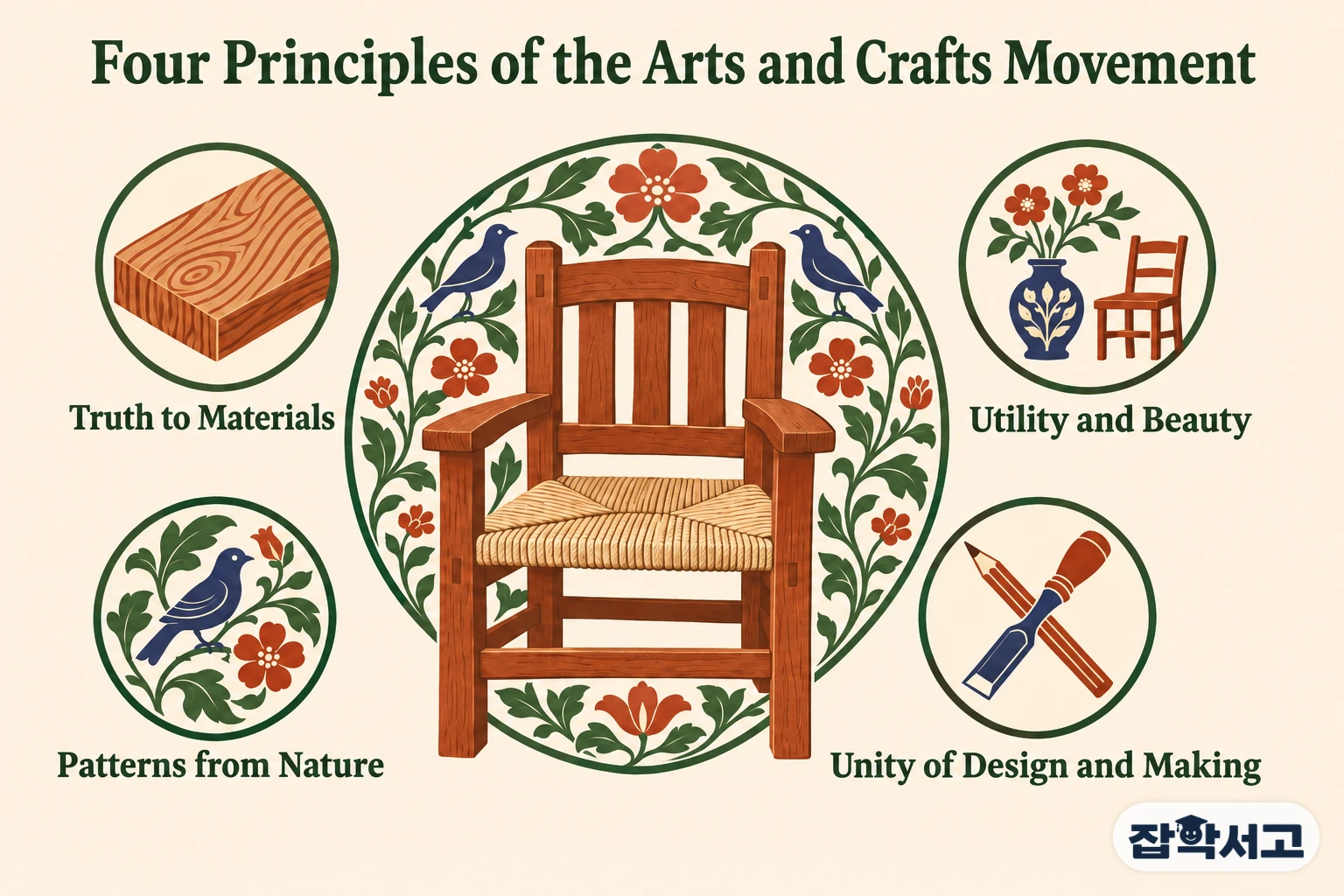
- Truth to Materials: Let wood show its grain and brick its texture, and never dress up cheap materials to look like expensive ones.
- Utility and Beauty: Ornament must not get in the way of use, and useful objects are made so that they are also beautiful.
- Patterns from Nature (Nature Motifs): Plants and animals seen in fields and gardens, such as leaves, flowers, vines and birds, become the basis of patterns.
- Unity of Design and Making: Designing and making are not kept apart; designers should learn the techniques themselves and understand the making process.
In an 1880 lecture, Morris said, “Have nothing in your houses that you do not know to be useful, or believe to be beautiful.” This one sentence captures the direction the four principles aimed for.
3. William Morris’s Workshops and the Kelmscott Press
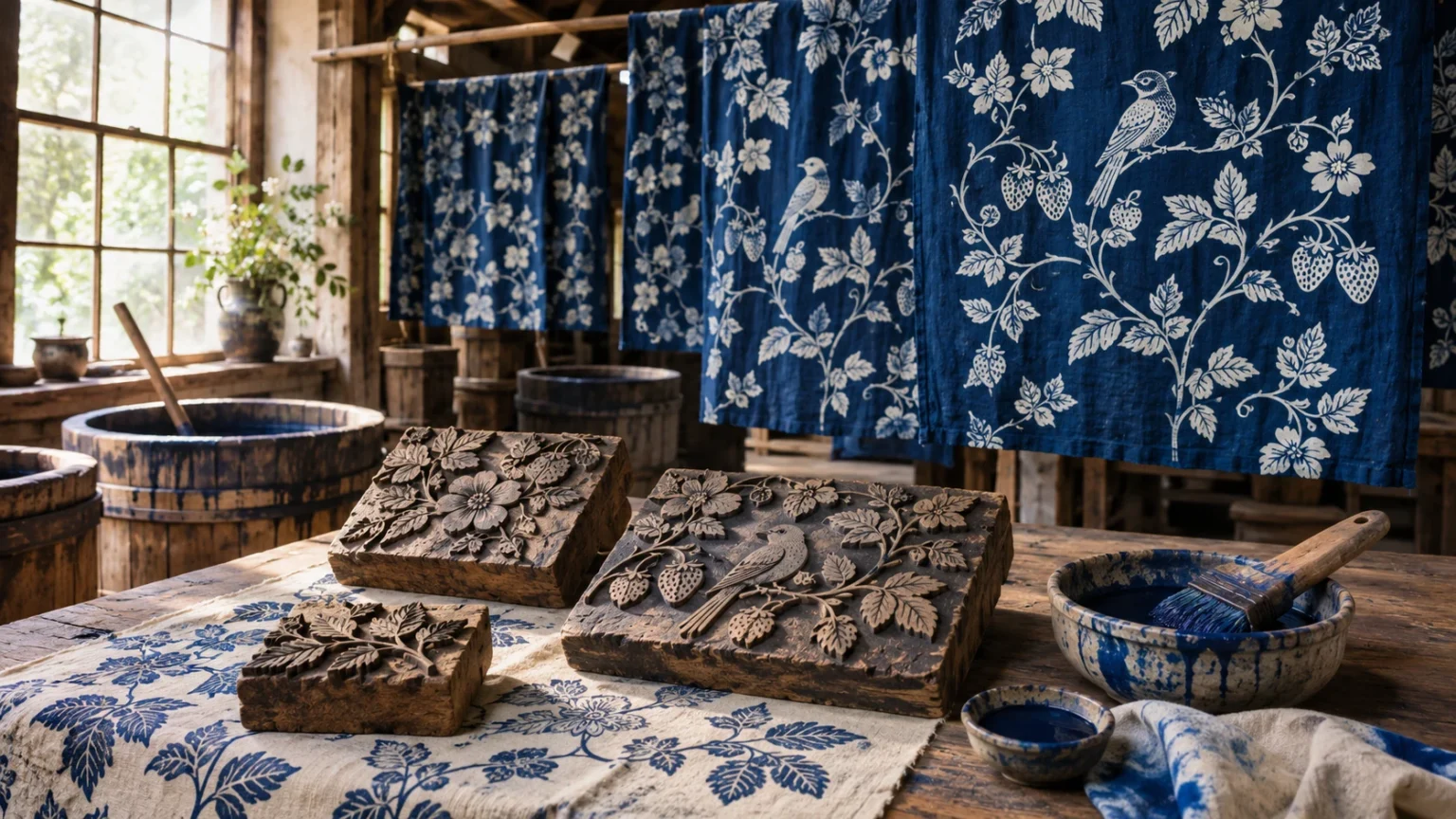
The company and workshops Morris founded himself played a large part in turning the Arts and Crafts Movement from an argument into a real movement.
(1) Morris & Co. and Hand-Printed Wallpapers and Textiles
In 1861 Morris founded the interior decoration firm Morris, Marshall, Faulkner & Co. with friends, and in 1875 he became its sole director and renamed it Morris & Co. He learned block printing, in which patterns are stamped with carved wooden blocks, and natural dyeing himself to make wallpapers and textiles; the textile “Strawberry Thief,” which he designed in 1883, is a signature work still widely used today.
(2) The Merton Abbey Workshops
In 1881 he bought Merton Abbey Mills, a textile works south of London, and brought his scattered workshops together in one place.
(3) The Kelmscott Press
In his later years, Morris founded the Kelmscott Press in 1891, designing typefaces and decorative borders himself and publishing 66 hand-printed books. The Kelmscott Chaucer, published in 1896, the year he died, is regarded as a masterpiece of book design.
4. The Legacy and Limits of the Arts and Crafts Movement
In the 1880s the movement became organized. In 1884 young architects founded the Art Workers’ Guild to break down the wall between art and craft, and the Arts and Crafts Exhibition Society, launched in 1887 with Walter Crane as president, held its first exhibition in November 1888 and went on to hold eleven exhibitions through 1916.
(1) The Paradox of Handwork
Morris dreamed of a democratic art for everyone, but handmade goods, which take much time and skill, were expensive and ended up mostly in the hands of the middle and upper classes. This is where the criticism comes from that keeping machines at a distance actually blocked the movement’s ideals.
(2) Successors Who Made Peace with the Machine
Efforts to overcome this limit continued in Germany. The Deutscher Werkbund, formed in 1907 by artists, architects, designers and industrialists together, sought to combine good design with industrial production, and this current led to the Bauhaus, which opened in 1919.
(3) An Aesthetic of the Hand That Spread Worldwide
In the United States, Gustav Stickley promoted simple, sturdy furniture through his magazine The Craftsman and his workshops, while in Japan Yanagi Sōetsu, influenced by Morris and Ruskin, led the Mingei (folk craft) movement from the 1920s, celebrating the beauty of everyday objects made by anonymous craftspeople.
The simple idea that good objects should be useful and beautiful, and that the people who make them should also find joy in their work — that is the first step to understanding the Arts and Crafts Movement.