Almost everyone has had this experience: during class you feel as if you understand everything, but when the test paper lands on your desk, your mind goes blank. Now imagine a teacher sitting right beside you, paying attention only to you, pointing out the spots you don’t understand the moment they come up, and having you rework the problems you got wrong. One education researcher reported that students who received this kind of one-to-one tutoring scored, on average, higher than 98% of students in an ordinary classroom. The question that grew out of this result is known as “Bloom’s 2 Sigma Problem.”
Put simply, the 2 sigma problem asks: “If one-to-one tutoring produces achievement two standard deviations higher than ordinary instruction, then in a world where we cannot give every student a personal tutor, how can group instruction come close to that effect?” It was first posed in 1984 by Benjamin S. Bloom, an educational psychologist at the University of Chicago, in a paper published in the journal Educational Researcher.
In this piece, we will look in turn at the three teaching methods Bloom compared, what the number “2 sigma” means and the conditions hidden behind it, and the lessons it holds for today’s classrooms and AI learning tools.
The Power of One-to-One Teaching, and How to Read the Number
The Three Teaching Methods Bloom Compared

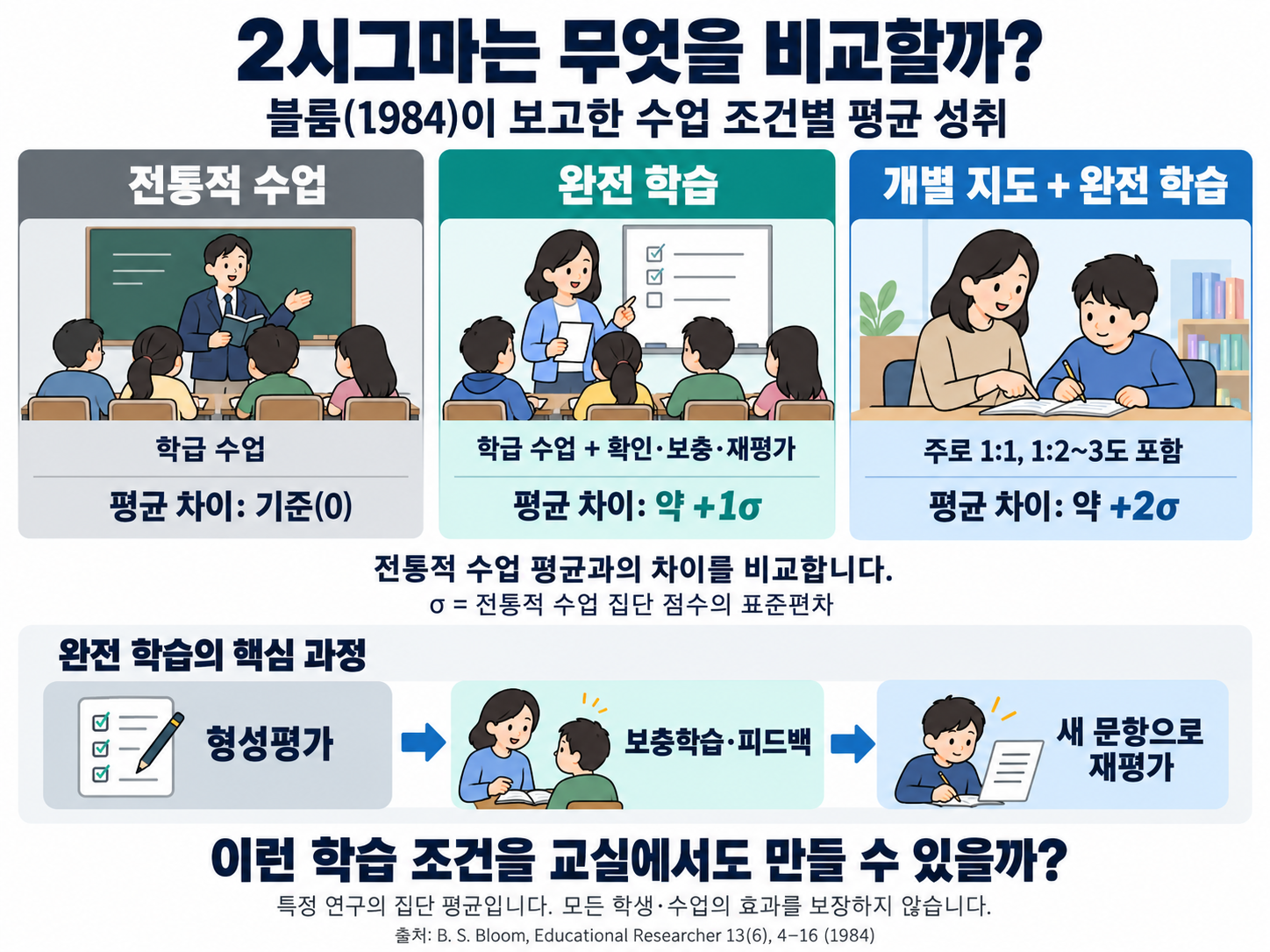
Bloom’s argument rests on experiments by Joanne Anania and Arthur J. Burke, who wrote their doctoral dissertations under his supervision. They randomly assigned students in grades 4 and 5 and in grade 8 to three groups, and over three weeks and 11 class sessions taught them subjects that were new to the students: probability and cartography (map-making).
(1) Conventional instruction
One teacher teaches about 30 students, and tests are given only occasionally, for the purpose of assigning grades.
(2) Mastery learning
The class size is the same, but understanding is checked with a formative test after each unit. Students who fall short of the standard do corrective work and are then tested again on similar problems.
(3) One-to-one tutoring
A trained tutor works with one student, or at most three. Formative tests, corrective work, and retesting are also part of the process.
The Remarkable Number Behind “2 Sigma”

When the scores were compared at the end of the experiment, the differences were striking. The average tutored student scored about two standard deviations above the average of the conventional class, and the mastery learning group scored about one standard deviation above it. To make sense of these numbers, a few terms are worth knowing.
- Standard Deviation: a value that shows how widely scores are spread around the average, written with the Greek letter sigma (σ).
- Effect Size: the difference between two groups’ averages expressed in units of standard deviation. Two sigma means an effect size of 2.0.
- Percentile: if the whole group is counted as 100, it shows what percentage of people you are ahead of. Two sigma above the average corresponds to about the 98th percentile, and one sigma above to about the 84th percentile.
Bloom reported that about 90% of the tutored students and about 70% of the mastery learning students reached the level that only the top 20% of the conventional class attained. The share of class time students actually spent engaged in learning also differed: about 65% in conventional instruction, about 75% in mastery learning, and over 90% in tutoring.
The Real Question the 2 Sigma Problem Posed

The conclusion Bloom drew from these results did not stop at “private tutoring is best.” He believed that most students could learn to a far higher level if they were given the right conditions. But assigning a personal tutor to every student was impossible in terms of cost. So he put forward, as a major challenge for education to solve, the search for ways to make group instruction produce effects comparable to individual tutoring. That is why it was named a “problem.”
Bloom proposed narrowing this gap by building on mastery learning and adding factors such as improving students’ learning processes, improving curricula and instructional materials, and strengthening learning support at home. His question later led to research on intelligent tutoring programs, in which computers set problems matched to each student’s level. In 2023, it drew attention again when Salman Khan, founder of Khan Academy, gave a talk arguing that AI tutors could be an answer to the problem.
The Conditions Hidden Behind the Number, and Today’s Lessons

Still, there are reasons to think twice before taking the number “2 sigma” at face value. In 2024, education researcher Paul T. von Hippel re-examined the original experiments and pointed out the following conditions.
(1) A narrowly focused test
Students covered a topic that was new to them for three weeks and were tested only on that content. Tests with a narrow scope tend to produce large effects.
(2) Not the effect of tutoring alone
The tutored group also received extra tests, feedback, and retests. Since the mastery learning group, which used the same tools, was also about 1.1 sigma ahead, roughly half of the effect can be seen as coming from feedback and retesting.
In fact, when the results of many studies are pooled and analyzed, the average effect of tutoring was about 0.33 sigma in a 1982 analysis and about 0.37 sigma in a 2020 analysis of 96 randomized experiments. That falls far short of 2 sigma, but given that most education programs stay at 0.1 sigma or less, it is by no means a small effect.
The value of Bloom’s 2 sigma problem lies less in the number itself than in the question that number raised. Checking understanding often, pointing out mistakes right away, and encouraging students to try again are things that classrooms and learning tools can do well even without a personal tutor.
Paying attention to where each person got stuck and giving them another chance to learn: that is the first step of an education that draws out the potential of every student.