If you don't want to get lost in a city you're visiting for the first time, it's better to unfold a map before wandering the alleys. Once you know the overall layout, you can guess roughly where you are even on unfamiliar streets. Studying works much the same way: hearing the big picture before starting a new unit helps everything that follows settle into place far more easily.
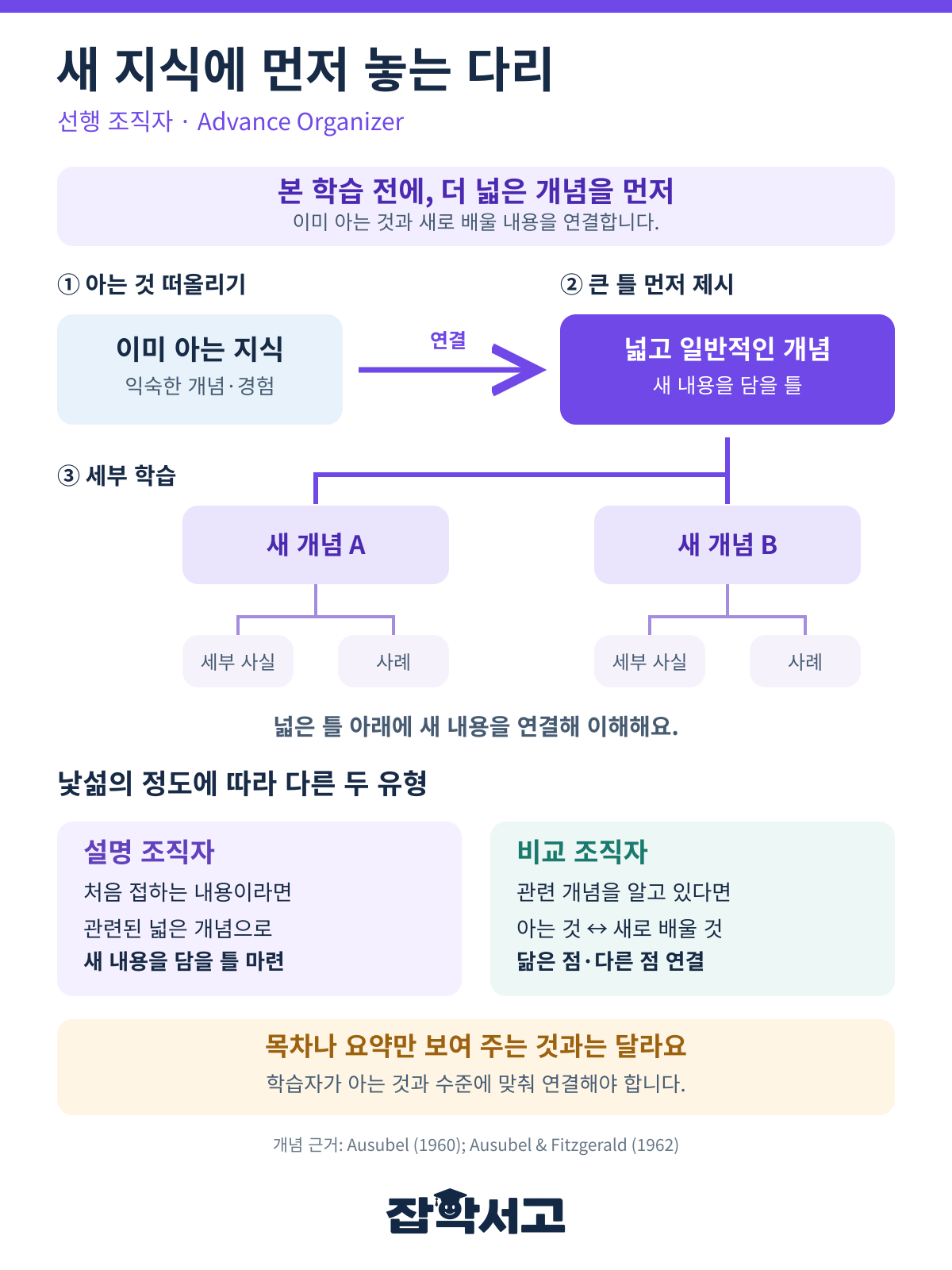
American educational psychologist David Ausubel turned this principle into a teaching technique. The idea is to present a concept broader and more general than the material to be learned, and use it as a bridge between what learners already know and the new knowledge. This is the “advance organizer.”
This article walks through meaningful learning theory, the background from which the advance organizer emerged, then the two types of advance organizers, how to use them in class, and finally the effects and limits that research has revealed.
Building the New on What You Already Know: How Advance Organizers Work and How to Use Them
Meaningful Learning and the Birth of the Advance Organizer

Ausubel divided learning into two kinds: rote learning, which means memorizing without grasping the meaning, and meaningful learning, which means understanding new material by connecting it to concepts you already know.
(1) The structure of knowledge in the mind
Ausubel believed that knowledge in the mind is organized as a hierarchy. Broad, inclusive concepts sit at the top, with narrower concepts and specific facts hanging beneath them. New knowledge finds its place by slotting in under an existing broad concept, a process he called subsumption.
(2) The 1960 experiment
In 1960, Ausubel had college students read an unfamiliar science passage on the properties of metals. Before reading it, one group first read a short text summarizing the concepts that encompassed the material, while the other read a historical story of similar length. On a test a few days later, the group that had read the concept text first remembered more.
(3) The single most important factor
In his 1968 book Educational Psychology: A Cognitive View, he stressed that the single most important factor influencing learning is what the learner already knows. His advice to ascertain this and teach accordingly is still widely quoted in education today.
Two Types of Advance Organizers

An advance organizer is a brief introduction presented before the main lesson at a more abstract and inclusive level. Depending on how unfamiliar the new material feels to learners, it comes in two types.
- Expository organizer: When learning completely new material, it first explains a broad concept that can hold that material, making room for it in the mind.
- Comparative organizer: When learning somewhat familiar material, it compares the similarities and differences between a known concept and the new one so learners don't confuse them.
For example, first explaining the big principle that power comes from the people to students learning about democracy for the first time is an expository organizer. Teaching the parliamentary system to students who have already studied the presidential system by setting the two side by side is a comparative organizer.
Not the Same as a Table of Contents or a Summary
An advance organizer is different from a table of contents that previews a unit's subheadings, or a summary that condenses the text. Its key feature is that it presents a general idea one level above the main text, linking new material to existing knowledge.
How to Use Advance Organizers in Class

Advance organizers are especially useful in lessons where the teacher organizes and delivers the content, such as lectures. Ausubel called this kind of instruction expository teaching and believed that well-designed expository lessons can lead to fully meaningful learning.
(1) Show the big picture at the start of the lesson
After stating the lesson's goals, present the principle or concept that encompasses the main content. Prompting students to recall examples or experiences they already know at this point makes the connection easier.
(2) Move from broad to narrow
Ausubel called the sequence of covering general concepts first and then gradually breaking them down into details progressive differentiation.
(3) Reconnect what has been learned
The teacher clarifies the relationships among newly learned concepts and between them and earlier knowledge, pointing out differences and contradictions. This is called integrative reconciliation.
Not only text but also pictures, diagrams, analogies, and short stories can serve as advance organizers. What matters is not the format but providing a broad framework that can hold the new material first.
Effects and Limits Revealed by Research

Advance organizers have inspired a great many studies since the 1960s, but opinions on their effectiveness have sometimes been divided.
(1) Mixed early assessments
In 1975, Barnes and Clawson reviewed 32 studies and concluded that it was hard to say advance organizers facilitate learning. In 1979, however, Richard Mayer countered that their review had not adequately taken theory and experimental conditions into account.
(2) The verdict of meta-analysis
In 1980, Luiten and colleagues conducted a meta-analysis of 135 studies and reported that advance organizers aid both learning and retention. That said, the size of the effect is generally considered small.
(3) They only work when designed well
An advance organizer that is too concrete is no different from a summary, and one that is too abstract goes over students' heads. Pitching it at the right level so it actually connects to what learners already know is what determines its effectiveness.
The advance organizer encouraged us to see learning not as pouring new knowledge into an empty vessel, but as stacking it neatly on the shelves of knowledge we already have. That is why many teachers today begin their lessons by showing the big picture.
Thinking first about what you already know that the new material could connect to is the first step toward learning that lasts.