Think of someone learning to cook. Rather than tasting the soup once after it is finished and giving it a score, tasting it now and then while it simmers and adjusting the seasoning makes a far better soup. Studying is the same. Short checks and advice received in the middle of learning change a student’s skills far more than a report card at the end of the semester. Assessment that takes place in the very middle of the learning process like this is called “Formative Assessment.”
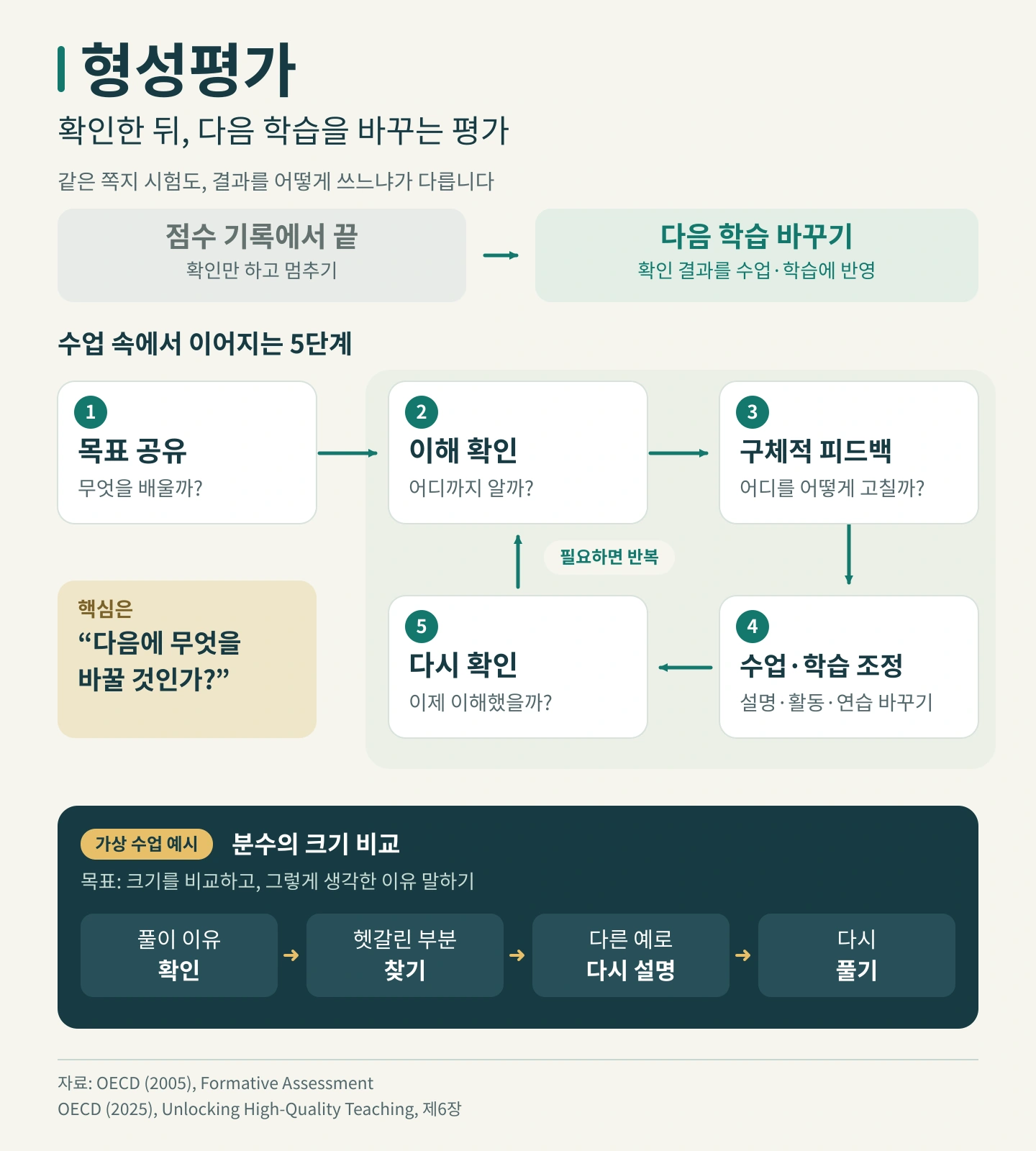
Put simply, formative assessment means “assessment that checks what students know and don’t know while learning is in progress, and uses the results to improve how teachers teach and how students learn.” Because its purpose is not to rank students by score but to make the next lesson better, it is also called “Assessment for Learning.”
In this article, we will look in turn at the background of how the term formative assessment came about, how it differs from summative assessment, specific methods used in the classroom, and the conditions for effective feedback.
How Assessment Helps Find the Way During Learning
How Did Formative Assessment Begin?

The term formative assessment was first used in 1967 by the American evaluation scholar Michael Scriven. He divided the evaluation of curricula into two kinds: evaluation that makes a final judgment about how good a finished curriculum is, and evaluation that gathers information while a curriculum is being developed and revised in order to refine it. He called the former summative evaluation and the latter formative evaluation.
The following year, in 1968, the educational scholar Benjamin Bloom applied this idea to the learning of each individual student in “Learning for Mastery.” His idea was to check understanding with a short assessment after each unit and give extra instruction to students who fell short, so that everyone could reach the goal. In 1971, in a book published with colleagues, he laid out in detail how to design unit-by-unit formative assessments, and most of the meaning we use today comes from there.
How Do Formative and Summative Assessment Differ?

School assessment is often divided into formative assessment and Summative Assessment. Even if the test papers look similar, the two serve completely different purposes.
(1) When it happens
Summative assessment is taken all at once at the end of a unit or semester. Formative assessment happens frequently during lessons, in units of seconds or minutes.
(2) What it is for
Summative assessment is for assigning grades and making decisions such as pass or fail. Formative assessment is for improving learning, so it has no score or is barely reflected in grades.
(3) How the results are used
The results of summative assessment remain as a final verdict. The results of formative assessment are used as material for deciding what to relearn and how to teach.
The important point is that formative assessment is defined by how it is used, not by the assessment tool. Even the same pop quiz is closer to summative assessment if only the score is recorded and that is the end of it, and it becomes formative assessment if the results are used to change the next lesson.
Adding Diagnostic Assessment, which checks what students already know before a lesson begins, schools in Korea often describe assessment in three stages: diagnostic, formative, and summative. If diagnostic assessment checks the starting point and summative assessment checks the destination, formative assessment acts as a guide that keeps students from getting lost in between.
Formative Assessment Methods Used in the Classroom

Formative assessment is often carried out not through elaborate tests but through small activities within lessons.
- Exit Ticket: At the end of a lesson, students write down “the one most important thing I learned today,” allowing a quick check of their understanding.
- Traffic Light Cards: Students use green, yellow, and red cards to show how well they understand right now, so the teacher can adjust the pace.
- Concept Map: Students draw the relationships between the concepts they have learned, giving a look at the structure in their heads.
- Peer Assessment: Students review a classmate’s work against a rubric and come to realize for themselves what good work looks like.
Waiting Is Part of Assessment Too
Waiting a few more seconds after asking a question instead of pressing for an immediate answer is also an important skill. In research by science education scholar Mary Budd Rowe, when teachers increased their wait time, students’ answers grew longer, cases of failing to answer decreased, and students offered a wider variety of explanations with more confidence.
Conditions That Make Formative Assessment Work

In 1998, Paul Black and Dylan Wiliam in the United Kingdom reviewed more than 250 studies and reported that lessons making good use of formative assessment raise achievement substantially, with especially large effects for students who had been low achievers. However, this effect appears when certain conditions are met.
(1) Share goals and criteria first
Students can check their own progress only when they know what they need to learn and what good work looks like.
(2) Show how to improve rather than give a score
Feedback is most effective when it focuses on the quality of the task rather than on the student, and tells them where and how to improve. There is also research showing that when comments are given together with a score, students often look only at the score and skip the comments.
(3) Students take ownership of learning
Ultimately, the goal of formative assessment is to build students’ ability to recognize their own strengths and weaknesses and decide their next step.
Formative assessment is the idea of moving assessment from the end of learning to the middle of it. Well-designed formative assessment gives teachers clues for improving lessons and gives students a map showing what to do next. Another great advantage is that, without any elaborate tools, it can start in today’s lesson with a single question or a single card.
Not stopping at receiving a score, but using the result to change how you study next: that is the first step of assessment that builds real ability.