This time, I would like to put together material on defensive psychology (defense mechanisms) as one element of psychology. More precisely, it is an important concept within Freud's psychoanalysis. Defense mechanisms can be described as instinctive strategies that people use unconsciously to reduce the psychological stress caused by anxious feelings or conflict.
Some defense mechanisms are also related to the unconscious. In connection with this, the material below partly covers the conscious, the preconscious, and the unconscious, so please refer to it.
 Exploring the Concepts of the Conscious, the Unconscious, and the Preconscious
There are quite a lot of human defense mechanisms, and in this material I have grouped 12 of them by type to make them easier to understand. Because the grouping is one I came up with on my own after some thought, a few items may seem to have been squeezed in.
Defense Mechanisms - Avoidance Type
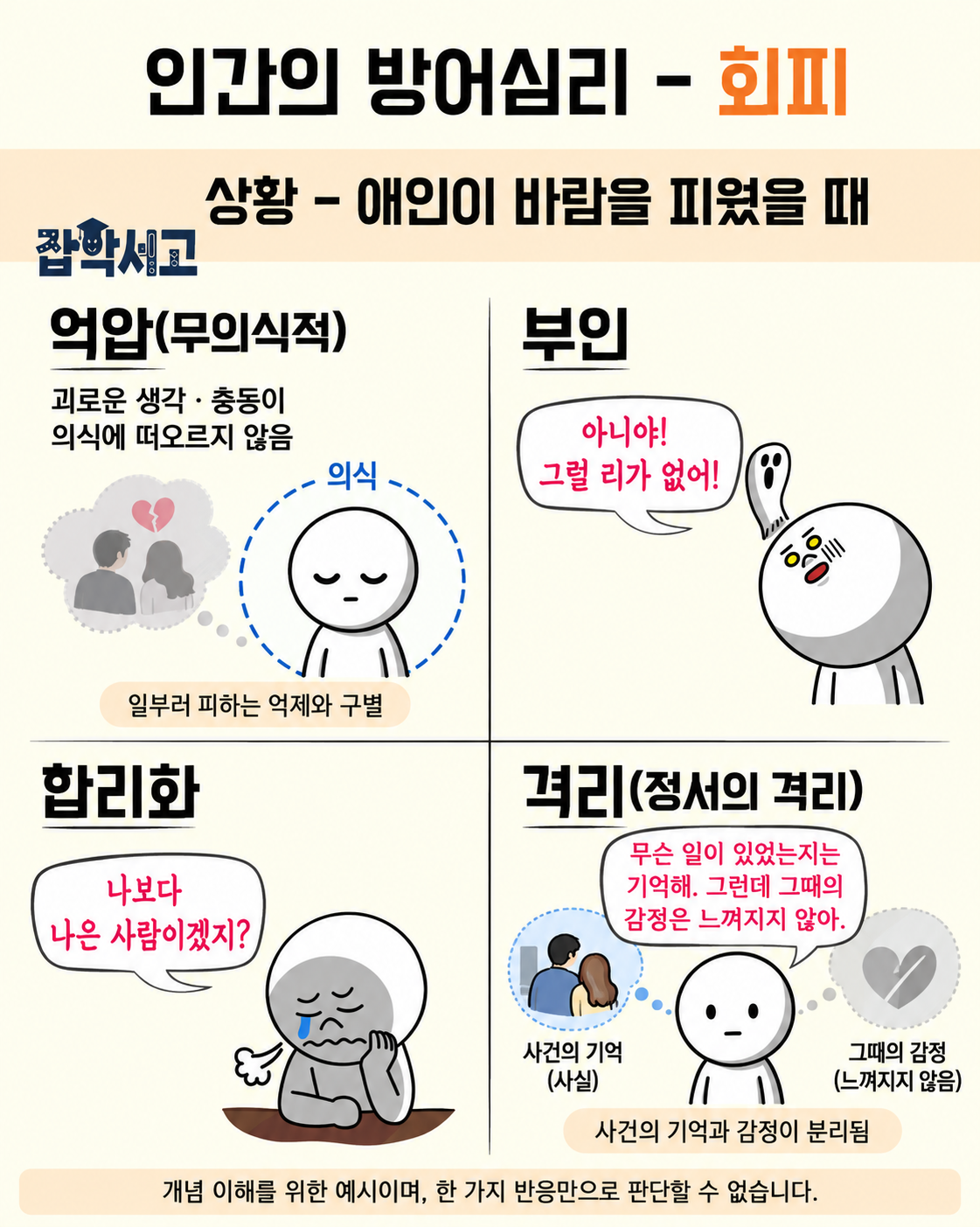 Human Defense Mechanisms - Avoidance Type
First, I have gathered four kinds of the avoidance type: repression, denial, rationalization, and isolation.
Repression, in psychoanalytic theory, is a defense mechanism in which painful experiences or unacceptable thoughts and impulses are unconsciously excluded from awareness. It differs from suppression, in which someone deliberately sets aside a known thought, and from consciously avoiding a conversation by saying, "I do not want to talk about it." Repression is a basic concept in Freud's psychoanalysis, but simply failing to recall something or avoiding a conversation does not establish that repression is occurring.
Denial (negation) refers to denying a situation or feeling that one cannot cope with. It is the mindset of refusing to admit or accept the facts even when they are pointed out.
Rationalization refers to justifying one's dishonorable behavior or a disappointing situation by attaching a plausible-sounding reason to it.
Isolation (isolation of affect), in psychoanalytic theory, is a defense mechanism that separates a memory or thought about an event from its associated emotion. For example, a person might remember and describe a painful event without experiencing the sadness or anger associated with it. This differs from repression, which excludes the memory itself from awareness, and from consciously holding back anger one is experiencing. Speaking calmly by itself, however, does not establish that isolation of affect is occurring.
Defense Mechanisms - Anxiety-Relief Type
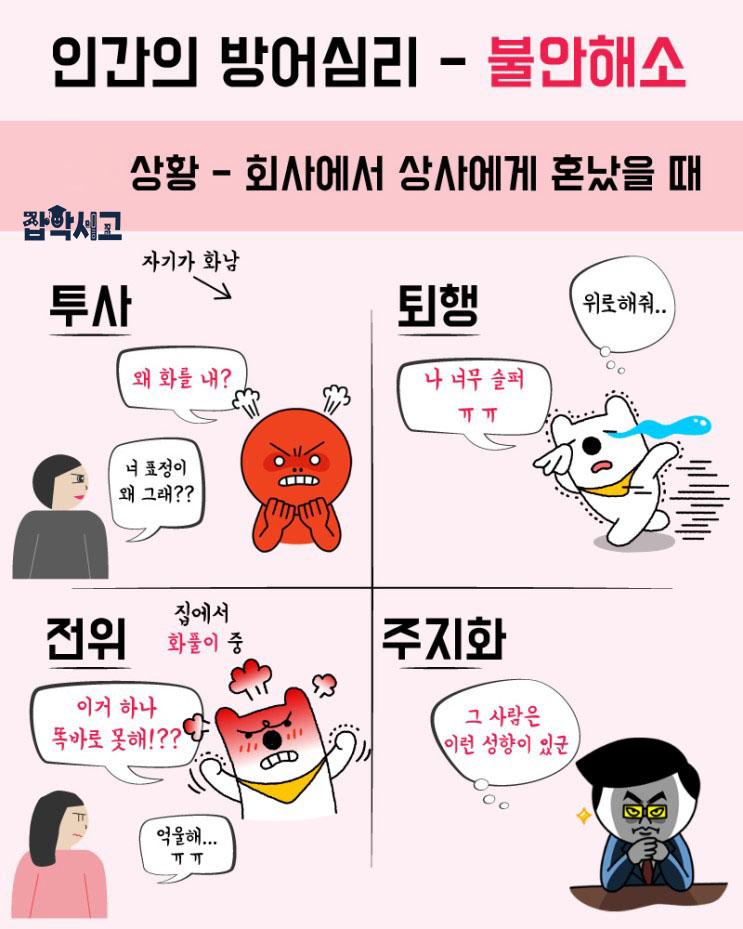 Human Defense Mechanisms - Anxiety-Relief Type
Next, I have gathered defense mechanisms that people use to relieve anxiety when they feel it. Here I have placed projection, regression, displacement, and intellectualization.
First, projection refers to blaming others for one's own inappropriate thoughts or actions as if someone else had them.
Regression refers to resorting to behaviors that worked well in childhood in order to relieve one's own anxiety or sense of threat. Examples include crying, throwing a tantrum, and other things one might have done as a child.
Displacement refers to taking out the unpleasant feelings one has toward someone on a different target judged to be weaker than oneself. It is also known as 'venting one's anger on someone else.'
Intellectualization refers to using one's intellectual abilities, such as thinking about or analyzing a painful mental problem, precisely in order to avoid facing it.
Defense Mechanisms - Satisfaction Type
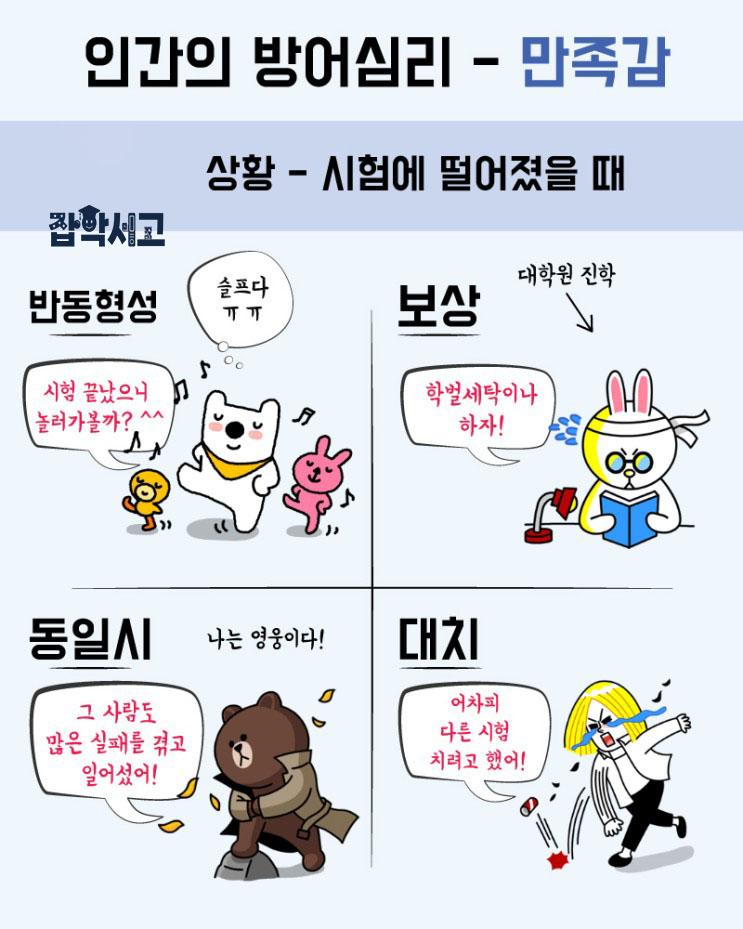 Human Defense Mechanisms - Satisfaction Type
For the last group, the satisfaction type, I have bundled together mindsets that seek to escape an immediate crisis and gain a sense of satisfaction. Here I have included reaction formation, compensation, identification, and substitution.
Reaction formation refers to actually behaving in the opposite way from what one originally thinks or intends.
Compensation refers to the mindset of trying hard to succeed in another area after a major failure at something. The idea is to cover up the past failure with this new success.
Identification refers to gaining satisfaction by identifying oneself with someone one respects or likes.
Substitution refers to the mindset of finding another, second-best option and settling for it instead, in order to relieve the desire for a goal that cannot be achieved.
This concludes our look at human defense mechanisms based on Freud's psychoanalysis. Defense mechanisms are mindsets that show up often in everyday life, so knowing them can become useful knowledge in daily living. It may feel unfamiliar at first, but with practice, I hope you will analyze people's reactions and gain insight into which type of defense mechanism they correspond to.