Attachment theory is recognized as a concept that plays an important role in human development and has a major influence on social and emotional development. It focuses mainly on explaining how childhood experiences affect a person's relationships and emotional stability in adulthood.
In this material, we will look at how attachment theory developed, its key concepts, and its psychological importance, and analyze how the various attachment types are classified and what characterizes them. We will also explore its practicality in depth through cases where attachment theory is actually applied in modern society.
The Concept and Development of Attachment Theory

How Attachment Theory Was Formed and Developed
Attachment theory was first systematized by John Bowlby in the mid-20th century. Bowlby hypothesized that a child's early relationship with their parents has a decisive influence on human development, and he carried out research on it. He argued that if a child fails to form a stable bond with their primary caregiver, an insecure attachment pattern develops. His research was later applied in a number of psychological and educational programs, shedding new light on the importance of attachment.
Bowlby's theory was later expanded through the research of Mary Ainsworth. Through the 'Strange Situation' experiment, Ainsworth observed how children reacted when they were separated from and reunited with their primary caregiver. This made it possible to classify attachment into three types: secure attachment, anxious-avoidant attachment, and anxious-ambivalent attachment. This research helped lay the empirical foundation of attachment theory.
Classification and Characteristics of Attachment Types
Attachment types are mainly classified into three. Secure attachment is the type in which the child forms a strong emotional bond with the primary caregiver and feels reassured when reunited with them. In anxious-avoidant attachment, the child has difficulty forming a bond with the caregiver and tends to keep their distance even when reunited. In anxious-ambivalent attachment, confusion and anxiety about the relationship with the caregiver persist, so the child shows strong dependence and angry resistance at the same time.
These attachment types are not merely traits of childhood; they also affect relationships and emotional stability in adulthood. The formation of an attachment type therefore acts as an important factor whose influence continues from early development into adulthood.
Modern Applications of Attachment Theory
Attachment theory is applied in many fields in modern society. In particular, it has become an important theoretical basis in areas such as education, psychotherapy, and family counseling. For example, in early childhood education, programs are being developed to help children form secure attachments, and in psychotherapy, a client's attachment type is analyzed and used to resolve emotional problems.
In family counseling as well, attachment theory is used as an important tool for improving the relationship between parents and children. Through it, approaches are being proposed that promote children's emotional stability and healthy development. Attachment theory continues to prove its usefulness in these various areas and is likely to be used in even more fields in the future.
The Importance of the Secure Base Concept
In attachment theory, the concept of a 'secure base' plays a very important role in child development. A secure base means someone who gives the child a foundation to return to and find reassurance at any time while exploring a new environment. In most cases the primary caregiver fills this role, and it serves as an important factor in securing the child's emotional stability.
This concept goes beyond simple protection and becomes a foundation that gives the child the psychological security to explore and grow independently. This sense of security has a great influence on the child's social development and emotional growth, and it continues to affect how they form relationships in adulthood.
The Lifelong Influence of Attachment Theory
Attachment has a lasting influence not only in infancy but also in adulthood. The attachment type formed in childhood affects emotional stability, relationships, and psychological adjustment in adulthood, and this shows up in romantic relationships, relationships at work, and elsewhere. Attachment theory therefore treats attachment as an important developmental factor across a person's entire life.
Attachment types can also change in adulthood, and through this, personality formation and the ability to regulate emotions can be modified as well. In this respect, attachment theory goes beyond a simple theory of infant development and provides an important framework for explaining psychological development across the whole human lifespan.
The Importance of Attachment Theory

The Role of Attachment Theory in Relationships and Emotional Development
Attachment theory is an important framework for explaining how people form relationships and what emotional development they go through in the process. Attachment experiences in childhood continue to have an effect after a person becomes an adult, deeply influencing how they form relationships with others, regulate their emotions, and cope with stress. For example, people who experienced secure attachment tend to form more trusting relationships as adults and are also more emotionally stable. In contrast, people who experienced insecure attachment are more likely to have many conflicts in their adult relationships and to experience emotional anxiety. For these reasons, attachment theory has become an essential concept for understanding the complexity of relationships and identifying the key factors of emotional development within them.
The Importance of Attachment Theory in Psychotherapy
Attachment theory is an important foundation of psychotherapy and is especially useful for analyzing a client's past experiences and current emotional state. In psychotherapy, a client's attachment type can help in understanding the relationship problems or emotional anxiety they are going through. For example, people with anxious-avoidant attachment tend to avoid close relationships and therefore feel isolated in their relationships, while people with anxious-ambivalent attachment often struggle between strong dependence and feelings of rejection. To resolve these problems, psychotherapy re-examines past attachment experiences and helps the client form healthier emotional bonds. During therapy, clients come to understand their own emotions and relationship patterns more deeply and, through this, go through a process of finding emotional stability.
Applying Attachment Theory in Education
In educational settings, attachment theory plays an important role in building relationships between teachers and students and in creating a learning environment. Students who have formed secure attachment relationships tend to become more engaged in their studies based on their trust in the teacher and to accept the teacher's guidance positively. These students feel emotionally secure, which results in higher learning motivation and achievement. In contrast, students with insecure attachment may adapt poorly at school and face ongoing difficulties in the learning process. It is therefore important for teachers to use an approach based on attachment theory in their relationships with students to provide a learning environment in which students can feel secure. Through this, students can be positively influenced not only in their studies but also in their social interactions and emotional development.
Attachment Theory as a Guide in Developmental Research
Attachment theory provides an essential research framework for understanding human development. Developmental researchers study how attachment is formed and how various environmental and genetic factors affect it. For example, a stable parenting environment at home leads a child to form secure attachment, which has a positive effect on the child's ability to interact socially and regulate emotions. In contrast, when the parenting environment is unstable or there are many stressors, the child forms an insecure attachment type, which can continue into adulthood. By tracking and analyzing these developmental processes, researchers contribute to a deeper understanding of human development and, on that basis, are developing various programs to support development.
Attachment Theory in Social Interaction
Attachment theory also plays an important role in understanding an individual's patterns of social interaction. The type and strength of attachment greatly affect how a person forms and maintains social relationships. People who have formed secure attachment build cooperative, trust-based relationships through smooth social interaction, while people with insecure attachment may experience ongoing conflict and anxiety in their relationships. In particular, people with the anxious-avoidant attachment type tend to shy away from or avoid close relationships, which can lead to a sense of social isolation. Because these attachment patterns are directly linked to a person's ability to adapt socially, a process of understanding and improving them is needed.
The Contribution of Attachment Theory to Child Welfare and Family Counseling
Attachment theory also plays an important role in child welfare and family counseling. In parent education programs and the development of parenting methods, attachment theory provides the theoretical background for supporting children's healthy development. A child who has formed secure attachment feels emotionally secure, and this becomes an important foundation for forming positive relationships even in adulthood. Conversely, a child who has formed insecure attachment is more likely to experience emotional anxiety, which can continue into adulthood. To prevent and resolve these problems, family counseling analyzes the relationship between parents and children based on attachment theory and suggests concrete ways to solve problems. This makes it possible to improve the quality of relationships within the family and support children's healthy development.
Understanding the Classification and Characteristics of Attachment Types
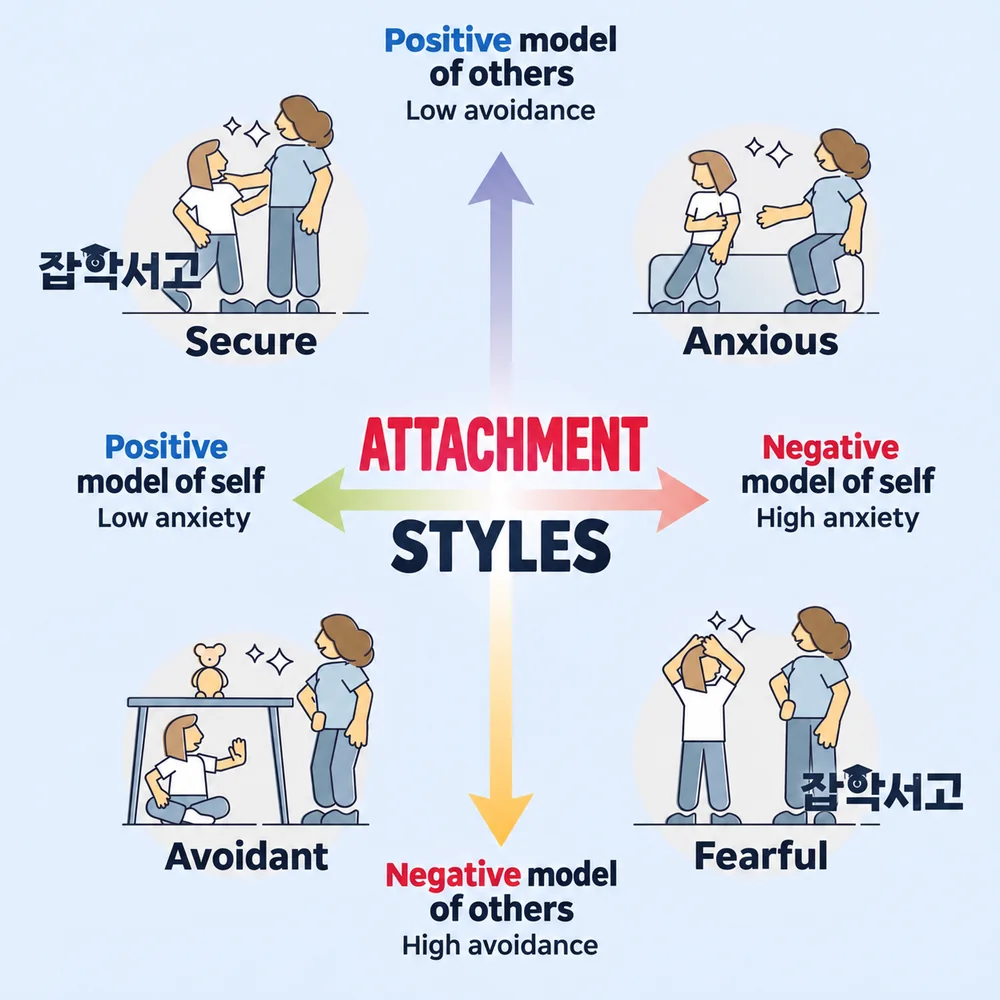
How Attachment Types Are Formed and Develop
Attachment types are formed mainly in infancy and childhood and are greatly influenced by interactions with the primary caregiver. During this period, a child who receives consistent care and emotional support from the caregiver forms secure attachment, whereas a child who experiences unstable or inconsistent responses forms insecure attachment. These attachment types do not end in childhood; they continue to affect relationships and emotional responses into adulthood. Attachment goes beyond the simple parent-child relationship and provides a fundamental understanding of how a person forms and maintains relationships throughout life.
The caregiver's responses play a decisive role in the formation of an attachment type. A caregiver who provides consistent affection and care fosters secure attachment, while a caregiver who responds inconsistently or negatively can cause insecure attachment. The attachment type formed in this way has an important influence on many aspects of the child's life as they grow, such as relationships, stress management, and emotional stability. The process of forming attachment therefore carries important developmental meaning across a person's whole life.
Secure Attachment: The Foundation for Positive Relationships
Secure attachment forms when the caregiver provides consistent, positive responses. Children with secure attachment trust that their caregiver will look after and protect them, so they can act freely and without fear when exploring a new environment. Children who have formed secure attachment are emotionally stable, and this sense of security leads to positive relationships and achievements as they grow up. In particular, based on their trusting relationship with the caregiver, the child develops the ability to form healthy, deep bonds with other people as well.
Adults with secure attachment maintain open, trust-based relationships and develop the ability to express their feelings honestly and accept the feelings of others. They are emotionally stable and show strong emotional resilience that lets them cope on their own even under stress. Secure attachment serves as an essential element in maintaining healthy relationships throughout a person's life.
Anxious-Avoidant Attachment: Distance and Emotional Suppression in Relationships
Anxious-avoidant attachment is the attachment type that forms when caregivers consistently respond to the child's needs with indifference or rejection. These children come to believe that their caregiver will not respond appropriately to their needs or will not provide enough emotional support. As a result, they tend to avoid close relationships with others or to keep an emotional distance. In particular, they appear restrained in expressing emotions and have difficulty forming deep bonds with others.
People who have formed anxious-avoidant attachment have a strong tendency to avoid emotional intimacy in their relationships even as adults. They suppress their emotions, fear depending on others, and tend to keep their distance in relationships. When under stress, such people tend to try to solve things on their own and often hesitate to ask for help or feel helpless. Because of this, they are more likely to experience ongoing conflict or a sense of isolation in their relationships.
Anxious-Ambivalent Attachment: Unstable Relationships and Excessive Dependence
Anxious-ambivalent (contradictory or conflicting feelings) attachment is the type formed by children who experienced inconsistent responses from their caregivers. These children feel confused as they repeatedly experience their caregiver sometimes responding appropriately when needed and at other times not. As a result, they carry strong anxiety and show excessive clinging to or dependence on the caregiver. Children with anxious-ambivalent attachment do not feel secure in their relationship with the caregiver, which can lead to unstable relationships when they become adults.
Adults with anxious-ambivalent attachment tend to show excessive dependence in relationships or react extremely sensitively to the other person's responses. They do not gain a sense of security from their relationships and are plagued by the fear that their partner does not love them enough or will leave them. This anxiety leads to ongoing conflict in relationships and becomes a factor that intensifies emotional anxiety. They also tend to cling too much in relationships or to rely on the other person's emotional support.
Disorganized Attachment: Relationship Confusion from an Unstable Environment
Disorganized attachment is the attachment type formed in an extremely unstable or threatening environment. It arises mainly in extreme situations such as abuse or neglect, in which the child is not protected by the caregiver and instead comes to feel afraid. These children cannot find a clear strategy in their relationship with the caregiver and experience confusion, and they also show unstable behavior in relationships with others. Children with disorganized attachment behave unpredictably in their relationships, which can often include aggressive or regressive behavior.
Adults who have formed disorganized attachment experience extreme instability and confusion in their relationships and find it difficult to build relationships based on trust. They are often in an emotionally confused state, which causes confusion not only for themselves but also for the people around them. People with disorganized attachment may need professional support to overcome their psychological instability, and intervention is required to prevent ongoing confusion in their relationships.
How Attachment Types Affect Adult Relationships
Attachment types are formed in infancy and childhood, but they continue to have an important influence on relationships in adulthood. People who have formed secure attachment build confident, trust-based relationships, while people with insecure attachment are more likely to experience ongoing conflict and anxiety in their relationships. In particular, people with anxious-avoidant or anxious-ambivalent attachment have difficulty forming emotionally intimate relationships even as adults and show excessive dependence or avoidance in their relationships with others.
Adult attachment types appear in a variety of social contexts, such as romantic relationships, friendships, and relationships at work. People with secure attachment are emotionally stable and tend to look for constructive solutions even in conflict situations. In contrast, people with insecure attachment may react in extreme ways in conflict situations or experience ongoing stress in their relationships. Attachment types therefore have a profound influence on relationships and emotional stability in adulthood.
Applying Attachment Theory in Modern Society

Modern Applications of Attachment Theory
In modern society, attachment theory is widely applied across many fields, and its importance and usefulness continue to be confirmed. In particular, attachment theory plays a central role in child development education and parent education programs, providing an important theoretical foundation that helps parents and children build healthy relationships. Parent education programs teach parents how to support their child's emotional stability through positive interactions. Parents who receive such education provide their children with a stable parenting environment, and as a result, the children achieve healthy emotional development and also build trust in their relationships with others.
Applying Attachment Theory in Childcare and Education
In childcare and educational settings, attachment theory is directly linked to the sense of security children feel at school or in childcare facilities. Based on attachment theory, teachers focus on forming emotional bonds through their interactions with children and on providing an environment where children feel safe. Children who feel this sense of security take in new knowledge more easily and show positive attitudes in the learning environment. This also has a positive effect on children's academic achievement and the development of their social skills. In addition, children who have experienced warm interactions with their teachers show greater cooperation and social adaptability in their peer relationships.
The Role of Attachment Theory in Psychotherapy
Attachment theory also plays an important role in psychotherapy. A client's past attachment experiences deeply affect their current patterns of behavior and emotion, so analyzing them during therapy is very important. Especially for problems related to emotional wounds, such as post-traumatic stress disorder (PTSD) and anxiety disorders, attachment theory offers an effective approach for helping clients understand and heal past wounds. During therapy, clients connect their past attachment experiences with their current relationship problems, and this can help them form healthier relationships. This therapeutic approach helps clients regain a sense of emotional stability and understand themselves.
Applying Attachment Theory in Family Counseling
In family counseling as well, attachment theory plays an important role in improving relationships among family members. The attachment relationship between parents and children acts as a major factor that determines the quality of interactions within the family, and family counseling provides ways to analyze and improve this relationship. In counseling based on attachment theory, parents learn how to provide their children with stable emotional support, and through this, trust and stability among family members are restored. Such counseling helps resolve conflicts within the family and build a healthier, more stable family system.
Applying Attachment Theory in the Workplace
Attachment theory also proves useful in workplace relationships. An approach based on attachment theory in the relationship between supervisors and subordinates helps create a positive workplace culture built on mutual trust and cooperation. Employees who have formed secure attachment relationships show improved work efficiency and teamwork and cope better even in stressful situations. On the other hand, employees who have experienced insecure attachment may often face tension and conflict in their relationships with supervisors, which can negatively affect their job satisfaction and performance. It is therefore important to build mutual trust in the workplace based on attachment theory as well.
Applying Attachment Theory in Social Policy
Attachment theory also has an important influence on the development of social policy. In child welfare policies, parenting support programs, and similar areas, attachment theory provides the theoretical background for policy design, thereby contributing to the emotional health and psychological stability of society as a whole. Through parenting support programs based on attachment theory, governments help parents form healthy relationships with their children and thereby promote children's healthy development. Such policies play an important role not only in reducing social costs but also in increasing the emotional stability and social adaptability of future generations.
Attachment theory is an important theory that provides an in-depth understanding of human development and relationships. It explains how experiences in early childhood affect emotional stability and social interaction in adulthood, and on that basis it offers a variety of approaches to support an individual's psychological health and social adjustment.
The importance of attachment theory is growing even further in modern society, and its usefulness is recognized in many fields, including education, psychotherapy, and family counseling. This theory is expected to continue playing a key role in understanding and supporting human emotional development.