Imagine teaching a class of thirty with the same textbook, the same explanation and the same test. Some students read quickly, but sitting beside them are students who cannot see well, students who understand pictures better than text, and students who are more confident explaining aloud than writing. The idea of designing the lesson itself so that all of these different students can reach learning from the start is called ‘Universal Design for Learning’.
Put simply, Universal Design for Learning means ‘designing lessons from the start so that a wide range of students can use them, instead of fitting students to the lesson.’ It is commonly called UDL, after its initials. It was systematized in the 1990s by CAST, an education research organization founded in the United States in 1984 by David Rose, Anne Meyer and others, and it borrowed its name and idea from Universal Design, proposed by the architect Ronald Mace.
In this article, we will look in turn at the background of Universal Design for Learning, its three principles and key terms through an illustration, how it is applied in the classroom, and finally its significance and limitations.
A lesson everyone can reach: Universal Design for Learning
1. Where Universal Design for Learning came from

Universal Design for Learning carries an idea that began with ramps in architecture into the classroom. Its starting point was research on technology to help students with disabilities, but it soon widened into an approach that helps every student.
(1) Universal Design in architecture
In the 1980s, Ronald Mace of North Carolina State University argued that buildings and products should be designed from the start so that anyone can use them, rather than fixed later. A typical example is the curb ramp: built for wheelchairs, it is also convenient for people pushing strollers or pulling suitcases.
(2) The beginnings of CAST
CAST (Center for Applied Special Technology), founded in 1984, first researched how technology such as computers could help students with disabilities take part in lessons. As the research went on, it concluded that the source of difficulty lay less in the students than in materials and lessons that allowed only one way of learning.
(3) Changing the curriculum, not the student
This idea became widely known through Teaching Every Student in the Digital Age, the book Rose and Meyer published in 2002. Shifting what needs fixing from the student to the curriculum is the biggest turn that Universal Design for Learning made.
2. The three principles and key terms at a glance

Universal Design for Learning divides the way the brain learns into three strands and sets a principle for each: wanting to learn, recognizing what is to be learned, and turning what has been learned into action.
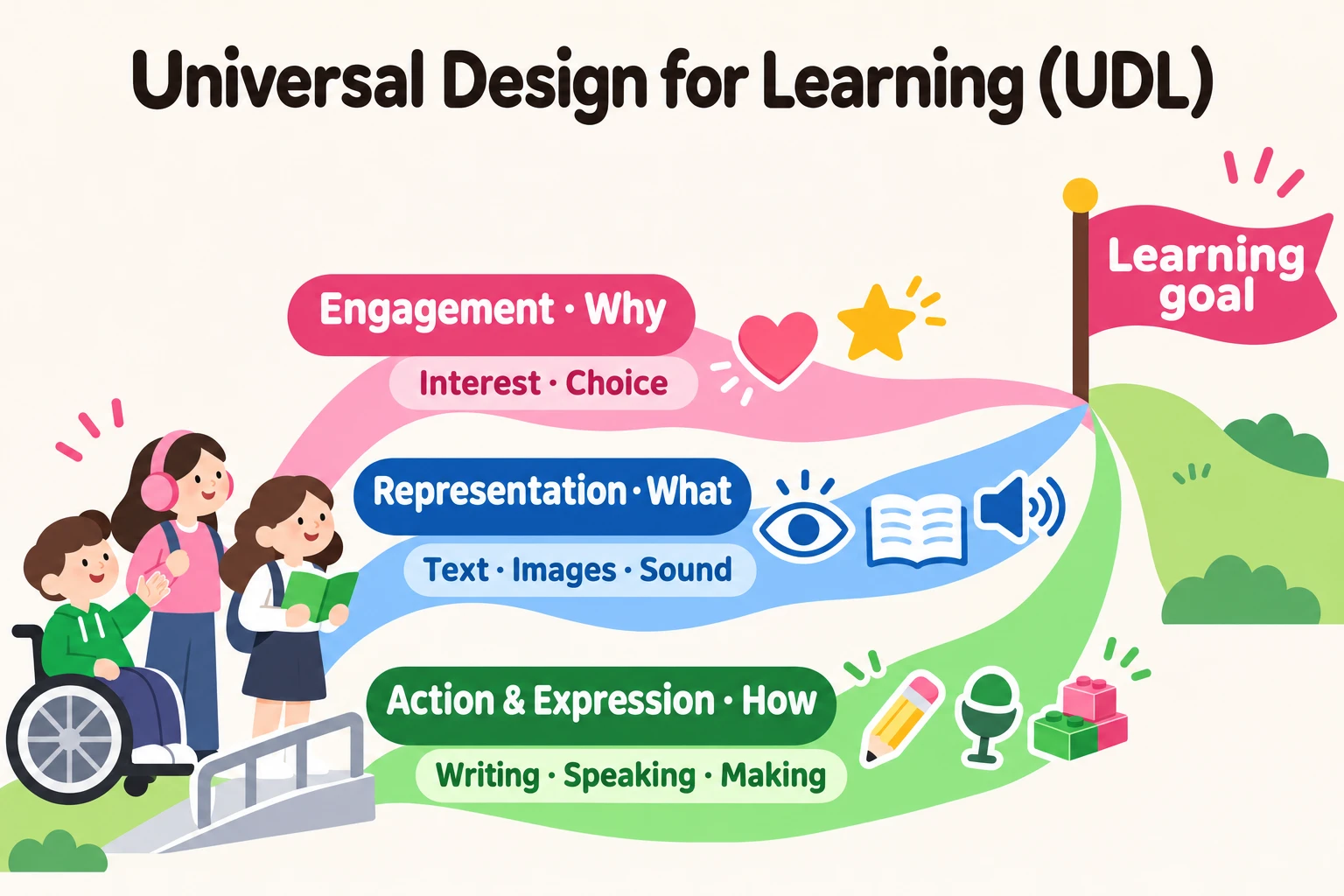
- Universal Design for Learning: An educational framework that designs goals, materials, methods and assessments from the start so that a wide range of students can use them.
- Engagement: The principle that fills in the ‘why’ of learning by offering varied interests, levels of challenge and chances to choose.
- Representation: The principle that fills in the ‘what’ of learning by presenting information in several forms, such as text, pictures, sound and video.
- Action & Expression: The principle that keeps many ways open for showing what one knows, such as writing, presenting and making, covering the ‘how’ of learning.
(1) The affective network and engagement
CAST held that the affective network shapes interest in and persistence with learning. It therefore recommends letting students choose topics or tasks and showing goals clearly.
(2) The recognition network and representation
The recognition network handles recognizing the information we see and hear. Offering the same content as pictures, captioned video and audio alongside the textbook lets more students reach it.
(3) The strategic network and action and expression
The strategic network handles planning and carrying out tasks. Students can be allowed to show understanding through a presentation or a model instead of a report, and tools such as planners can support them in carrying out their work.
3. How to apply it in the classroom

Universal Design for Learning starts not with special equipment but with the order in which a lesson is prepared. When planning, the teacher first imagines which students might get stuck, and where.
(1) Separate goals from methods
First, decide what the lesson’s essential goal is. If the goal is ‘identifying the theme of a story,’ it makes no difference whether students read the book themselves or listen to an audiobook, so the way of reading can be left open.
(2) Find barriers in advance
Look ahead for points where students might get stuck, such as materials with print too small to read or instructions given only out loud, and remove them. Options anyone can choose, such as captions, large print and picture guides, are prepared from the start.
(3) Let students choose and reflect
Guide students to pick the method that suits them, try it, and look back on it. CAST’s Guidelines 3.0, released in 2024, place even more emphasis on this kind of learner agency, in which students lead their own learning.
4. Significance and limitations of Universal Design for Learning
Universal Design for Learning has influenced education policy and lesson design in many countries, but proving its effects remains a challenge.
(1) Universal Design for Learning in law and policy
In 2008, the United States included a definition of Universal Design for Learning in the Higher Education Opportunity Act. Since then it has been widely used beyond support for students with disabilities, in ordinary classrooms and in university course design.
(2) Benefits that reach everyone
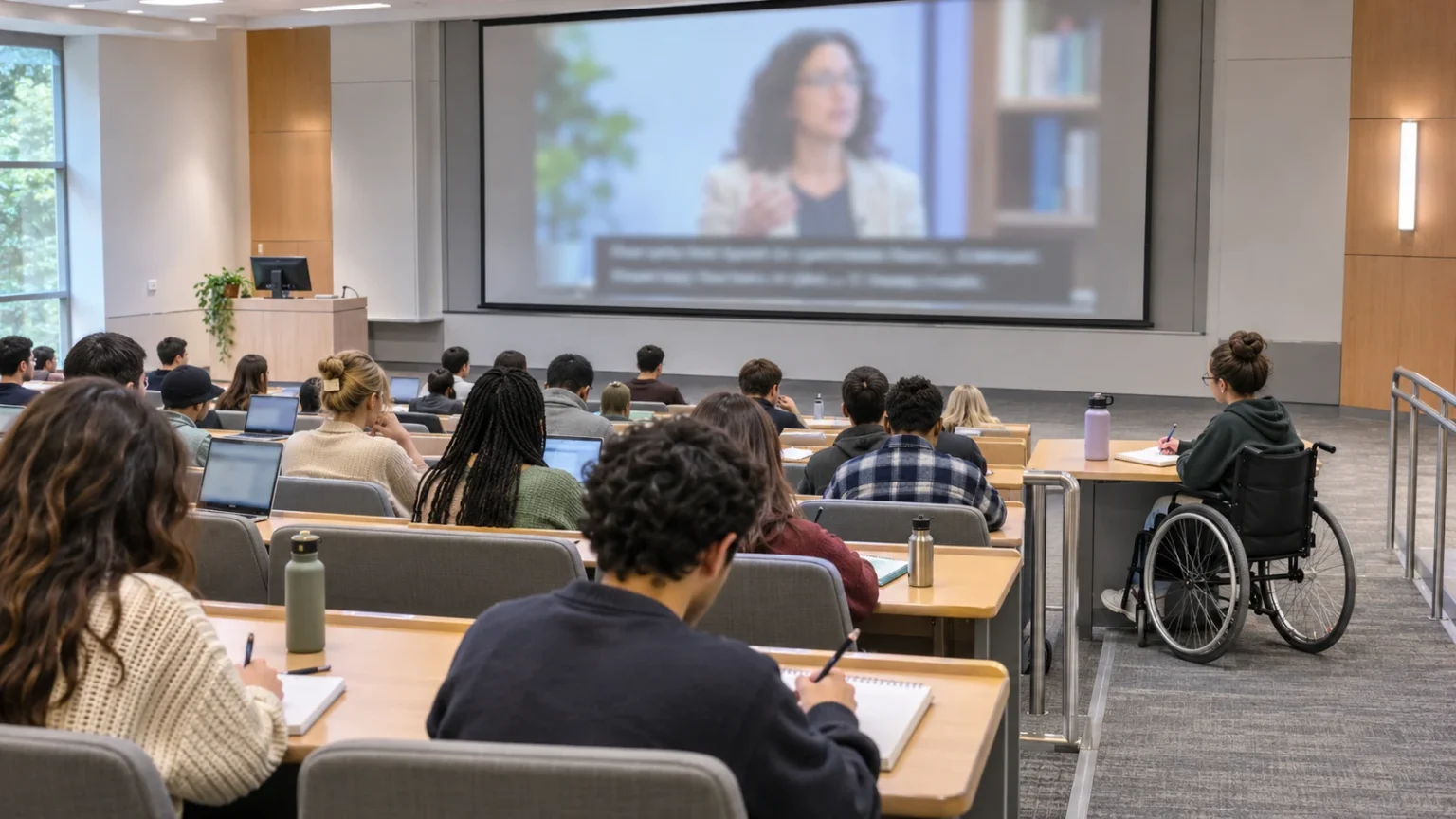
Options prepared for particular students often help others too. Just as captions for deaf and hard-of-hearing students are useful to students learning a foreign language or watching video in a noisy place, the ramp effect appears in the classroom as well.
(3) The difficulty of measuring effects
Because Universal Design for Learning is a framework that mixes many teaching methods, critics point out that its own effect is hard to isolate and measure. The large amount of time needed for teacher training and lesson preparation is also cited as a challenge in schools.
In the end, Universal Design for Learning is the idea of building lessons for all the real students sitting in a classroom, not for one imaginary ‘average student.’ The simple thought that a lesson can widen before we try to change the student is the first step toward understanding Universal Design for Learning.