In modern society, childcare has become an important factor that goes beyond simply looking after children and has a significant influence on their growth and development.
In particular, providing an appropriate childcare environment and programs during the early stages of a child’s development greatly supports their social, emotional, and intellectual growth.
This article introduces successful childcare strategies needed for a child’s future and examines in detail the concept and importance of childcare, the types of childcare programs and their advantages and disadvantages, the roles of childcare teachers, and specific strategies for successful childcare.
The Concept and Importance of Childcare
 What Is Childcare, and Why Is It Important?
Childcare refers to the process of caring for and nurturing children so that they can grow up healthy and safe. It goes beyond physical care to include comprehensive support that promotes emotional, social, and cognitive development.
The main goal of childcare is to provide an environment in which children can grow holistically, enabling them to develop autonomy and social skills and achieve successful development in school and later life. The importance of childcare can be emphasized from several perspectives.
1. Foundations of Early Development: Experiences early in life have a decisive influence on a child’s brain development. Providing a positive and stimulating environment during this period can greatly enhance a child’s cognitive and emotional abilities.
2. Social Development: Childcare provides opportunities for children to interact with peers and learn social skills. These play an important role later in school and social life.
3. Emotional Security: A stable and trustworthy childcare environment provides children with emotional security. This helps build their self-esteem and reduce stress and anxiety.
4. Support for Parents: Childcare services help parents maintain a balance between work and family life. This allows parents to experience less stress and spend quality time with their children.
5. Social Equality: High-quality childcare services provide all children with an equal starting point and can help reduce social inequality.
Childcare therefore goes beyond basic care and serves as an essential element in a child’s overall development and happy future. Through childcare, children can achieve healthy, balanced growth, and parents can effectively support their development.
Types of Childcare Programs and Their Advantages and Disadvantages
 What Types of Childcare Programs Are Available?
Childcare programs are various forms of education and care services provided to support children’s development and protect them. Each program has different characteristics, advantages, and disadvantages, and can be chosen according to the needs of parents and children. The following outlines the main types of childcare programs and their advantages and disadvantages.
1. Home-Based Childcare (Home-based Childcare)
Characteristics: A childcare provider looks after a small number of children in their own home. Care often takes place in a home-like atmosphere.
Advantages
Provides comfort in a family-like atmosphere
Small groups allow for individual attention
Flexible operating hours
Disadvantages
Quality may vary depending on the childcare provider’s individual capabilities
There may be fewer opportunities for social interaction
Educational programs may lack structure
2. Childcare Centers (Daycare Centers)
Characteristics: This program cares for children of various ages in a professional facility. It follows a set educational curriculum and daily schedule.
Advantages
Provides professional childcare and education
Offers various opportunities for social interaction
A regular and structured environment
Disadvantages
Costs may be high
There may be relatively less individual attention
Waiting times may be long
3. Precare (Pre-Kindergarten Programs)
Characteristics: It primarily serves children aged 3-5 and provides preparatory education before they enter school. It offers an environment similar to that of a kindergarten.
Advantages
Helps children prepare for school
Promotes social and emotional development
Provides a systematic educational program
Disadvantages
Serves only a specific age group
Limited operating hours
Costs may be burdensome
4. Montessori (Montessori)
Characteristics: This program is based on the Montessori educational philosophy and uses an approach centered on independent learning and hands-on practice.
Advantages
Promotes autonomy and creativity
Individualized learning experiences
Various activities and opportunities for hands-on practice
Disadvantages
Differences from other educational philosophies may make adjustment difficult
Costs may be high
The educational approach may be unfamiliar to some parents
5. Playgroups (Playgroups)
Characteristics: These are play-centered group activities in which parents and children participate together. They usually meet on an irregular basis and emphasize social interaction.
Advantages
Opportunities for close interaction with parents
A free and creative play environment
Provides varied play experiences
Disadvantages
Does not provide regular childcare services
May lack educational structure
Parental participation is essential
Each childcare program may work differently depending on a child’s characteristics and the family’s circumstances. It is therefore important to consider the advantages and disadvantages of each program and choose the most suitable childcare environment.
The Roles of Childcare Teachers
 What Roles Do Childcare Teachers Play?
Childcare teachers perform various roles as key figures supporting children’s holistic development. Their roles go beyond simply caring for children to include promoting emotional, social, and cognitive development and providing a safe and stimulating learning environment. The main roles of childcare teachers are as follows.
1. Providing a Safe and Healthy Environment
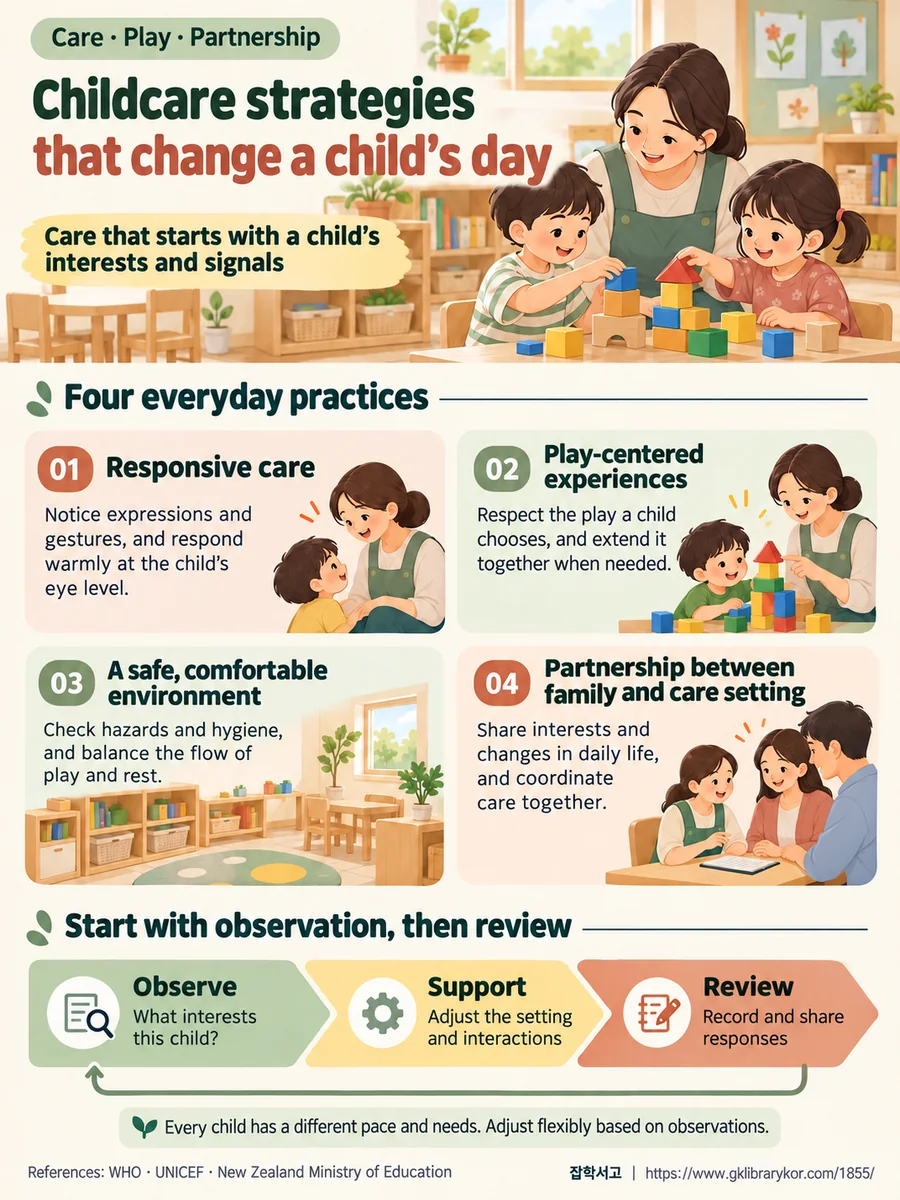
Childcare teachers continually observe children and take necessary measures to ensure that they can spend their time in a safe and healthy environment. They follow safety rules, maintain thorough hygiene practices, and have the skills to respond to emergencies.
2. Providing Developmentally Appropriate Learning Opportunities
Childcare teachers understand each child’s developmental stage and individual needs and provide learning activities and experiences that meet them. They combine play and learning to create an environment in which children can enjoy learning.
3. Social Skills and Emotional Support
Childcare teachers help children interact positively with peers and learn social skills. They also understand children’s emotions and provide emotional support so that children can express them in healthy ways. Through this, children develop self-regulation skills and build confidence and self-esteem.
4. Communication and Collaboration
Childcare teachers share information about a child’s development and needs through ongoing communication with parents. Collaboration with parents is important for ensuring consistency in a child’s education and care, helping the child feel secure. Teachers also work with fellow teachers and childcare institutions to create the best possible childcare environment.
5. Observation and Assessment
Childcare teachers continually observe and assess children’s development and learning. This allows them to identify each child’s strengths and needs and develop individualized educational plans. Regular assessments and records serve as important resources for feedback with parents.
6. Professional Development
Childcare teachers must continually work on their professional development to learn the latest childcare theories and methods and apply them in practice. They can maintain and improve the quality of childcare by regularly participating in training and workshops.
The roles of childcare teachers are essential to children’s healthy and happy growth. They play an important role as children’s first educators and supporters, laying a foundation that positively influences their future.
Strategies for Successful Childcare
 How Can Childcare Be Used to Benefit Children?
Successful childcare requires a systematic and integrated approach. This aims to promote children’s overall development, create a positive learning environment, and strengthen collaboration between parents and childcare teachers. The following are key strategies for successful childcare.
1. An Individualized Approach to Learning
Every child learns at a different pace and in a different way. Childcare programs should respect these individual differences and provide tailored learning plans suited to each child’s needs and interests. This helps children realize their full potential and develop confidence.
2. Providing a Stable and Consistent Environment
Children grow best in a stable and predictable environment. Consistent routines and rules help children feel safe and develop self-regulation skills. Regular activities and rest periods also contribute to children’s overall health and well-being.
3. Active Learning and Play
Learning through play is children’s natural way of learning. Various play activities can develop creativity, problem-solving abilities, social skills, and more. Childcare teachers should provide a balance of free play and structured activities so that children can have varied experiences.
4. Collaboration with Parents
Close collaboration with parents is a key element of successful childcare. Parents should be encouraged to participate actively in the childcare process through regular parent-teacher meetings, daily communication notebooks, and parent participation programs. This helps share information about a child’s development and maintain consistency between the home and childcare environments.
5. Emotional Support and Social Skills Development
Emotional support should be provided to help children understand their feelings and express them in healthy ways. Children should also be helped to learn social skills and develop cooperation and empathy through interactions with peers. This plays an important role in children’s overall social development.
6. Ongoing Assessment and Feedback
Children’s development and learning processes should be continually assessed, and feedback should be provided. This makes it possible to identify each child’s achievements and provide appropriate support when needed. Regular assessments and feedback with parents are essential to improving the quality of childcare.
Through these strategies, childcare programs can promote children’s holistic development and support their healthy and happy growth. Successful childcare is an important process that positively influences both a child’s present and future.
Childcare for a child’s future requires collaboration and ongoing attention from parents and childcare institutions. Children should be supported in growing up healthy and happy by choosing an appropriate childcare program, providing an environment suited to their developmental stage, and maintaining effective communication with childcare teachers.
We hope you will use the successful childcare strategies introduced in this article to help your child look forward to a bright and hopeful future. Proper childcare will be the first step toward a positive influence throughout a child’s lifetime.